The Lost Colony of Roanoke: New Evidence and Theories for 2024
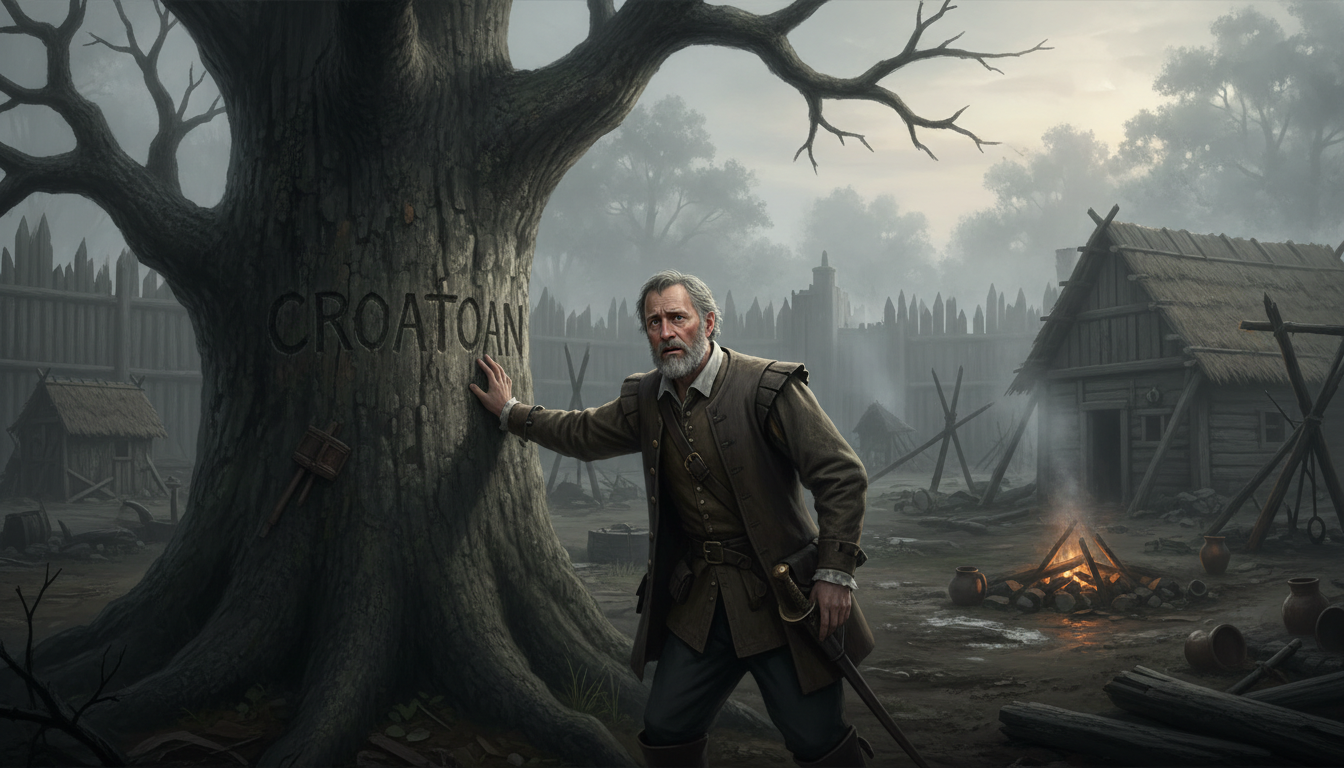
On August 18, 1590, John White, the governor of the Roanoke Island colony, stepped off a ship onto the shores of the Outer Banks. It was his granddaughter Virginia Dare’s third birthday, and he had returned from England after three grueling years of delay caused by the Anglo-Spanish War. But the homecoming he envisioned—filled with the laughter of 115 settlers—was met with a chilling, absolute silence. The settlement was fortified but deserted. The houses had been taken down. The only clues left behind were the word “CROATOAN” carved into a sturdy post and “CRO” etched into a nearby tree. There was no cross of distress, the pre-arranged signal for an emergency. To this day, the disappearance of the Roanoke settlers remains the premier historical mystery of the Americas, an unsolved case that has baffled generations of historians and archaeologists alike.
Historical Context: The Elizabethan Dream of Empire
The Roanoke expeditions were the brainchild of Sir Walter Raleigh, an ambitious courtier of Queen Elizabeth I. Raleigh sought to establish a permanent English presence in North America to challenge Spanish hegemony and provide a base for privateering. Following a reconnaissance mission in 1584 and a failed military-led colony in 1585, the 1587 attempt was unique. Unlike its predecessors, this group consisted of civilians—men, women, and children—intended to establish a self-sustaining agrarian community.
The 1587 colony faced tragedy before it even began. Tensions between the English and the local Algonquian tribes were high due to previous conflicts. Furthermore, the fleet’s pilot, Simon Fernandes, refused to take the settlers to their intended destination in the Chesapeake Bay, forcing them to land on Roanoke Island—a location already poisoned by past hostilities. When White left for England to secure supplies just weeks after Virginia Dare’s birth, he left a community on the edge of survival, nestled between an unforgiving wilderness and wary neighbors.
The Event: A Vanishing Without a Trace
When John White finally returned in 1590, the scene he discovered was more confounding than a typical massacre. A controversial event in its own right, the site showed signs of an orderly departure rather than a frantic flight. The settlers had “taken down” their houses, a term suggesting they had dismantled the structures to reuse the materials elsewhere. Their heavy belongings, including trunks of books and maps White had left behind, were found ransacked and buried, yet there were no human remains.
The word “CROATOAN” pointed toward Croatoan Island (modern-day Hatteras Island), home to the friendly Croatan tribe and their leader Manteo, who had visited London. However, a fierce storm and failing anchors forced White’s fleet to abandon the search and return to England. The 115 settlers were never seen by English eyes again, leaving a void in the historical record that 2024 researchers are still struggling to fill.
The Mystery: Why Roanoke Still Haunts Us
What makes Roanoke the ultimate unsolved case is the lack of closure. Over the centuries, several questions have persisted: Why didn’t they leave the cross of distress if they were in danger? If they moved to Croatoan, why were they never found by subsequent English expeditions to Jamestown in 1607? The mystery is compounded by the political climate of the 16th century; some suggest the settlers were victims of a geopolitical game between England, Spain, and the indigenous nations of the Carolina coast. Others propose more terrestrial disasters: famine, plague, or internal discord.
Competing Theories: From Assimilation to Slaughter
1. The Assimilation Hypothesis
This remains the most widely accepted theory among modern historians. It suggests that the settlers, realizing White was not returning quickly, moved in with local indigenous groups. Given the lack of a distress signal, it is likely they left voluntarily, potentially splitting into smaller groups to reduce the burden on their hosts’ food supplies. This theory is supported by later reports from Jamestown settlers of “Europeans” living among the Chowanoke and Tuscarora tribes.
2. The ‘Site X’ and ‘Site Y’ Movement
In recent years, the First Colony Foundation has focused on “Site X” at Salmon Creek in Bertie County. This theory posits that a significant portion of the colony moved inland to the head of the Albemarle Sound. The discovery of English-style pottery (Border ware) and tool fragments at these sites suggests a long-term presence of Europeans in the late 16th century.
3. The Spanish Attack
During the late 1500s, Spain claimed all of North America and viewed the English presence as a direct threat. While records show the Spanish were searching for the colony to destroy it, there is no definitive Spanish record of them actually finding or massacring the Roanoke settlers. However, the fear of such an attack likely influenced the settlers’ decision to dismantle their fort.
4. The Dare Stones: Hoax or History?
In the 1930s, a series of 48 stones were found across the Southeast, purportedly carved by Eleanor Dare to tell the story of the settlers’ trek inland and their subsequent deaths. While the majority were debunked as hoaxes, the first stone—found in 1937—continues to be a subject of intense debate among some scholars for its linguistic accuracy to the period.
Evidence Breakdown: What Science Tells Us in 2024
- The Virginea Pars Map: In 2012, researchers found a hidden ‘patch’ on a map drawn by John White. Underneath the patch was a symbol of a four-sided fort located 50 miles west of Roanoke. This discovery led to the excavations at Site X, providing the first physical evidence of where the settlers might have relocated.
- Dendrochronology (Tree Rings): Studies of ancient cypress trees in the area revealed that the 1587-1589 period coincided with the most extreme drought in 800 years. This environmental data suggests that the settlers were likely facing a total crop failure, which would have forced them to abandon the island in search of food.
- Paleogenetics: DNA projects are currently attempting to map the genomes of families in the Outer Banks. While tracing 400-year-old ancestry is difficult, researchers are looking for specific European markers that appeared in the local population before the arrival of later 17th-century settlers.
Modern Interpretation: A Story of Survival, Not Loss
In 2024, the narrative of Roanoke is shifting. Historians like James Horn argue that we should stop looking for a ‘lost’ colony and start looking for a ‘dispersed’ one. The prevailing modern view is that the Roanoke settlers did not simply vanish into thin air; they were absorbed into the fabric of the indigenous world. This perspective transforms the event from a tragic disappearance into a story of cultural hybridization.
Conclusion
The Roanoke Colony remains a powerful symbol of the risks and uncertainties of the early colonial era. As an unsolved case, it challenges our understanding of how history is recorded and whose voices are preserved. Whether through the pottery shards at Site X or the genetic echoes in the modern descendants of the Carolina tribes, the ‘Lost’ colony is gradually being found.
FAQ
Q: What does ‘Croatoan’ actually mean?
A: Croatoan was the name of a nearby island (now Hatteras) and the Algonquian-speaking tribe that inhabited it. It was not a cryptic curse, but likely a destination marker.
Q: Was Virginia Dare ever found?
A: No. The first English child born in the Americas vanished along with the rest of the colony.
Q: Why didn’t the Jamestown settlers find the Roanoke colonists?
A: By 1607, twenty years had passed. If the Roanoke settlers survived, they would have been fully integrated into indigenous tribes, possibly miles away from the coast.