The Unsolved Mystery of the Voynich Manuscript: What New Research Reveals
1. Suspenseful Opening
Deep within the rare book vault of Yale University’s Beinecke Library sits a small, unassuming volume. Measuring just 9 by 6 inches, its vellum pages are battered, its cover completely devoid of a title. Yet, within its 240 remaining pages lies a historical mystery so profound that it has broken the minds of the world’s greatest codebreakers. Since its rediscovery in 1912 by an antique book dealer named Wilfrid Voynich, this artifact has defied every attempt at translation. It is written in an unknown script, filled with illustrations of nonexistent plants, naked women bathing in bizarre plumbing systems, and celestial charts mapping alien skies. It is the ultimate unsolved case of the cryptographic world.
2. Historical Context
To understand this controversial event, one must look to the late medieval and early Renaissance period. Carbon-14 dating places the creation of the parchment between 1404 and 1438. During this era, Europe was a hotbed of intellectual awakening, alchemy, and esoteric knowledge. Cryptography was evolving rapidly to protect state secrets, trade routes, and dangerous scientific inquiries from the prying eyes of the Inquisition. Scholars often encoded their work to avoid accusations of heresy. Against this backdrop, the creation of a deeply enciphered or heavily obfuscated text makes historical sense. However, no other text from this era resembles the bizarre nature of the Voynich Manuscript.
3. The Event (Detailed Account)
The physical journey of the manuscript is a historical mystery in itself. The earliest confirmed record of the book is from the early 17th century. A letter dated 1666, written by Johannes Marcus Marci, accompanied the manuscript when it was sent to Athanasius Kircher, a renowned Jesuit scholar in Rome. Marci claimed the book once belonged to Emperor Rudolf II of Bohemia (1552–1612), who allegedly purchased it for 600 gold ducats, believing it to be the work of the 13th-century philosopher Roger Bacon. After Kircher’s death, the manuscript vanished into the library of the Collegio Romano, remaining hidden for over two centuries until Wilfrid Voynich unearthed it in a chest at the Villa Mondragone in Italy.
4. The Mystery (What Remains Unsolved)
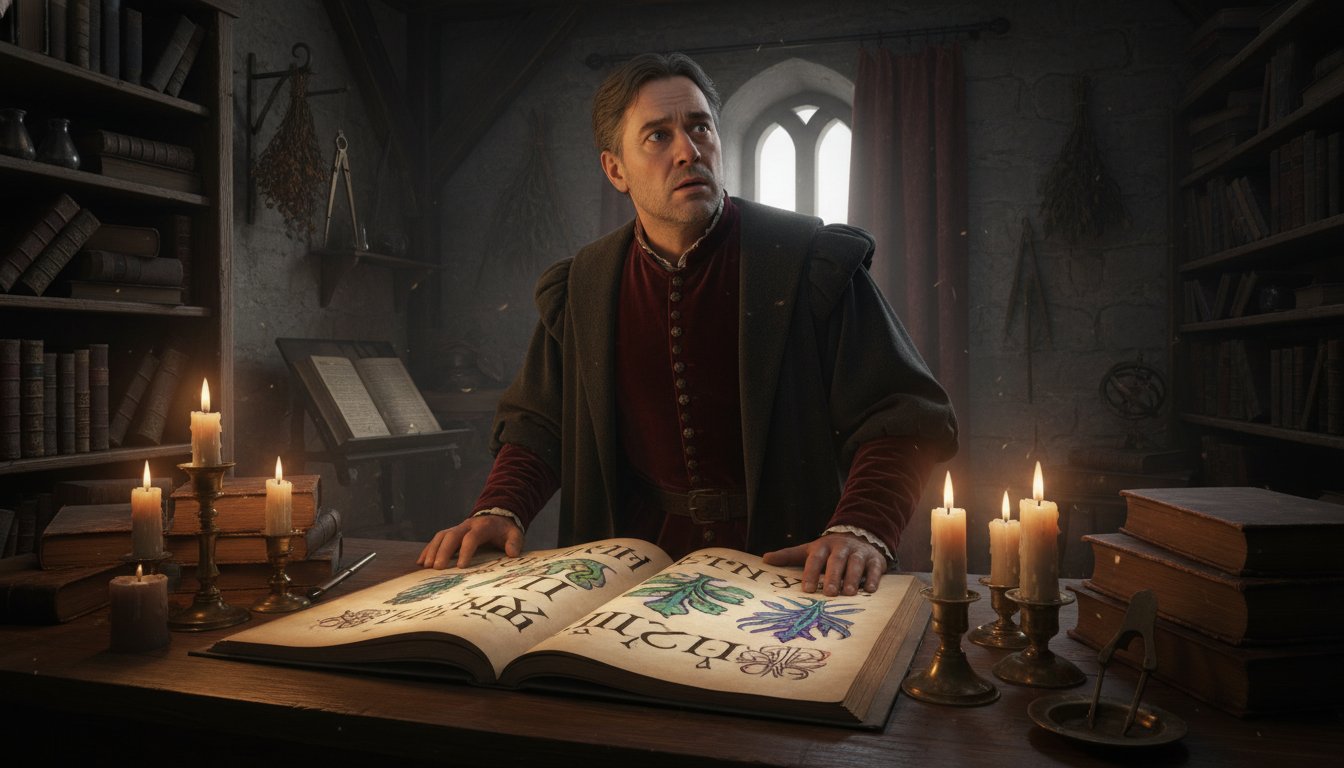
The core of the mystery is twofold: the script and the illustrations. The text is written smoothly, showing no signs of hesitation or correction, which is unusual for a complex cipher. The alphabet consists of 20 to 30 distinct glyphs. Statistical analysis proves it behaves remarkably like a natural language, adhering strictly to Zipf’s Law. Yet, it corresponds to no known linguistic structure. The illustrations are equally baffling. The botanical section features plants with roots and leaves that do not match any known species on Earth. The balneological section shows miniature women navigating tubes and pools of green and blue liquids, defying logical explanation.
5. Competing Theories
Over the century, historians and linguists have proposed numerous hypotheses:
- The Cipher Theory: The text is a natural language hidden behind a complex substitution cipher or codebook.
- The Hoax Theory: Proponents argue that the book is a sophisticated forgery, possibly created by Edward Kelley, a known charlatan of the 16th century.
- The Constructed Language Theory: It is an early attempt at a universal, artificial language.
- The Lost Language Theory: It represents a phonetic transcription of an undocumented oral language.
6. Evidence Breakdown
Modern scientific analysis has provided some hard data, even if it hasn’t cracked the code.
- Carbon Dating: In 2009, researchers at the University of Arizona radiocarbon-dated the vellum to 1404–1438.
- Ink and Pigment Analysis: McCrone Associates analyzed the ink and confirmed it contains materials consistent with the 15th century.
- Multispectral Imaging: This revealed hidden, faded writing on the first page, identifying the name of Jacobus Horcicky de Tepenecz, confirming part of its historical provenance.
7. Modern Interpretation
In recent years, artificial intelligence and computational linguistics have taken the lead in this controversial event. Some algorithms suggest the underlying syntax resembles Hebrew or an anagrammed proto-Romance language. Periodically, a researcher will publish a claim of decipherment. However, none of these claims have withstood peer review. The prevailing modern consensus among renowned historians is that the manuscript is a genuine artifact, but whether it holds profound meaning or is medieval gibberish remains deeply contested.
8. Conclusion
The Voynich Manuscript stands as the ultimate historical mystery. It taunts us from behind the glass of a modern library, a ghost from the 15th century that refuses to speak. Whether it is the desperate cipher of a persecuted genius or the elaborate con of a medieval grifter, it reminds us that history still holds secrets that we cannot unravel. It remains a fascinating, unsolved case that will continue to captivate the human imagination for generations.
9. FAQ
What is the Voynich Manuscript?
It is an illustrated, handwritten book from the early 15th century, written in an unknown script and an unknown language.
Has anyone translated the Voynich Manuscript?
No. Despite frequent claims in the media, no translation has ever been verified or accepted by the broader linguistic and cryptographic communities.
Could it be a modern fake?
Highly unlikely. Carbon dating of the vellum and chemical analysis of the ink confirm the materials date back to the early 1400s.
Where is the manuscript today?
It is housed in the Beinecke Rare Book and Manuscript Library at Yale University.