Psychology & Skills · TALE24 REVIEW
The Righteous Mind and the Limits of Moral Maps
Jonathan Haidt’s account of moral intuition can make political disagreement easier to understand, but its memorable categories work best as questions to test—not a complete map of every person’s moral life.
An accessible framework for noticing moral concerns beyond harm and fairness; encourages readers to examine opponents’ values rather than dismissing them.
A Map of Moral Intuitions, Not a Map of Every Person
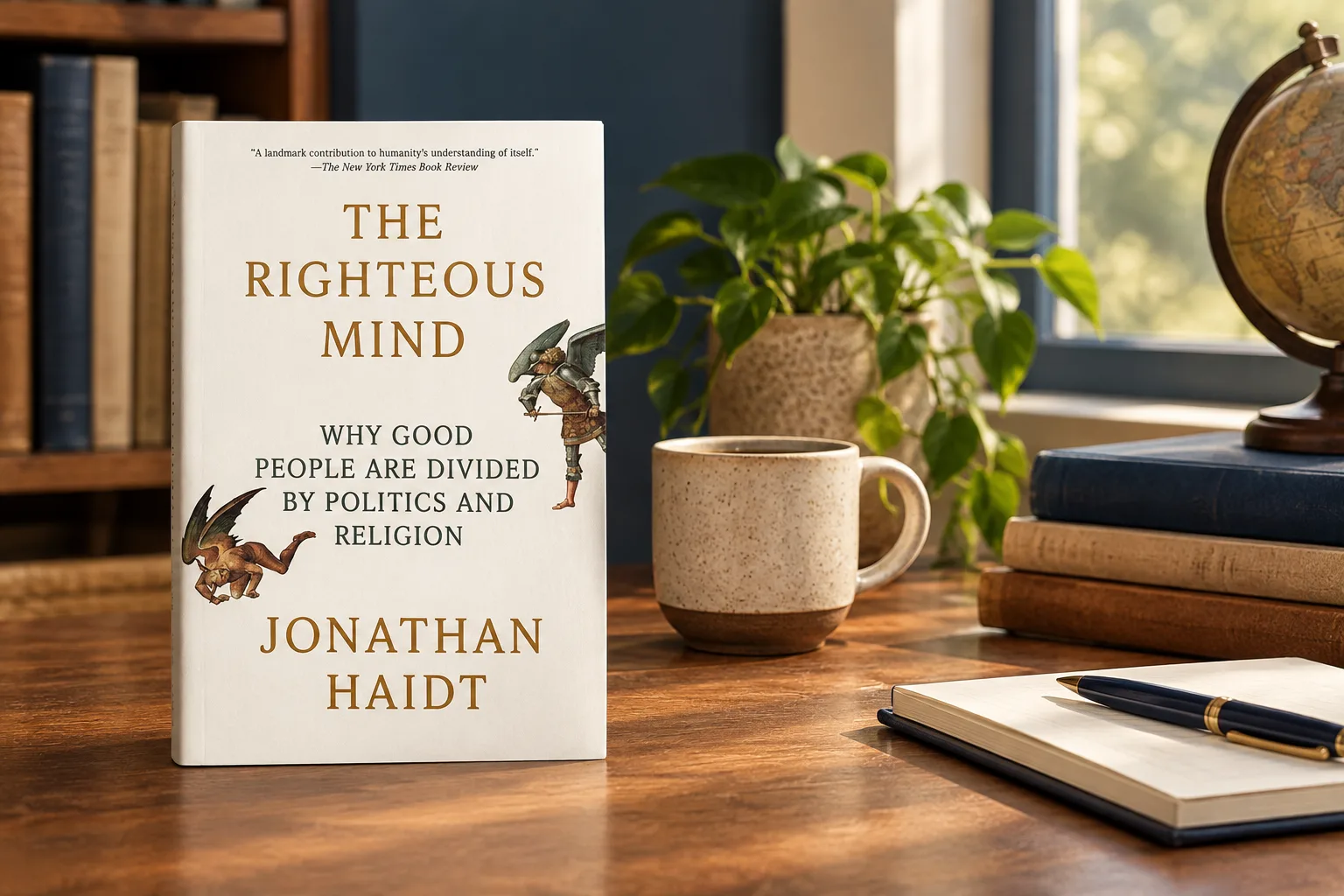
The Righteous Mind: Why Good People Are Divided by Politics and Religion is at its most useful when it shifts a reader’s first question. Instead of asking why political opponents are foolish or malicious, Jonathan Haidt asks what moral concerns make their judgments feel compelling from the inside. That change in perspective is valuable. It is also the point at which the book’s elegant framework needs the most care: a map that helps explain disagreement can become too neat if readers mistake its categories for a complete account of moral life.
Haidt’s publisher describes the book as drawing on decades of moral psychology and argues that moral judgments often begin in intuitive responses rather than deliberate reasoning. The book compares liberal, conservative, and libertarian outlooks, and proposes that people can be moved by concerns beyond harm and fairness, including loyalty, authority, sanctity, and liberty. Kirkus summarizes the familiar six-foundation scheme as care, fairness, loyalty, authority, sanctity, and liberty. The framework’s appeal is plain. A disagreement about a policy may not be a simple contest between compassion and indifference; participants may be weighing different ideas about duty, belonging, autonomy, or social order.
That possibility makes the book a strong invitation to listen before rebutting. It directs attention to the moral vocabulary behind a claim, not only to its surface conclusion. For readers accustomed to treating politics as a debate in which one side has reasons and the other has interests, Haidt’s lens can make the exchange more reciprocal. Everyone has intuitions. Everyone can reason selectively in their defense. The framework therefore resists the flattering idea that one’s own political community is uniquely rational while opponents are simply driven by emotion.
The strongest version of this insight is modest: moral reasoning is shaped by more than abstract principles, and people may recognize some values more readily than others. The weaker version turns the framework into a sorting device. Once a reader labels a person as motivated by authority or care, the label can replace listening just as quickly as an insult does. Categories that explain broad patterns do not tell us what a particular person means, which experiences shaped that view, or whether the person’s stated reason is more important than a theorist’s preferred interpretation.
That limitation matters because the book’s topic is politically charged. Broad comparisons between ideological groups can illuminate patterns, yet they also tempt readers to treat a group average as a portrait of each member. Political identity changes across countries, institutions, generations, and issues. A moral vocabulary that organizes one debate may not neatly organize another. The framework works best as a set of questions to test—what is being protected, what is being treated as unfair, whose obligations count?—rather than a ready-made diagnosis of any individual or movement.
There is a further scientific question beneath the popular argument. The title’s confidence and the book’s accessible synthesis can make its account sound like a settled anatomy of morality. But the existence and boundaries of the proposed foundations are themselves matters of debate. In a 2011 paper indexed by PubMed, Christopher Suhler and Patricia Churchland argue that the theory’s proposed taxonomy and its claims about innate, modular foundations face conceptual and neuroscience problems. Their critique does not erase the book’s usefulness as a public framework. It does mean that readers should distinguish an influential explanatory model from a conclusive inventory of the human moral mind.
This distinction is not a minor footnote. Frameworks are powerful partly because they simplify. They let a reader notice a pattern and carry it into a conversation. But the simplicity that makes a theory memorable can also conceal variation, historical context, and competing explanations. A responsible reading keeps the model provisional: it can help generate questions without deciding in advance what the answers must be. Haidt’s argument is most productive when it loosens certainty about one’s opponents, not when it replaces that certainty with a new typology.
The book’s conciliatory ambition also invites a practical question: does understanding another side’s moral language require agreeing with its conclusions? It should not. Recognizing why a person values loyalty or authority does not settle whether a specific loyalty is deserved or whether an authority is legitimate. Empathy can improve diagnosis, but judgment still depends on evidence and principle. A reader can take the other person seriously while disagreeing sharply about consequences, rights, or fairness. The framework is useful precisely when it makes disagreement more informed rather than less possible.
As an editorial assessment based on the publisher’s description, the professional overview in Kirkus, and published criticism of Moral Foundations Theory, The Righteous Mind offers a compelling lens on why disputes can feel moral as well as factual. Its accessible synthesis asks readers to question the assumption that their own values exhaust the meaning of morality. The same synthesis can overreach if its categories are treated as universal, fixed, or sufficient to explain political behavior.
Readers interested in moral psychology, political disagreement, and the language people use to defend their values will find a stimulating starting point here. They should pair its memorable model with current and specialist research when making scientific claims, and with curiosity when applying it to real people. The book’s most durable contribution is not a final chart of who believes what. It is the reminder that understanding a moral argument begins by asking what the speaker thinks is at stake—and continues by testing whether that account fits the evidence.
EDITOR’S VERDICT
Tale24’s assessment
An accessible framework for noticing moral concerns beyond harm and fairness; encourages readers to examine opponents’ values rather than dismissing them.
Points to considerThe categories can appear more universal or fixed than the evidence warrants; group patterns should not be mistaken for individual explanations.
Best for: Readers interested in moral psychology, political disagreement, and the ways people justify their values; best read alongside current specialist research.
Editorial method: This is an independent assessment informed by the work and its official supporting information. AI tools may assist the drafting process; Tale24 reviews and takes responsibility for everything it publishes.