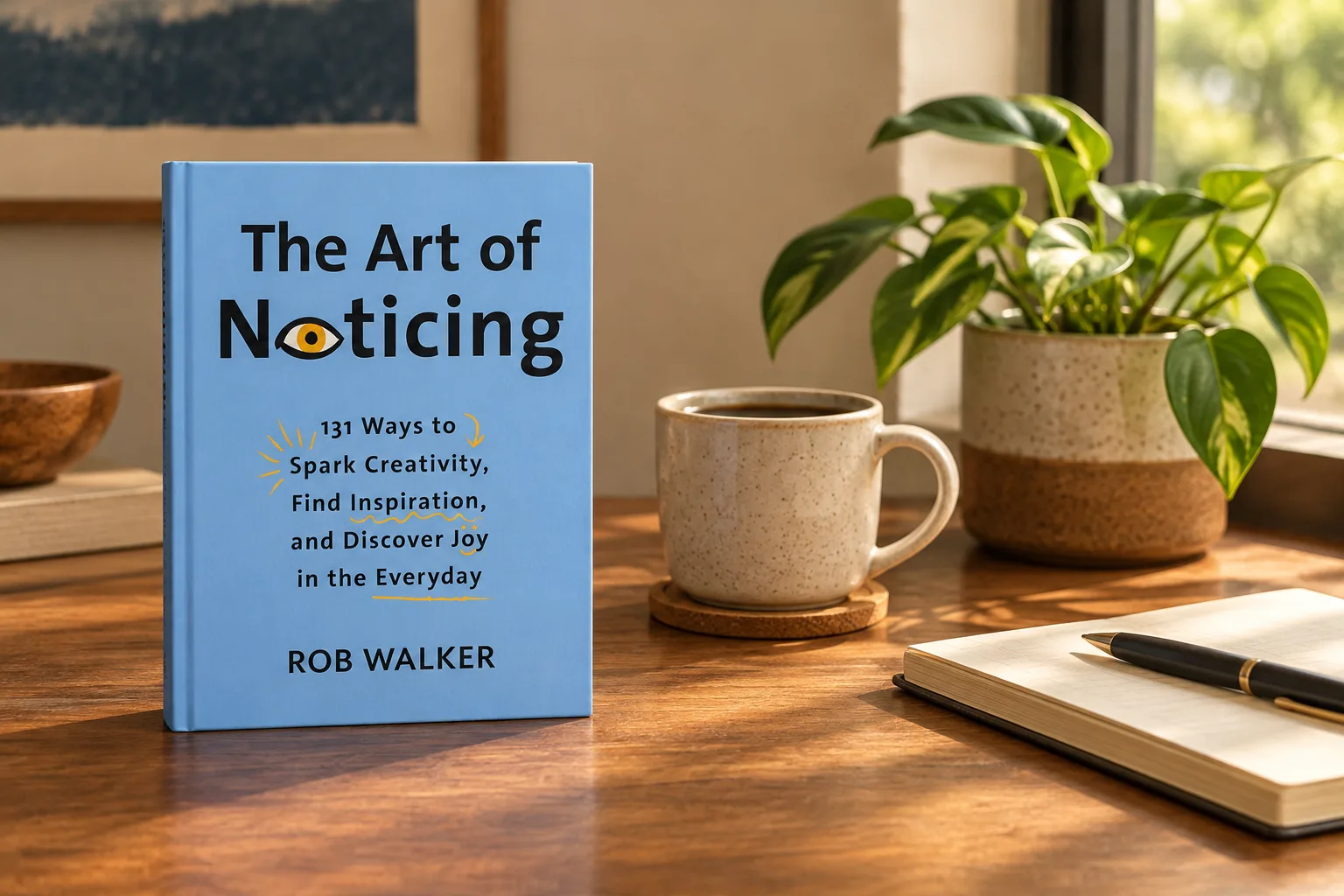
Psychology & Skills · TALE24 REVIEW
The Art of Noticing: Attention as a Practice of Curiosity
Rob Walker turns the familiar complaint about distraction into an invitation to practice attention. His 131 small exercises make curiosity feel usable in ordinary life, though the book’s open-ended format offers more prompts than a sustained theory of why they work.
Concrete, varied prompts turn attention into something readers can practice; the illustrated, reusable format invites experimentation without expensive tools.
The standard advice about distraction is subtractive: put the phone away, close a tab, resist the next interruption. Rob Walker’s The Art of Noticing starts from a more interesting question. Once attention has been freed, where should it go? His answer is a collection of 131 invitations to look, listen, and investigate the ordinary world. The book’s wager is that curiosity can be practiced in small acts, without waiting for travel, a retreat, or a sudden burst of inspiration.
Published by Knopf in 2019, the illustrated book sits between a creativity guide and a field notebook. The publisher presents it as a response to a life crowded by email, phones, and social media. Walker’s own description stresses use over one-time reading. That distinction matters: a list of exercises is valuable only if it changes what readers choose to notice after they close the book. Its form therefore carries the argument. The reader is asked to try a prompt, return to daily life, and see whether a familiar place becomes less automatic.
Walker’s examples show how modest the entry point can be. In an interview shared by the publisher, he suggests looking out a window, identifying the oldest and newest things in view, taking a photo walk without a camera, or choosing five sounds that define a neighborhood. None requires special equipment. Each replaces a vague demand to be “more mindful” with a question specific enough to act on. The oldest-and-newest exercise, for example, asks a reader to see a street as layers of time instead of a route between errands. The sound exercise shifts attention away from the visual habits that dominate much advice about observation.
The photo walk without a camera is especially revealing as a design choice. A device might make the outing more productive in a conventional sense: it creates a record to keep or share. Removing it changes the task from collecting images to making judgments in the moment. What deserves a longer look if no evidence will be saved? The exercise does not prove that cameras are harmful. It demonstrates how a small rule can expose the expectations we bring to an activity. Walker’s strongest prompts seem to work this way, by changing the frame around an ordinary action rather than demanding an entirely new life.
There is also a social dimension to noticing that a simple “digital detox” story can miss. To listen for neighborhood sounds is to treat a place as more than scenery. To inspect a shop as if one were an anthropologist, another practice Walker describes in an interview, is to ask what everyday objects reveal about taste and commerce. Such prompts can sharpen curiosity about other people’s choices, though they also require humility. Observation does not give the observer a complete account of anyone else’s life. The book is most useful when noticing becomes the beginning of a question, not a license for instant conclusions.
This flexibility is an advantage for readers whose days differ. A long walk, a brief pause at a window, and a few minutes of listening do not demand the same time or energy. The range lets readers choose an experiment that fits the day. It also resists the common self-help promise that one perfected routine will solve every problem. Attention here appears less like a trait one either has or lacks and more like a set of decisions that can be renewed. A reader can fail to sustain one exercise and still try another tomorrow.
The same abundance creates the book’s chief limitation. One hundred and thirty-one prompts can become another list to browse, admire, and abandon. The format offers many openings but may not provide the continuity some readers need to build a lasting habit. Nor does the public description establish that these exercises measurably improve concentration or creativity. The claim that attention can be directed through playful practice is plausible and attractive; its results will depend on what a reader actually does with the prompts. Readers seeking a rigorous account of cognitive science, or a single cumulative argument, should approach the book with different expectations.
Its anti-distraction stance has a further boundary. Choosing to notice is easier when a person has some control over time, workload, and surroundings. The book’s small exercises may fit into constrained lives, but they cannot remove the structural pressures that keep people hurried or exhausted. That is not a reason to dismiss them. It is a reason to read their promise at the right scale. A prompt can change an afternoon’s quality of attention; it cannot, on its own, redesign the conditions that fragment that afternoon.
For that reason, The Art of Noticing is best understood as a portable practice book rather than a cure. Its practical intelligence lies in turning an abstract virtue into experiments with clear beginnings. The exercises offer occasions to test how much of a place remains unseen when we move through it on autopilot. The book will suit readers who enjoy creative prompts, design questions, and low-pressure ways to reengage with familiar surroundings. It may frustrate those who want a tightly argued theory or quantified outcomes. Its enduring question is modest but sharp: what might become available if we gave the everyday world a second look?
A useful way to read it is to select a few prompts, try them in the same place on different days, and keep track of what changes in your own observations. That approach respects the book’s experimental spirit without pretending that a pleasant exercise is a proven treatment. It also makes the reader responsible for deciding which questions deserve another attempt.
EDITOR’S VERDICT
Tale24’s assessment
Concrete, varied prompts turn attention into something readers can practice; the illustrated, reusable format invites experimentation without expensive tools.
Points to considerThe large menu may feel scattered; the public evidence does not establish measurable improvements in focus or creativity; individual exercises cannot solve structural causes of distraction.
Best for: Readers interested in creative exercises, observation, design, and gentle ways to reengage with everyday surroundings.
Editorial method: This is an independent assessment informed by the work and its official supporting information. AI tools may assist the drafting process; Tale24 reviews and takes responsibility for everything it publishes.