Literature & Thought · TALE24 REVIEW
The Dawn of Everything and the Limits of Grand History
Graeber and Wengrow challenge linear stories of agriculture, hierarchy, and the state. The book’s expansive synthesis makes past political experiments vivid, while leaving an important question: do diverse cases prove a new master narrative, or open history to more local explanations?
A wide-ranging synthesis that highlights human political agency; brings archaeological and anthropological findings into public conversation; prompts readers to question historical inevitability.
History as Possibility, Not a Replacement Master Story
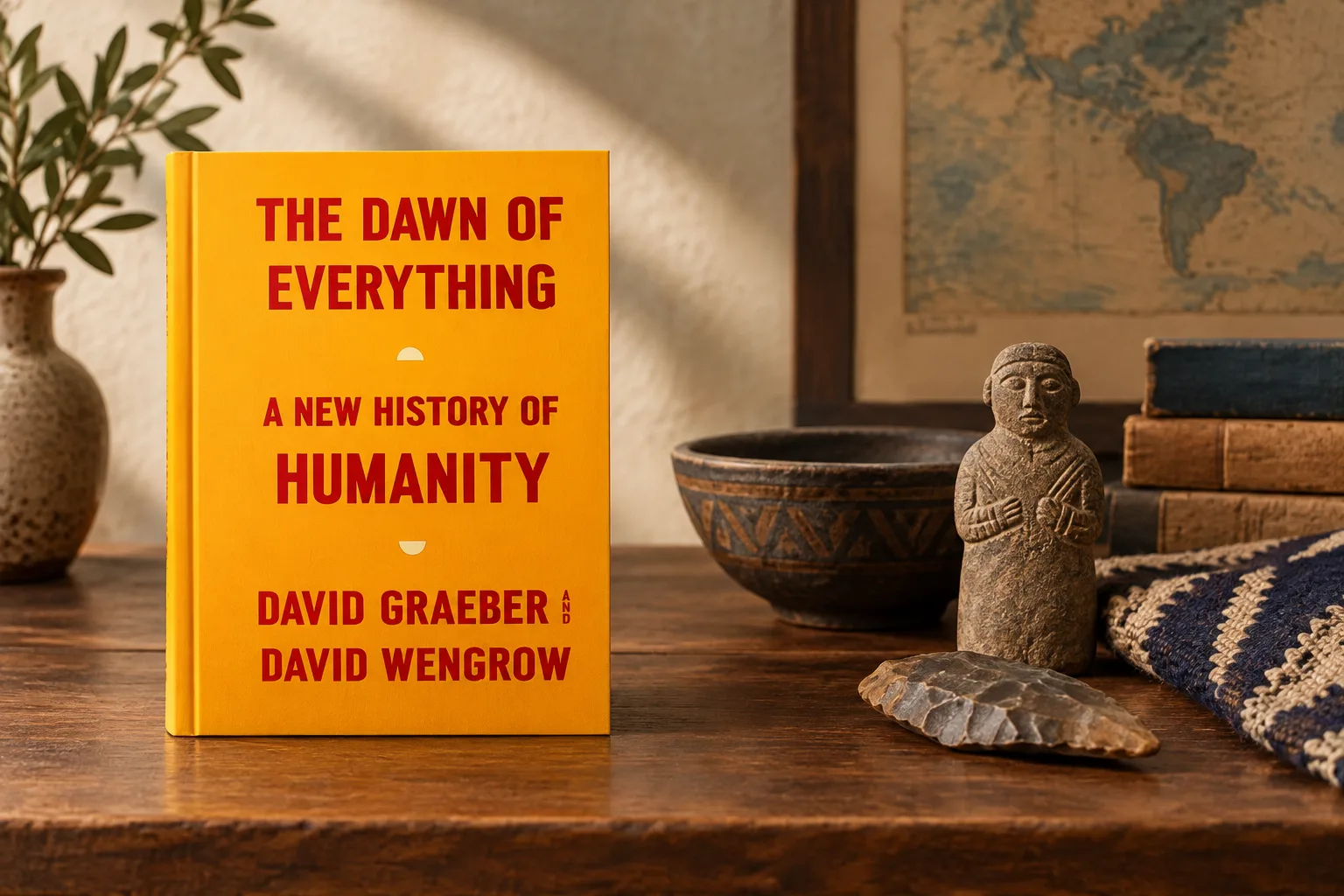
The Dawn of Everything begins from a question with consequences beyond the past: if the familiar path from small bands to farming, cities, hierarchy, and states was not inevitable, what alternatives have people already tried—and what might that history let us imagine now? David Graeber and David Wengrow build their book around this challenge to linear accounts of social evolution. Its most compelling contribution may be the freedom of that question. Its most demanding task is proving that a wide range of historical cases adds up to a new picture rather than simply complicating the old one.
The Picador edition is a 720-page synthesis of archaeological and anthropological research. The publisher presents its argument as a challenge to assumptions about agriculture, cities, states, democracy, and inequality. That framing tells readers what the authors hope to unsettle, but it should not be confused with a settled consensus about human history. Even the publisher’s sample material acknowledges that the evidence remains incomplete and that the project is a beginning for further research and debate. The book’s scale is part of its ambition: it tries to connect particular findings to the very large stories societies tell about freedom, hierarchy, and how we came to live together.
That ambition has a clear strength. Popular histories often make the deep past feel like a corridor with one exit. Agriculture appears, population grows, hierarchy follows, and centralized rule arrives as the unavoidable cost of complexity. Graeber and Wengrow ask readers to look again at cases that do not fit so comfortably. The point is not simply that ancient societies were varied. It is that variation may reveal human beings as active political thinkers who organized and reorganized collective life, rather than as passengers carried by a universal sequence of technological stages.
The book’s focus on Indigenous intellectual traditions also has a meaningful role in that argument. The publisher’s excerpt emphasizes that social thought did not originate only within the European philosophical canon. Taking Indigenous critique seriously can change how a history of political ideas is told: people once treated as objects of observation may instead appear as commentators who challenged European assumptions. That shift can widen the archive of political thought and make contact between societies a source of ideas, not merely a backdrop to European intellectual history.
But recovery and interpretation are different achievements. Showing that social arrangements were more varied than simple models suggest does not, by itself, prove every larger conclusion drawn from that variety. Ian Morris’s review in the American Journal of Archaeology makes this distinction central. He praises the book as original, lively, ambitious, carefully researched, and supported by substantial scholarly notes. He also questions whether the examples logically disprove broad evolutionary accounts, and argues that the authors do not give a clear method for deciding when either their account or its rivals have been falsified. This is a serious criticism of inference, not a dismissal of the evidence or of the book’s ability to make ancient history engaging.
The distinction matters because a grand synthesis must choose. A global account cannot include every site, period, or disagreement. Selection is inevitable; the question is whether the selected cases support the connective argument, or whether vivid examples do more work than they can bear. Morris notes that even well-researched books can move from cautious hypotheses toward statements that sound certain. For readers, that is a reason to pause at the transitions: what does a specific archaeological case establish, and what additional step turns it into a claim about the overall course of history?
A second useful check comes from the Chicago Review’s discussion of the book and its disciplinary context. It recognizes the value of making archaeological and anthropological evidence accessible and of reading findings against inherited assumptions. At the same time, it notes that archaeology has increasingly asked site-specific questions about local histories rather than relying on universal stages. That context complicates the polemic. The alternative to one rigid master story may not be another equally broad story with a different moral direction. It may be a more plural account that accepts variation, regional explanation, and unresolved debate.
This tension helps clarify what the book offers best. It is strongest as an invitation to resist inevitability. If evidence reveals repeated experimentation, shifting authority, or organizations that do not match a tidy stage model, then readers have reason to distrust claims that the present arrangement was the only possible outcome. Yet the move from “other arrangements existed” to “we can reorganize society now” is partly interpretive and political. The past can enlarge our imagination without serving as a direct blueprint. Historical examples make possibility visible; they do not remove the practical and ethical questions involved in choosing among possibilities today.
The book’s sheer length intensifies both sides of this experience. A 720-page panorama can supply the variety needed to challenge compressed narratives and draw attention to scholarship outside specialist circles. It can also make a reader work to keep track of which claims are local, which are comparative, and which support the book’s broad thesis. For a subject this large, the apparatus and the argument deserve to be read together. The evidence notes are not decorative back matter; they are part of how a reader can assess the connections the narrative invites.
This editorial assessment draws on Macmillan’s bibliographic description, Morris’s scholarly review, and the Chicago Review discussion rather than claiming firsthand reading of every page. Taken together, these sources suggest a book whose ambition is most productive when treated as a challenge to complacency, not a final replacement history. Its accessible synthesis can make distant societies intellectually present and question the idea that inequality or centralized authority arrived through one unavoidable route. Its broad conclusions remain open to scrutiny, especially where diverse cases are woven into a single counter-narrative.
Readers interested in anthropology, archaeology, political thought, and the stories behind institutions will find a substantial provocation here. The book asks a valuable question: what did people do when they had room to organize life differently? The best response is neither to accept its whole argument as proven nor to dismiss its cases because the synthesis is disputed. Read it as a doorway into evidence, disagreement, and political imagination. Its promise lies in making history feel less like a sentence and more like a field of choices whose limits must still be investigated.
EDITOR’S VERDICT
Tale24’s assessment
A wide-ranging synthesis that highlights human political agency; brings archaeological and anthropological findings into public conversation; prompts readers to question historical inevitability.
Points to considerThe leap from diverse cases to a new global account is contested; its scope makes selection and connective logic difficult to assess; not a substitute for specialist regional studies.
Best for: Readers interested in anthropology, archaeology, Indigenous intellectual history, and political theory who enjoy ambitious, debated syntheses.
Editorial method: This is an independent assessment informed by the work and its official supporting information. AI tools may assist the drafting process; Tale24 reviews and takes responsibility for everything it publishes.