Literature & Thought · TALE24 REVIEW
Good Strategy/Bad Strategy and the Work of Diagnosis
Rumelt separates a real response to an obstacle from slogans and targets. This practical framework makes strategic thinking clearer, while reminding readers that diagnosis still depends on local evidence.
A memorable structure for diagnosing challenges; clear distinction between strategic choices and aspirations; varied examples across business and public life.
Good Strategy Begins With Diagnosis
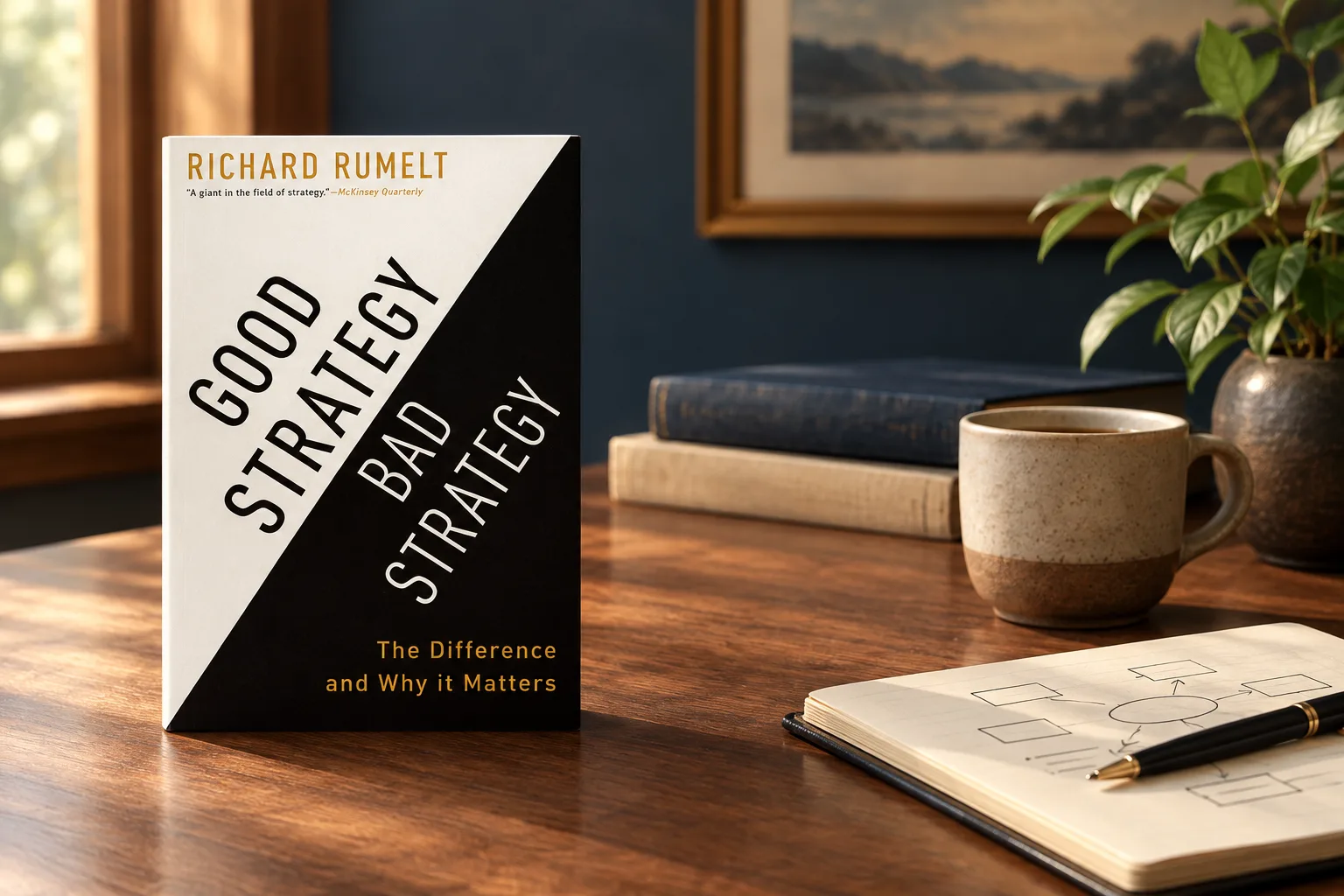
Strategy is one of those words organizations use so often that it can lose its meaning. A target, a mission statement, and a list of initiatives may all be presented as strategy, even when they do not explain what problem the organization faces or why its actions fit together. Richard Rumelt’s Good Strategy/Bad Strategy asks readers to draw that line more carefully. Its central insight is practical and bracing: strategy is a response to a challenge, not a collection of ambitions. The book is most useful when it teaches readers to demand that response. Its framework is less useful when treated as a recipe that can diagnose a business from the outside.
The 336-page Crown Currency edition was published in 2011. Penguin Random House describes it as a guide to distinguishing coherent, action-oriented strategy from slogans, vague values, buzzwords, and financial goals. That publisher summary also highlights cases from business, nonprofit, and military settings. Rumelt’s examples are intended to make abstract ideas concrete, but their age matters. The cases belong to the circumstances in which they arose; a reader should examine the reasoning behind them rather than copy them as if they were current instructions.
The book’s most memorable standard is often called the strategy kernel: diagnosis, guiding policy, and coherent action. Diagnosis names the important obstacle. A guiding policy establishes how to approach it. Coherent actions coordinate the work that follows. This sequence is simple enough to remember and demanding enough to expose weak plans. If a leadership team cannot say what is getting in the way, a confident vision of future growth may be no more than a wish. If it can name the obstacle but lists initiatives that compete for attention, it has not yet shown how its choices reinforce one another.
That distinction gives the book a lasting practical value. Organizations often confuse motion with progress. They may set ambitious targets, commission presentations, and launch projects without identifying the constraint that most affects results. Rumelt’s approach asks leaders to concentrate attention and resources where they can have an effect. The question is not merely whether each initiative sounds positive. It is whether the collection responds to a real diagnosis and whether the actions fit the chosen approach.
Brian Harney’s 2012 review and commentary in the Irish Journal of Management places the book within a wider criticism of strategy practice. Harney describes concerns about complacency, inertia, and mission or vision language becoming empty and similar across organizations. He also connects Rumelt’s argument to earlier work on strategy evaluation and the resource-based view of the firm. That context helps explain why the book pushes against generic formulae: the claim is that advantage and action depend on the particular organization and its circumstances. The repository identifies Harney’s contribution as a published review, not a refereed article, so it is useful commentary rather than a peer-reviewed test of the book’s claims.
A second strength is the book’s insistence that good strategy involves choices. A plan cannot pursue every attractive goal at once. It has to recognize limits, identify where effort can matter most, and accept the opportunity costs of focus. This can be uncomfortable in organizations where leaders want a plan that promises growth everywhere, protects every existing activity, and avoids naming tradeoffs. Rumelt’s distinction turns that discomfort into an analytical test: what is the organization willing to do differently because of the challenge it has identified?
Still, the three-part framework does not make hard diagnosis automatic. A company may describe a symptom as the central obstacle while overlooking a deeper cause. Leaders may select evidence that favors an appealing direction. A coherent policy can also be coherent and wrong. Frameworks clarify the questions that need answering; they cannot replace careful research, disagreement, or knowledge of customers and operations. The book’s language is strongest as a discipline for thinking, not a guarantee that a team will choose well.
The examples create a related tension. They make strategy vivid across sectors and settings, allowing readers to compare problems that might otherwise seem unrelated. At the same time, an example is selected and compressed. It may highlight the choices that fit the author’s argument while leaving less room for the uncertainty, implementation difficulty, or competing explanations surrounding the outcome. Readers should ask what the case demonstrates, what it leaves out, and whether the same mechanism exists in their own situation. A memorable case can prompt useful inquiry, but it cannot establish that a tactic will travel intact into another organization.
The book’s age reinforces that need for judgment. Published in 2011, it predates many shifts in technology, markets, and the wider business environment. Its core distinction between a real response and decorative language can remain relevant, while particular examples and operating assumptions may need updating. The publisher’s synopsis presents cases from business, nonprofits, and military affairs; that breadth offers variety, not proof that every lesson applies in every field. Read the examples as historical demonstrations of reasoning, then test their lessons against present evidence.
This editorial assessment draws on the publisher’s bibliographic description and synopsis and on Harney’s published commentary, rather than claiming firsthand reading of every page. Together, they support a measured view of Rumelt’s contribution. He gives readers a compact way to examine whether a plan identifies an obstacle, chooses a guiding response, and coordinates action around it. The book also encourages skepticism toward slogans and goals that avoid the real problem. Its limitations appear when a reader expects a framework to provide answers without local analysis or treats illustrative cases as universal prescriptions.
Good Strategy/Bad Strategy is therefore best suited to managers, founders, students, and organizational leaders who want to inspect the logic beneath a plan. It is especially useful for anyone who has seen objectives multiply while priorities remain unclear. The book offers a vocabulary for asking sharper questions, not a shortcut around them. Its enduring lesson is that serious strategy starts by seeing the challenge clearly, then choosing what to do about it. Whether those choices work depends on the quality of the diagnosis, the evidence behind it, and the discipline to align action with the response.
EDITOR’S VERDICT
Tale24’s assessment
A memorable structure for diagnosing challenges; clear distinction between strategic choices and aspirations; varied examples across business and public life.
Points to considerExamples are selective and date from their own contexts; the framework cannot replace local research; coherent choices still carry tradeoffs and can be wrong.
Best for: Managers, founders, students, and nonprofit leaders who want to evaluate whether a plan responds coherently to a specific challenge.
Editorial method: This is an independent assessment informed by the work and its official supporting information. AI tools may assist the drafting process; Tale24 reviews and takes responsibility for everything it publishes.