Technology & Careers · TALE24 REVIEW
The Song of the Cell and the Limits of Therapeutic Promise
Siddhartha Mukherjee connects the history of cell biology with medicine’s hopes for cellular therapies. The book makes a microscopic subject accessible, while raising a harder question: who sets priorities when scientific promise meets public need?
Makes cell biology approachable through history and metaphor; links scientific discovery with medical questions; invites readers to think across cells, bodies, and society.
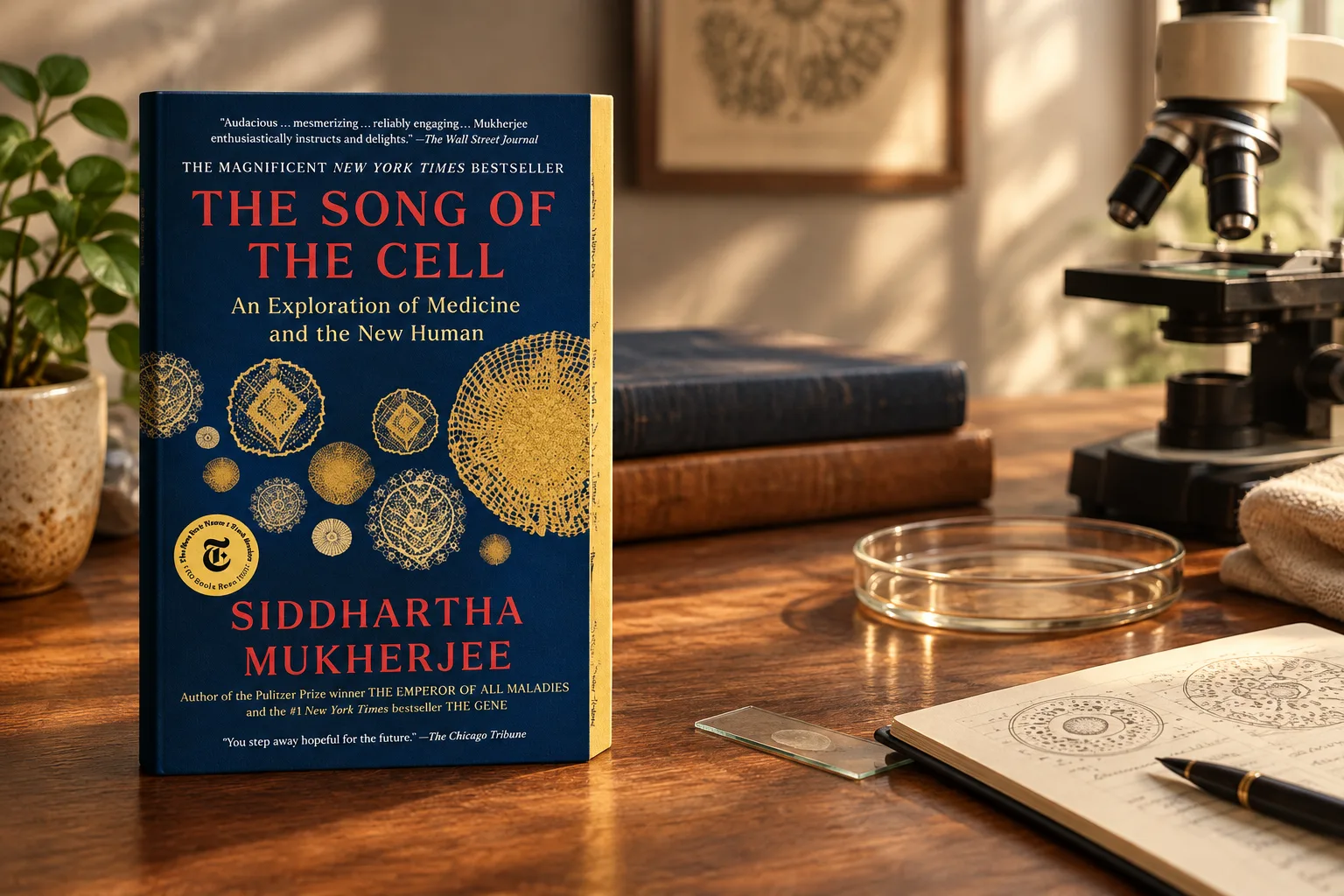
The Song of the Cell begins with a scale problem. Cells are small enough to escape ordinary sight, yet the publisher’s account of Siddhartha Mukherjee’s book asks readers to see them as the basis of bodies, organs, disease, and medicine. Its subtitle, An Exploration of Medicine and the New Human, signals a journey from the history of seeing cells to the question of what people may do with cellular knowledge. The title’s musical metaphor adds another question: how do tiny units make a functioning whole? The book’s appeal lies in bringing those scales into the same story; its challenge is keeping the metaphor from sounding like a complete explanation.
Simon & Schuster says the account opens in the late seventeenth century with Robert Hooke and Antonie van Leeuwenhoek looking through handmade microscopes. Their observations helped establish the cell as a unit of living organisms and changed the way biology and medicine could describe the body. This is a compelling beginning for a history because the microscope is both an instrument and a shift in perspective. What had been invisible becomes available for study, and a new level of explanation enters the sciences. From that starting point, the book ranges toward the ways cellular knowledge shapes medical ideas and therapies.
A history of a scientific object can easily become a procession of discoveries and names. Mukherjee’s wider method, as described by the publisher and reviewers, appears to resist that narrow form by combining scientific explanations with intellectual history, biography, and his experience as a researcher and physician. Ian Tucker’s Guardian review calls the account assured and accessible, while noting that much remains unknown about cell biology. Those two observations belong together. Clarity can invite readers into complex material, but a clear narrative should not make a developing field seem complete. The frontier of knowledge is part of the subject, not a footnote to it.
The title promises a relationship between parts and wholes. A cell can be studied as a unit, while a body depends on interactions among many units and systems. TIME’s interview with Mukherjee describes his interest in cooperation among cells and the larger forms that cooperation makes possible. This frame is useful for general readers because it resists a purely mechanical picture of life: biological explanation involves organization as well as components. Yet musical language is also a metaphor. It can suggest harmony, coordination, and shared purpose where actual biological processes may be uneven, competitive, or simply not well understood. The metaphor works best as a guide to curiosity rather than a substitute for technical precision.
The same issue appears when the book turns toward medicine. The publisher presents cellular knowledge as a basis for new ways to understand and treat disease. Carolyn Y. Johnson’s Washington Post review discusses the book’s accounts of interventions including vaccines, gene editing, immunotherapies, and stem-cell research. Bringing these examples into a historical narrative can help readers see that medicine changes when scientists develop new ways to describe what is happening in bodies. It can also create an atmosphere of promise. The existence of a cellular approach does not by itself establish its availability, effectiveness, or suitability for a particular patient. A book about medical possibility should prompt interest, not be mistaken for clinical advice.
This is where the criticism in Laura Kolbe’s New York Review of Books essay becomes especially useful. Kolbe argues that the book grows less clear when it comes to who should set the priorities of biomedical research. A vivid account of discovery and therapeutic ambition cannot answer every question about public investment. Which problems receive attention? Who is likely to benefit from expensive interventions? What alternatives, including prevention, should be considered alongside new treatments? These questions are not external distractions from science. They shape how scientific knowledge becomes medical practice. If the book leaves them less fully examined, that limitation marks a boundary readers should carry into the discussion.
The book’s six-part structure, according to the publisher, supports a panoramic tour of the subject. Such breadth has an obvious advantage: cells can connect the history of biology to physiology, illness, and the modern ambitions of medicine. But a large subject brings a risk of unevenness. Historical episodes, conceptual explanations, and therapeutic examples do not always share the same kind of evidence or the same level of certainty. Moving quickly among them may encourage the reader to treat an established discovery and an emerging intervention as equally settled. The critical task for a reader is to notice when the book is describing what scientists learned, when it is presenting an interpretation, and when it is pointing toward a future possibility.
Metaphor can make that task easier and harder at once. The Washington Post notes Mukherjee’s use of comparisons to explain cellular structures and processes. A good analogy gives a reader a mental foothold; it allows an unfamiliar object to become imaginable. But every analogy chooses what to highlight and what to leave behind. Cells are not miniature people with intentions, and bodies are not simply collections of independent workers. The explanatory image should open a door to the science, then allow the science to complicate the image. The book’s lyrical framing is an asset when it encourages attention to the invisible; readers should still ask where an evocative comparison stops matching the evidence.
The strongest case for this book is its ability to make a microscopic subject feel relevant to lives outside a laboratory. The subtitle places medicine and the human future alongside cell biology, and the publisher describes a work that joins the science to the author’s professional experience. For nonspecialists, this can be a welcome route into a subject that is both technically dense and personally consequential. The Guardian’s praise for accessibility suggests that the account does not require advanced training as an entry ticket. At the same time, readers who want to understand a specific therapy or health decision need current, expert sources. A broad science history can supply context, but it cannot replace detailed evidence about an individual intervention.
The Song of the Cell is most rewarding when read as an invitation to move between scales: microscope, organism, patient, and society. Its ambition is to show how a once-invisible unit became central to modern biological thought and medical imagination. Its limitation, identified most sharply by Kolbe, is that the story of exciting research does not fully settle who should guide that research or how its benefits should be distributed. That tension gives the book more than an inspirational arc. It gives readers a reason to ask not only what cells make possible, but also what standards should govern the promises made in their name. For curious readers drawn to the history of medicine, it offers a vivid map; for specialist detail or clinical decisions, that map should be the beginning of further inquiry.
EDITOR’S VERDICT
Tale24’s assessment
Makes cell biology approachable through history and metaphor; links scientific discovery with medical questions; invites readers to think across cells, bodies, and society.
Points to considerIts broad scope can leave research priorities underexamined; metaphors need to be distinguished from biological evidence; not a source for clinical decisions.
Best for: Curious nonspecialists interested in cell biology and medical history; readers seeking treatment guidance should consult current clinical sources.
Editorial method: This is an independent assessment informed by the work and its official supporting information. AI tools may assist the drafting process; Tale24 reviews and takes responsibility for everything it publishes.