Technology & Careers · TALE24 REVIEW
The Gene and the Stories We Tell About Inheritance
Siddhartha Mukherjee’s sweeping history pairs the changing science of heredity with the personal and political stories that give genes their meaning. The book’s broad reach is its strength—and a reason to keep scientific uncertainty in view.
Connects scientific history with personal and social stakes; makes heredity a subject for public and ethical reflection; ranges from early accounts to modern genetics.
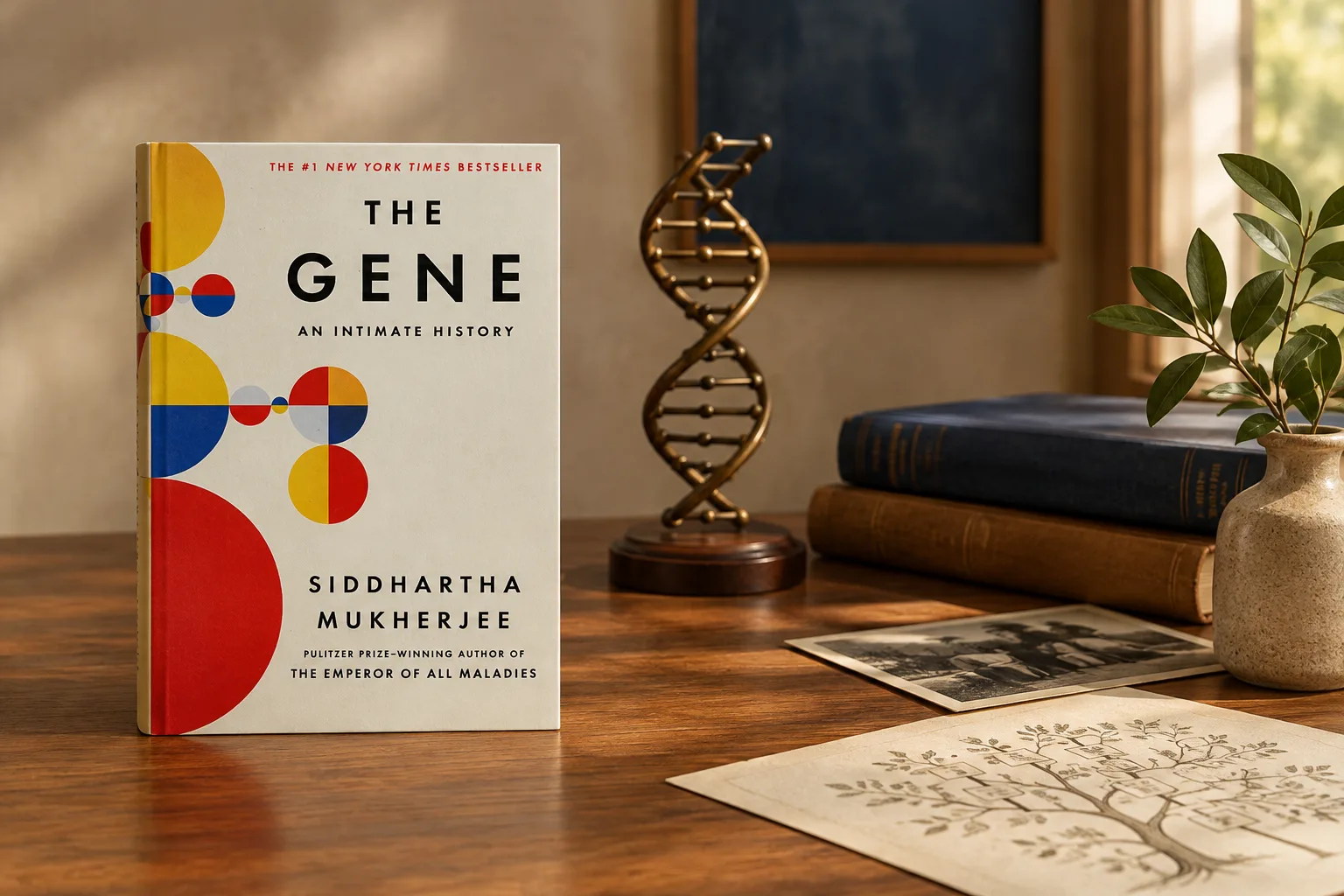
The Gene: An Intimate History takes a scientific idea and gives it two kinds of scale: the long history of attempts to explain heredity, and the personal stakes that make those explanations matter. Simon & Schuster describes Siddhartha Mukherjee’s book as moving from ancient thinkers through Mendel and the scientists who mapped the human genome, while also bringing in his family’s history of mental illness. That pairing suggests the book’s most interesting question is not simply what a gene is. It is how a scientific account of inheritance becomes part of the stories people tell about identity, illness, and possibility.
This is a useful frame for popular science because genetics can otherwise seem to belong entirely to the laboratory. A gene is at once a material object of study and a powerful public idea. People use genetic language to explain similarities, differences, risk, and family resemblance, often with more certainty than the evidence warrants. A history of the concept can show that the meaning assigned to genes has changed alongside the methods used to investigate them. The book’s wide historical range, as summarized by its publisher and reviewers, gives readers a way to see that scientific ideas acquire influence through institutions, interpretation, and debate as well as through experiments.
The account begins well before modern molecular biology. The publisher’s excerpt opens with a discussion of heredity and then turns to Gregor Mendel in the setting of an Augustinian monastery in Brno. This choice makes a strong editorial point: scientific discovery does not arrive outside time, in a clean laboratory detached from the world. Mendel’s place in the story is connected to a particular community, its routines, its intellectual resources, and its practical work with plants. Robin McKie’s Guardian review describes the book’s broad arc from Mendel’s pea experiments toward modern gene editing. The distance between those moments is itself a subject: the tools, questions, and social meanings of heredity have all changed.
A panoramic history can make this development legible, but it also faces a difficult tradeoff. To connect distant episodes, a narrative has to select and compress. The result can give readers a memorable line through a complicated field, yet make some changes look more orderly or inevitable than they were. James Randerson’s Guardian review raises a related concern about how cautiously the book handles disputed questions around heredity, environment, and epigenetics. That criticism does not cancel the value of the history; it clarifies the standard such a book must meet. When the evidence is contested, a confident story needs to keep uncertainty visible rather than smoothing it away for momentum.
The word “intimate” points to the book’s other scale. The publisher says Mukherjee sets the history beside his own family’s experience of mental illness. Personal history can make abstraction tangible: questions about inheritance are no longer only diagrams or terminology but questions with emotional consequences. That method also asks readers to be careful. One family’s story can illuminate why a subject matters without serving as proof of a general genetic rule. The distinction is essential in a field where people have repeatedly been tempted to turn observations about inheritance into sweeping judgments about character, capacity, or social worth.
That danger gives the history of eugenics a central ethical importance. Randerson’s review emphasizes the gene as a politically charged idea, including the history of efforts to use heredity to rank people and shape populations. The Yale Journal of Biology and Medicine’s appreciation of the book likewise notes its attention to eugenics, gene therapy, research ethics, and scientists’ responsibilities. These are not side issues attached to an otherwise neutral science. They show how descriptions of nature can be converted into prescriptions about who should be allowed to flourish. A history that places scientific language beside its uses in society can help readers recognize that leap—and question who benefits when it is made.
The book’s popular-science ambition is strongest when it encourages that kind of questioning. Accessible narrative can invite readers into a subject whose technical vocabulary may feel forbidding. At the same time, readability is not a substitute for precision. A metaphor can make an idea memorable and still leave out the limits of what is known. Likewise, a historical overview can explain why an idea became influential without establishing that every older interpretation remains scientifically sound. The National Human Genome Research Institute characterizes the book as combining science, social history, and personal stories around heredity, disease, and behavior. That description captures both its reach and the need to keep those different kinds of evidence distinct.
Readers should also remember the book’s publication date. Scribner published this edition in 2016. A historical work from that moment can help explain the debates and ambitions surrounding genetics then, but it cannot serve as a current technical reference for every subsequent development. Anyone making a medical, research, or policy decision needs up-to-date specialist sources. This is not a defect unique to Mukherjee’s book; it is the ordinary limit of a work that tries to tell a broad history of a changing science. The right response is to read its narrative as an invitation to ask better questions, then consult current evidence when the question demands it.
The scale may also divide readers. Someone seeking a concise guide to a single genetic mechanism may find a history that ranges across centuries too expansive. A reader looking for a first map of the field’s intellectual and moral terrain may welcome the sweep, especially when it is tied to personal consequence. The publisher’s presentation and outside reviews support that distinction: this is a work of science history and public interpretation, not a specialist manual or clinical handbook. Its usefulness depends on whether a reader wants context as well as explanation.
The Gene’s lasting promise, then, is not that it settles what heredity means. It is that it puts the question into a larger frame: how knowledge is produced, how families experience it, and how society decides what to do with it. Its historical breadth can make a powerful idea easier to follow, while its ethical subject asks for a reader who notices where narrative ends and evidence begins. For curious nonspecialists, that combination offers a strong reason to read the book. For readers who need precise contemporary science, it should be a starting point for further research rather than the final word.
EDITOR’S VERDICT
Tale24’s assessment
Connects scientific history with personal and social stakes; makes heredity a subject for public and ethical reflection; ranges from early accounts to modern genetics.
Points to considerIts panoramic sweep can compress disputes; published in 2016, it is not a current technical guide; personal history must not be mistaken for general genetic evidence.
Best for: Curious nonspecialists interested in genetics, science history, family, and bioethics; pair with current specialist sources for technical questions.
Editorial method: This is an independent assessment informed by the work and its official supporting information. AI tools may assist the drafting process; Tale24 reviews and takes responsibility for everything it publishes.