Technology & Careers · TALE24 REVIEW
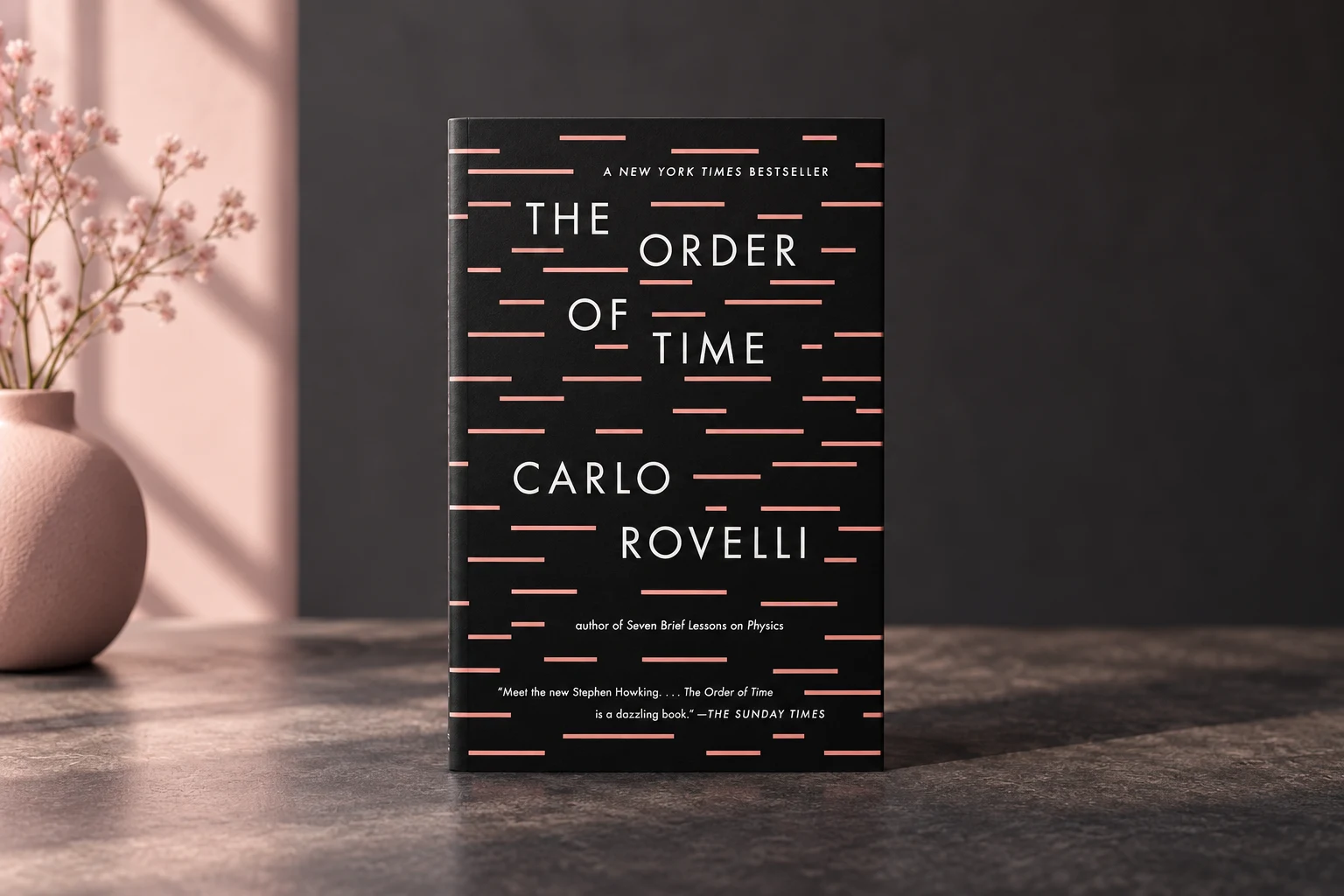
The Order of Time and the Limits of the Clock
Carlo Rovelli turns a familiar certainty into a series of questions. His compact account of modern physics is most illuminating when it connects the clock's measurements with the time we actually feel.
Elegant explanations that connect physics, philosophy, and everyday experience.
A clock seems to settle an argument. Two people can disagree about whether an hour passed quickly, but the hands provide a shared measure. In The Order of Time, Carlo Rovelli does not deny the usefulness of that measure. He asks a more troubling question: what assumptions must be true for the clock to describe a single time belonging to everyone? Modern physics has made the answer less secure than common sense suggests. Rovelli's brief book is an invitation to follow that disturbance from scientific description into human experience.
The book's scale is one of its attractions. Rovelli is a theoretical physicist, but he writes for readers who need no specialist training to grasp the stakes of a problem. Rather than beginning with equations, he begins with familiar intuitions: a universal present, a steady flow, and a clear direction from past to future. He then shows why each intuition becomes difficult when examined through contemporary physics. The result is not a claim that clocks are useless or that time is an illusion in every sense. It is a challenge to treat one everyday picture as the whole story.
Relativity is central to that challenge. The idea of a single cosmic “now” is appealing because it resembles our immediate social world. We schedule meetings and speak of events as happening at the same time. Yet the description of distant events in physics does not grant every observer one privileged present. Rovelli uses this gap between local habit and broader description to unsettle the reader without requiring technical mastery. The question is not whether we should stop making appointments. It is why an arrangement that serves ordinary life should be mistaken for a basic feature of the universe.
The direction of time brings a different difficulty. We remember yesterday and not tomorrow; we expect a cup to break more readily than its fragments to reassemble. Rovelli connects this asymmetry to entropy and to the conditions from which our observations arise. The material is challenging precisely because it touches something that seems self-evident. A reader may follow the general argument without feeling able to reconstruct every scientific step. That is a fair limitation of a concise book, but it is also part of its achievement: it makes a problem visible where there seemed to be none.
Rovelli's prose moves easily between physics, philosophy, and images drawn from ordinary life. This movement gives the book a lyric energy uncommon in introductions to science. It also creates a risk. When a sentence is beautiful, a reader can feel that a difficult question has been resolved before its terms have become clear. The distinction between a well-established result, an interpretive proposal, and an open area of research deserves attention. The book gestures toward quantum gravity, where the status of time remains especially demanding. Its brevity cannot carry a full account of that debate.
That caveat should not be confused with a dismissal of popular science. An accessible book has to choose its level of detail, and Rovelli chooses conceptual movement over exhaustive proof. He wants readers to experience a change in perspective. At its best, this method restores wonder to a subject that schoolroom diagrams can make mechanical. Time is not simply a ruler stretched over an already completed universe. The ways we locate events, explain change, and distinguish past from future depend on the scale and questions we bring to them.
The book becomes most affecting when it returns to the human creature asking these questions. A scientific account can describe processes without reproducing the felt thickness of waiting, aging, and remembering. Rovelli does not treat those experiences as embarrassing errors to be deleted by physics. Instead, he places them inside the inquiry. Our perception of time has a history and a bodily location. The fact that it is not a universal clock does not make it unreal. It means that an account of nature must explain why beings like us encounter the world in this particular way.
There is a useful humility in that turn. Readers sometimes approach physics hoping for a decisive answer to an existential question: What is a moment? Why does life pass? Can the past still exist? The Order of Time offers no simple reassurance. It gives a vocabulary for separating different questions that everyday speech tends to collapse. A mathematical description of relations among events is not identical to the experience of regret. Both may be serious, but they require different forms of explanation. The book's crossing between them is stimulating when the distinction remains visible.
The most likely disappointed reader is one looking for a textbook's sequence of worked examples. Rovelli often prefers a swift conceptual leap. A difficult paragraph may need rereading, and some claims invite further study before they can be assessed in detail. The book should be treated as a doorway, not as a final account of the subject. That is especially true where physics is still developing. Its value lies in teaching a general reader which apparent certainties are questions and why the questions matter.
The Order of Time leaves the clock on the wall, but changes what we think it measures. The clock remains a remarkable tool for coordinating life. It does not, by itself, tell us everything about simultaneity, change, memory, or the universe's deepest structure. Rovelli's compact argument is persuasive because it neither discards human experience nor enthrones it as cosmic law. It asks us to keep the practical measure and loosen the picture we built around it. That is a demanding, rewarding kind of clarity.
EDITOR’S VERDICT
Tale24’s assessment
Elegant explanations that connect physics, philosophy, and everyday experience.
Points to considerThe compressed treatment can leave readers wanting slower derivations and clearer boundaries between established results and open questions.
Best for: Curious general readers interested in physics, philosophy, and the experience of time.
Editorial method: This is an independent assessment informed by the work and its official supporting information. AI tools may assist the drafting process; Tale24 reviews and takes responsibility for everything it publishes.