Literature & Thought · TALE24 REVIEW
The Husbands and the Trouble with an Endless Choice
Holly Gramazio turns an attic into an endless supply of husbands—and a funny, searching test of whether more options make it easier to choose a life.
A high-concept comic premise makes choice, commitment, and the pull of imagined alternatives easy to discuss.
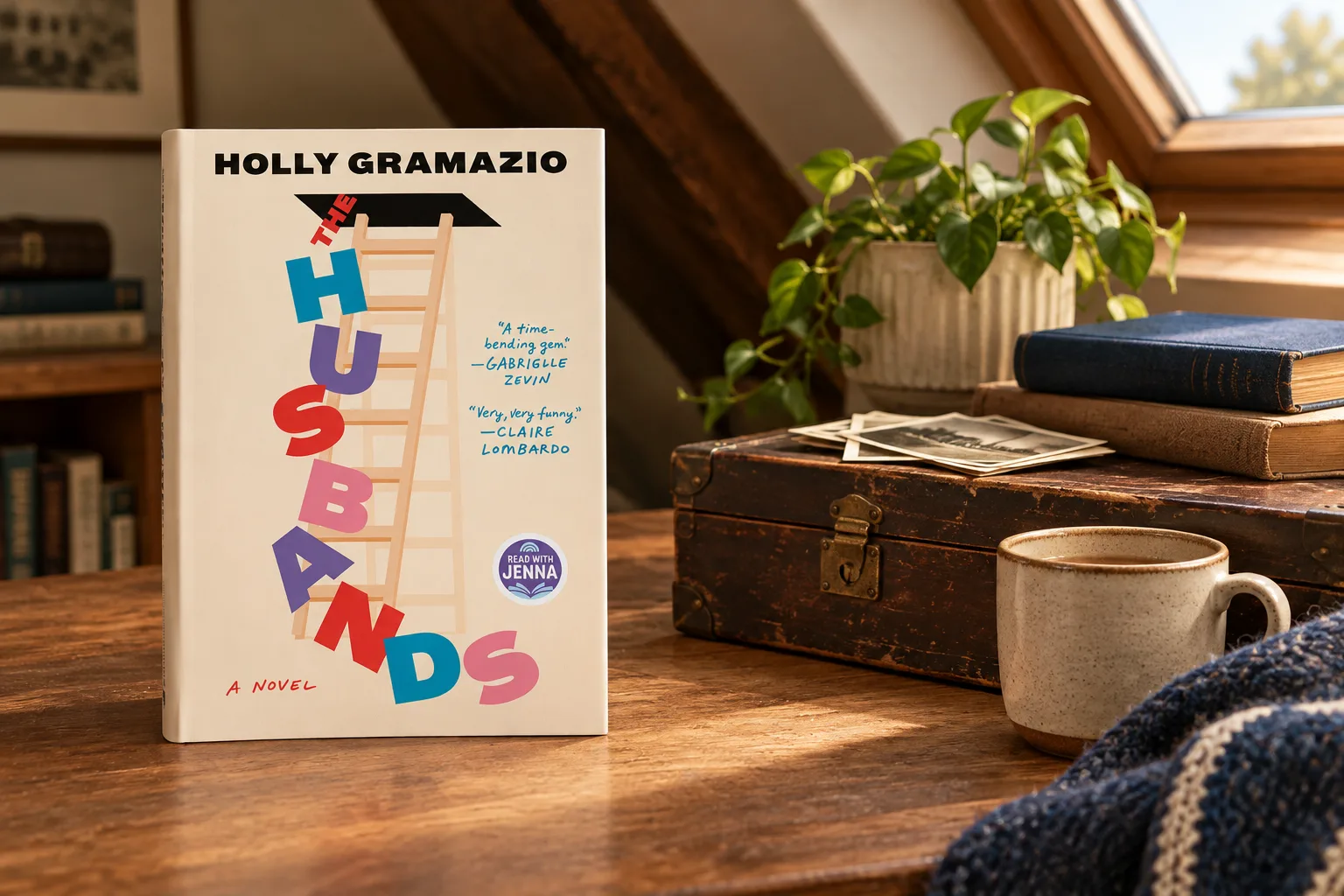
A story about an endless supply of husbands could easily become a parade of romantic types. Holly Gramazio’s The Husbands gives that comic premise a more pointed question: if another life is always available, what would make anyone choose the one they already have? Lauren returns to her London flat and finds a man who seems certain he is her husband, although she has never knowingly met him. When he goes into the attic, a different man comes down, and the details of Lauren’s life change with him. The attic turns the familiar fantasy of “what if?” into a literal household system.
That system makes a private dilemma visible. People often compare possible partners, jobs, cities, or versions of themselves against an ideal they cannot fully define. Lauren’s attic removes the ordinary limit: there is always another option upstairs. The question shifts from whether she can find a good life to whether she can recognize one while alternatives keep appearing. That is a sharp fit for a story shaped by contemporary dating culture, where the supply of profiles can make choosing feel less like a decision than a test of whether one has searched long enough.
Gramazio has connected the premise to watching friends become overwhelmed by dating profiles and to her own difficulty making decisions, even over small things. She has also described attics as mysterious spaces she encountered after moving from Australia to England. Those inspirations meet neatly in the novel’s central image. The attic is both a neglected part of the home and an engine of possibility: a place whose contents are unknown until someone climbs the stairs. It makes the fantasy feel domestic rather than cosmic. A single lightbulb and a staircase can rearrange a whole future.
The mechanism also raises a question about what counts as a “better” choice. A new husband arrives with a life that differs around Lauren: work, appearance, and the arrangement of her home can all shift. The attraction is therefore not only to another person but to the self one might become beside him. That is an important complication. Relationships do not simply add a partner to an otherwise unchanged life; they can alter habits, rooms, social worlds, and ambitions. The novel’s playful device can make those changes easier to see because it lets Lauren compare versions side by side.
But comparison is not the same as knowledge. A life viewed from the outside can look optimized because its costs are still hidden. The publisher frames the book around the question of how to navigate love and choice when options seem unlimited; Kirkus notes that time continues to advance as Lauren moves among husbands rather than resetting to the same starting point. That detail gives the conceit consequence. This is not simply a button that lets her replay one day until she gets a perfect result. Each choice takes place in a life already moving forward. The possibility of another option can feel liberating, but it cannot guarantee that the next version will answer every desire.
This forward motion gives the book an opening for more than a dating joke. When alternatives accumulate, indecision has a cost of its own: time passes while the chooser keeps looking. A decision may be imperfect and still make a life possible, while refusing to decide can preserve the fantasy of perfection at the expense of experience. Gramazio’s interview suggests that she is interested in the emotional absurdity of this problem, not in declaring that every choice is easy or that one option is universally correct. That makes the attic a useful metaphor for optimization culture: the belief that enough searching will reveal the objectively best version of a life.
The book’s comedic energy is part of its argument. An infinite staircase of husbands is absurd, and the premise invites the fun of imagining which versions Lauren might encounter. Yet humor can make an unsettling question easier to approach: if people become interchangeable options, what happens to the obligations that make a relationship more than a preference? The setup has room for tenderness as well as jokes because each change involves a person, not just a new set of décor. Kirkus notes that one husband’s reluctance to return brings a more serious complication into the story. Even without treating that moment as a summary of the novel, the detail points to an ethical boundary in the fantasy: the person Lauren sees as an option may have his own stake in the life being changed.
There is also a formal risk built into the premise. A continuous stream of alternatives could turn character into a checklist, with each new husband serving mainly to demonstrate another variable. The strongest version of this story is one in which differences reveal how relationships shape Lauren, rather than treating the men as contestants in a search for a flawless match. Gramazio’s background in game design offers an intriguing context: she has described drafting many separate scenes and possibilities before shaping them into a novel. That process echoes the book’s subject, but it does not tell us whether every possibility belongs in the finished narrative. The central craft question is whether variation keeps deepening the choice or eventually repeats it.
For readers who enjoy speculative premises grounded in ordinary life, The Husbands offers a conversation starter with real range. It can prompt playful questions—what small incompatibility would send you back upstairs?—and more serious ones about commitment, compromise, and the stories people tell themselves about a perfect match. Its comic setup is likely to be most satisfying when the humor leaves room for those consequences. Readers looking for a conventional romance centered on one destined couple may want a different kind of emotional arc; the book’s engine is comparison itself.
The attic makes the fantasy of keeping every door open wonderfully concrete. Its deeper challenge is that an open door does not tell Lauren which room contains a life worth inhabiting. The Husbands turns the search for an ideal partner into a question about attention: can a person notice the value of a choice while it is still possible to abandon it for something unknown? Gramazio’s premise is funny because it exaggerates a familiar habit, but it lingers because the habit is recognizable. More options may widen the field of possibility; they do not make a decision for us.
EDITOR’S VERDICT
Tale24’s assessment
A high-concept comic premise makes choice, commitment, and the pull of imagined alternatives easy to discuss.
Points to considerThe endless-variation structure risks making partners feel like a sequence of options if each change does not deepen Lauren’s perspective.
Best for: Readers of comic speculative fiction, contemporary romance, and book clubs interested in choice and commitment.
Editorial method: This is an independent assessment informed by the work and its official supporting information. AI tools may assist the drafting process; Tale24 reviews and takes responsibility for everything it publishes.