Literature & Thought · TALE24 REVIEW
Orbital and the Earth Seen as Home
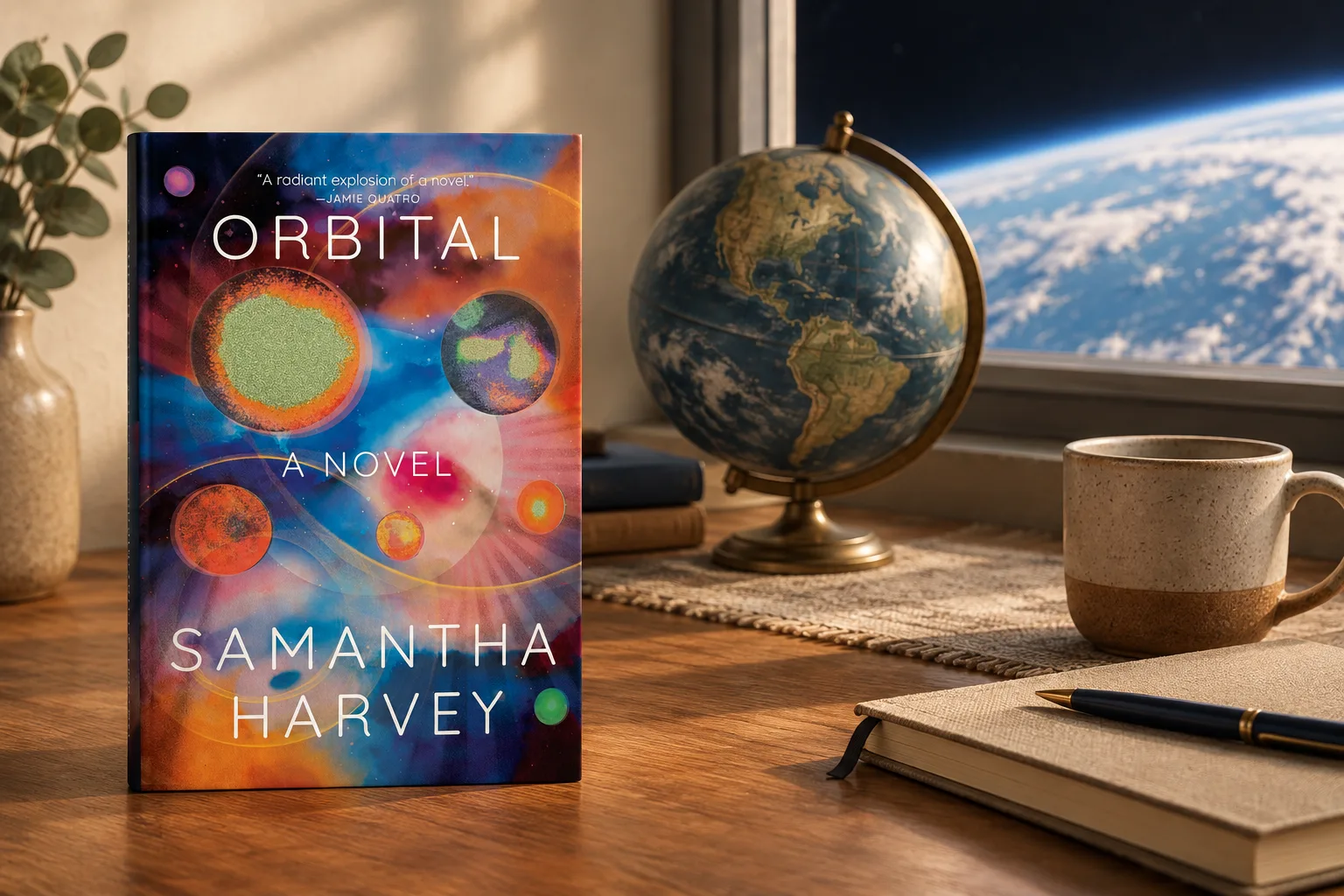
Samantha Harvey turns a day in orbit into a study of how attention changes when Earth becomes both view and home. Orbital’s lyric scale is its great strength—and the reason readers seeking conventional plot or deeply developed character arcs may feel held at a distance.
A distinctive orbital structure joins vivid planetary observation to the crew’s bodily routines, grief, and interdependence.
Orbital begins with a premise that seems to promise distance: six astronauts and cosmonauts circling Earth aboard the International Space Station, far above the routines and conflicts below. Samantha Harvey uses that vantage point for a more intimate purpose. The novel makes the planet look strange enough to be noticed again, then asks what changes when the place we usually treat as scenery is recognized as home. Its central movement is less a plot than a discipline of attention, repeated until looking becomes a way of thinking.
The book’s day is measured in sixteen circuits of Earth, with the crew witnessing a corresponding succession of sunrises and sunsets. That repeating structure gives the novel a clock, but not the familiar pressure of a countdown. There is no conventional emergency driving the characters toward a climax. Instead, the orbit itself supplies recurrence: the planet turns beneath the station, light shifts, and familiar geography returns in altered conditions. Harvey asks form to do what a plot often does—create momentum—by making each return an opportunity to see differently.
This choice matters because the astronauts are not presented as distant heroes conquering space. Their work includes collecting meteorological information, running experiments, and testing the body’s limits. The publisher’s description also emphasizes ordinary routines: eating, exercising, sleeping, handling equipment, and maintaining bonds in a confined environment. These details keep the spectacle attached to labor and vulnerability. The station is not a fantasy of weightless freedom; it is a workplace where bodies require care and the crew remains connected to life on Earth through memories and messages.
The cast’s stories appear in fragments rather than as complete biographies. We learn about grief, separation, and family through small points of contact, including the death of one astronaut’s mother and the concerns of people waiting below. A typhoon gathering over the Pacific offers a different kind of connection: from orbit, weather can look visually magnificent and carry immediate danger for those on the ground. Harvey places intimate loss, scientific observation, and planetary scale in the same frame. The result is not that individual experience becomes insignificant, but that it is understood as part of a shared, fragile system.
That shift in scale is the novel’s strongest critical idea. Borders and political divisions are difficult to see from above, while oceans, clouds, deserts, and weather patterns become prominent. The view can unsettle the habits by which people imagine nations as natural facts. Yet Orbital does not need to pretend that political conflict disappears when it becomes visually small. The astronauts remain products of institutions and countries, and their routines depend on an international technical project. The changing perspective is a challenge to our assumptions, not evidence that distance alone can solve the problems those assumptions produce.
Harvey’s language is built for this movement between the measurable and the immense. A chapter can turn from practical work to reflections on time, mortality, or what it means to belong to a planet. Critics have noted the book’s lush descriptions and its unusual position between lyrical meditation and novel. That hybrid quality is part of the point: the characters’ task is to observe, and the reader is invited to practice observation with them. Light and weather are not decorative interludes; they are the material through which the book considers human dependence on conditions larger than any one person.
The environmental argument is therefore carried by perspective more than by a policy program. Earth appears beautiful, but its beauty is inseparable from vulnerability: the crew can witness storms, changing seasons, and the surface where human life unfolds without being able to step out of the station and intervene. This distance produces awe and helplessness together. Harvey’s stated idea of a “space pastoral”—nature writing seen from orbit—helps explain why the novel is attentive to the living planet rather than to technological conquest. It also marks a limit. Readers looking for a sustained account of the political or economic causes of environmental damage may find the book’s ethical emphasis broader than its analysis.
Orbital’s formal wager also affects its characters. Their brief backstories provide emotional coordinates, but the book’s main subject remains the planet and the act of looking. This can make the crew feel like points of view arranged around a central image rather than six fully developed dramatic arcs. Readers who want conflict, dialogue, and relationship change to drive a novel may find the human material too slight. The repetition that creates a contemplative rhythm can also make the argument feel insistent: Earth is beautiful and endangered, and the view returns to that truth from many angles.
Still, the novel’s narrow timeframe creates a useful contrast. A single day is small in cosmic terms and expansive in the lives of the people who inhabit it. As the crew circles the world, domestic tasks and private grief keep scale from becoming abstraction; the planet’s immensity, in turn, gives those particulars a setting that feels shared rather than sealed off. The book does not solve the tension between individual story and planetary story. It makes that tension visible, and trusts sustained attention to matter.
Orbital is best approached as a lyrical, philosophical work of literary fiction with a science-fiction setting, not as a space adventure. Its achievement lies in making a familiar view newly legible and in connecting bodily routine to planetary belonging. Its limitation is the same one that gives it distinction: plot and character development yield ground to description and reflection. For readers willing to follow a novel organized by looking, Harvey offers a compact but resonant meditation on what it means to live on Earth. For readers who need a tightly escalating story, the orbit may feel too circular.
EDITOR’S VERDICT
Tale24’s assessment
A distinctive orbital structure joins vivid planetary observation to the crew’s bodily routines, grief, and interdependence.
Points to considerThe limited backstories and lack of a conventional dramatic arc can leave the crew less developed than the novel’s ideas and descriptions.
Best for: Readers drawn to lyrical literary fiction, environmental themes, space settings, and reflective rather than plot-driven novels.
Editorial method: This is an independent assessment informed by the work and its official supporting information. AI tools may assist the drafting process; Tale24 reviews and takes responsibility for everything it publishes.