Literature & Thought · TALE24 REVIEW
Flesh and the Life We Barely Choose
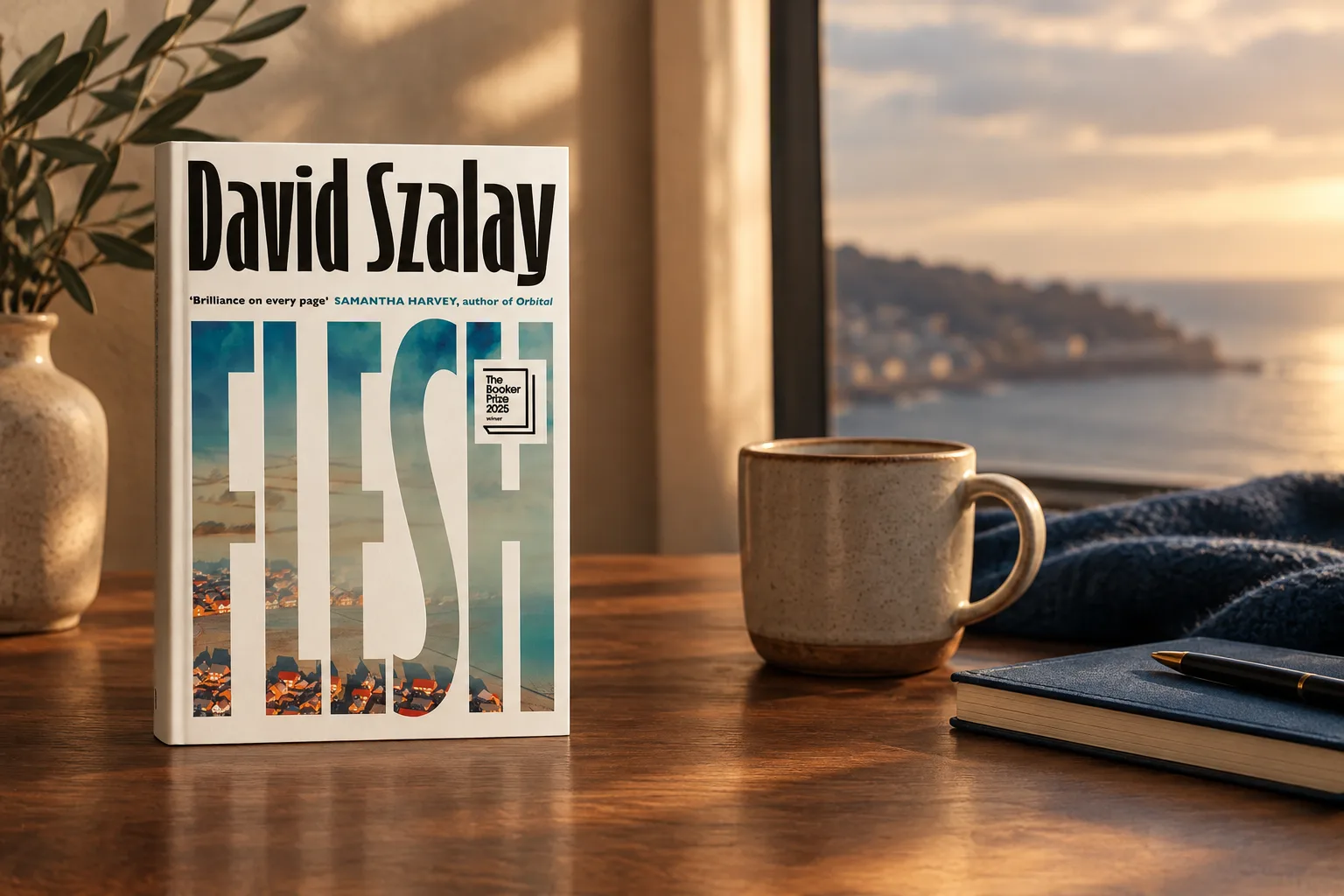
David Szalay builds a life story out of silences, bodily experience, and the years a conventional novel might explain. Flesh asks whether a person can be understood through the forces that move him when he cannot—or will not—name what he wants.
A formally bold life story; spare prose and temporal gaps make silence, class, and bodily experience part of the novel’s meaning.
Many novels explain a life from the inside: a remembered wound, a private ambition, a decision that changes everything. David Szalay’s Flesh takes a riskier route. Its protagonist, István, is often difficult to read even as the novel follows him across decades and social worlds. The book asks us to infer a self from what a body endures, what other people want from it, and what remains unsaid. That restraint gives Flesh its unusual force, though it also makes emotional access a deliberate challenge.
István first appears as a shy teenager living with his mother in Hungary. An adult neighbor draws him into a relationship whose imbalance and secrecy leave lasting consequences. The novel does not turn this beginning into a neat origin story that explains everything afterward. Instead, it treats early experience as one current among many: consequential, but not a complete map of character. The distinction matters. Flesh is interested in how a life is shaped by events, including events a person cannot properly interpret at the time, without claiming that one early wound accounts for every later choice.
Szalay organizes the book through broad jumps in time. The reader encounters István at significant intervals as his circumstances shift from Hungary to military service and then to London, where he works as a doorman before entering the world of considerable wealth. Each stretch has the compressed feel of a self-contained story, yet the gaps between them carry much of the narrative. Szalay has described the book as a story collection concealed inside a novel, with some of István’s agency taking place between chapters. The form makes the reader do consequential work: a new social position arrives before its full history does, and we must consider what has changed without receiving a complete transcript of how it happened.
That method is reflected in the prose. Dialogue is spare, and István often answers with little more than an acknowledgment. The effect can be comic, frustrating, and finally unsettling. His silences do not grant automatic access to some deeper, more authentic truth; they leave room for other people to project their own meanings onto him. The Booker judges drew attention to the novel’s use of white space, where absence itself becomes expressive. Readers may find themselves assembling a character from gestures, reactions, and the accounts other people give of him. This is a form of participation, but also a test of patience.
The title points toward the novel’s most persistent subject: the body as the place where history becomes immediate. István’s experiences of sex, labor, violence, money, and aging are not abstract themes laid over a psychological portrait. They are conditions he lives through, sometimes with little language for them. Szalay has said he wanted to write about life as a physical experience. The book’s attention to embodiment helps explain why its muted style can still feel propulsive: vulnerability and appetite create movement even when the protagonist cannot describe a clear plan.
Flesh also charts a change in class position without treating wealth as a simple reward for effort. István moves from a modest Hungarian housing estate into the orbit of London’s super-rich, but the novel’s account of that ascent is tied to chance, migration, and the demands of other people. Money changes the rooms he can enter and the way he is viewed; it does not necessarily give him a language for his own desires. This tension makes the book’s treatment of masculinity more interesting than a diagnosis of one man’s emotional reserve. The question is not only what István feels, but what kinds of feeling his circumstances allow him to recognize or express.
The novel’s scale can be disorienting by design. A major event may be followed by a leap forward rather than by a long scene of explanation or recovery. That compression resists the comforting idea that suffering automatically produces insight, and it refuses to make every transition a triumph of will. But the same strategy can leave readers uncertain about the causal texture of István’s life. If interiority stays largely out of reach, a reader may wonder whether his passivity is a chosen artistic lens, a consequence of social pressure, or both. The book does not settle that uncertainty, and its ambiguity is more productive for some readers than for others.
This is where Flesh’s minimalism succeeds and risks becoming a limitation at once. Its blank intervals encourage attention: a change in circumstance can make the preceding scene look different, and the absence of explanation keeps fate and agency in uneasy conversation. Yet withholding can also thin out the relationships around István, especially if a reader wants the people who affect him to possess as much presence as the forces they represent. The novel’s emotional power depends on small encounters accumulating rather than on a fully articulated inner life. That is a precise wager, not a universally welcoming one.
The Booker Prize panel called the novel singular, and the description fits its formal confidence. Flesh does not make silence a puzzle with one correct solution. It uses silence to ask what a novel can know about someone who does not narrate himself. By the time István has crossed borders and class lines, the reader has seen how much can happen without a clean story of self-invention. The result is a spare, searching portrait of a life that is neither wholly chosen nor merely imposed. Readers drawn to formally adventurous fiction, questions of masculinity and class, and characters understood through omission will find much to think about. Those who need close access to a protagonist’s thoughts may find the same restraint distancing.
EDITOR’S VERDICT
Tale24’s assessment
A formally bold life story; spare prose and temporal gaps make silence, class, and bodily experience part of the novel’s meaning.
Points to considerIstván’s limited interiority can make emotional connection difficult, while the large time jumps sometimes leave relationships and causality deliberately unresolved.
Best for: Readers of formally adventurous literary fiction interested in masculinity, class, migration, and the limits of self-knowledge.
Editorial method: This is an independent assessment informed by the work and its official supporting information. AI tools may assist the drafting process; Tale24 reviews and takes responsibility for everything it publishes.