Psychology & Skills · TALE24 REVIEW
Refactoring: changing code structure while protecting system behavior
The value of refactoring lies in the series of small steps, quick feedback, and the ability to reverse when assumptions are wrong.
Step-by-step approach, testing, and clear vocabulary
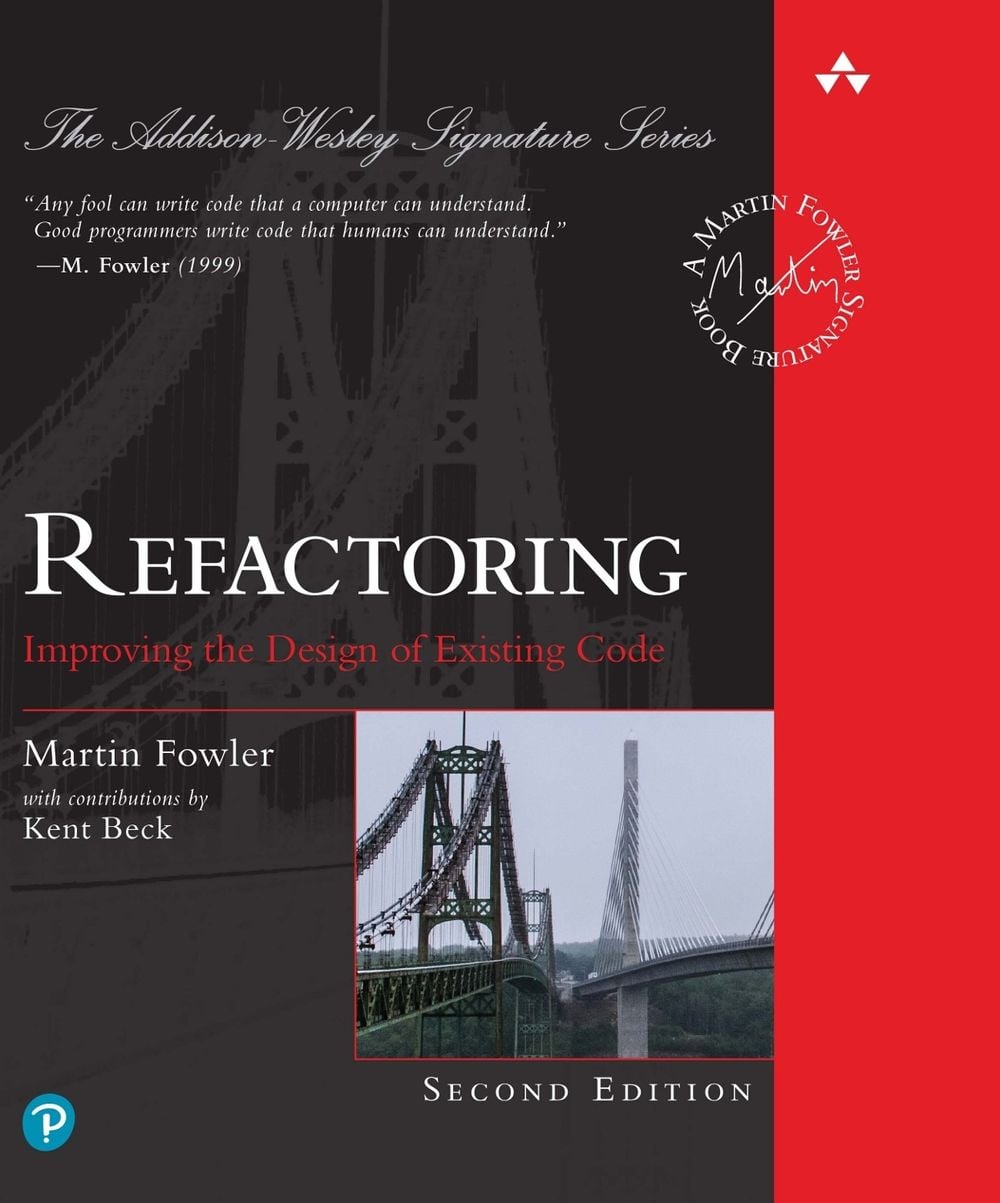
Refactoring is often used as a polite word for rewriting a section of code. Martin Fowler's book gives it a narrower and more demanding meaning: change the internal structure while preserving observable behavior. That constraint changes the pace of work. Instead of waiting for a large redesign to be ready, an engineer makes a small transformation, checks the result, and repeats. The second edition uses JavaScript examples, but its central lesson is about disciplined feedback, not loyalty to a language or a catalog of named moves.
Why change code that already works? The answer is usually that its current shape makes the next change expensive. A customer-facing rule may be spread across several conditionals, a field may have different meanings in different places, or one function may mix calculation with storage and presentation. None of these problems necessarily breaks today's behavior. They make tomorrow's change harder to reason about. Fowler's framing is useful because it asks for a concrete purpose: what future modification becomes easier when this structure improves? Beauty alone is too weak a reason to spend time on a risky system.
Imagine a pricing function that applies discounts, tax, and delivery charges. A request arrives to introduce a regional exemption. A risky response is to rewrite the entire calculation and hope existing examples still pass. A refactoring approach first records current behavior in tests, then isolates the tax decision without changing its result. Only after the new boundary is understood does the team add the exemption. This is an illustrative workflow, not an example claimed from the book. It shows why the sequence matters: separating structural change from a new feature makes it easier to identify which step caused a failure.
Tests are necessary, but the book should not be read as a promise that tests eliminate risk. A suite can miss behavior, especially at database, time, concurrency, or third-party boundaries. An engineer may preserve a return value while changing performance, logging, or a side effect that users depend on. The practical discipline is to decide what counts as observable behavior in the context, run checks frequently, and keep each step small enough to reverse. For a critical payment path, that might include contract tests, traces, and a cautious rollout. For a small pure function, unit tests may be enough.
The catalog of transformations is useful because it turns a vague desire for cleaner code into a sequence of specific moves. Extracting a function, moving a field, or replacing a conditional with a clearer model can all help, but none is automatically correct. Every move trades one kind of simplicity for another. Extracting can reveal a business concept, or it can scatter the flow. Moving responsibility can reduce duplication, or it can create a new dependency. Fowler's stronger contribution is the habit of examining the change in place, asking whether the resulting code communicates the domain more clearly than it did before.
The second edition's JavaScript examples lower the barrier for many contemporary developers, while also exposing the need to translate the method. A typed language may make some moves easier to validate; a dynamic language may require more explicit tests; a functional codebase may express a boundary through data flow rather than object methods. The principles still transfer, but the exact mechanics do not always. Readers should study the reason a move is made, then use the idioms and tooling of their own codebase. Copying a pattern without its purpose can produce a more uniform program that is no easier to change.
One of the book's most useful ideas is that refactoring belongs near ordinary feature work. When a change request reveals a confusing area, a small improvement can prepare the code for the new behavior. This avoids the false choice between endless cleanup projects and never improving anything. The decision still needs restraint. A team facing an urgent incident should stabilize the service before reshaping unrelated modules. A rarely touched component may not justify a broad cleanup. The right scope is often the smallest change that makes a current requirement safer and leaves a clearer path for the next one.
There is an organizational side that a catalog cannot solve. Small safe steps require a build that runs quickly, tests that are trusted, code review that can follow the intent, and a release process that does not turn every change into an event. Without those conditions, even a disciplined engineer may have to batch too much work before receiving feedback. Teams can use the book to diagnose this environment as well as the code. If refactoring always feels dangerous, the missing capability may be a reliable test seam or shorter release cycle rather than more knowledge of transformations.
Fowler's method is also a guard against grand architectural claims. A sweeping proposal may sound persuasive on a diagram while hiding migration costs and unknown contracts. Small structure-preserving changes let a team learn about the system as it moves. That does not mean every redesign can be achieved through a series of tiny refactorings; sometimes requirements genuinely change and a new design is needed. The distinction matters because the risks and review criteria differ. Readers should name which kind of work they are doing, especially when both occur in the same project.
Refactoring is most valuable for developers who have felt the drag of a system that works but resists change. Read it with a real piece of code and a real future requirement in mind. The goal is not to memorize the names of every transformation. It is to develop a rhythm of observing a problem, protecting behavior, making one understandable move, and checking the result. That rhythm makes improvement part of engineering practice while keeping the team's claims about safety honest.
EDITOR’S VERDICT
Tale24’s assessment
Step-by-step approach, testing, and clear vocabulary
Points to considerNeed actual codebase to understand when it should or shouldn't be applied
Best for: Developer regularly maintains and expands the system for many years
Editorial method: This is an independent assessment informed by the work and its official supporting information. AI tools may assist the drafting process; Tale24 reviews and takes responsibility for everything it publishes.
KEEP READING