Literature & Thought · TALE24 REVIEW
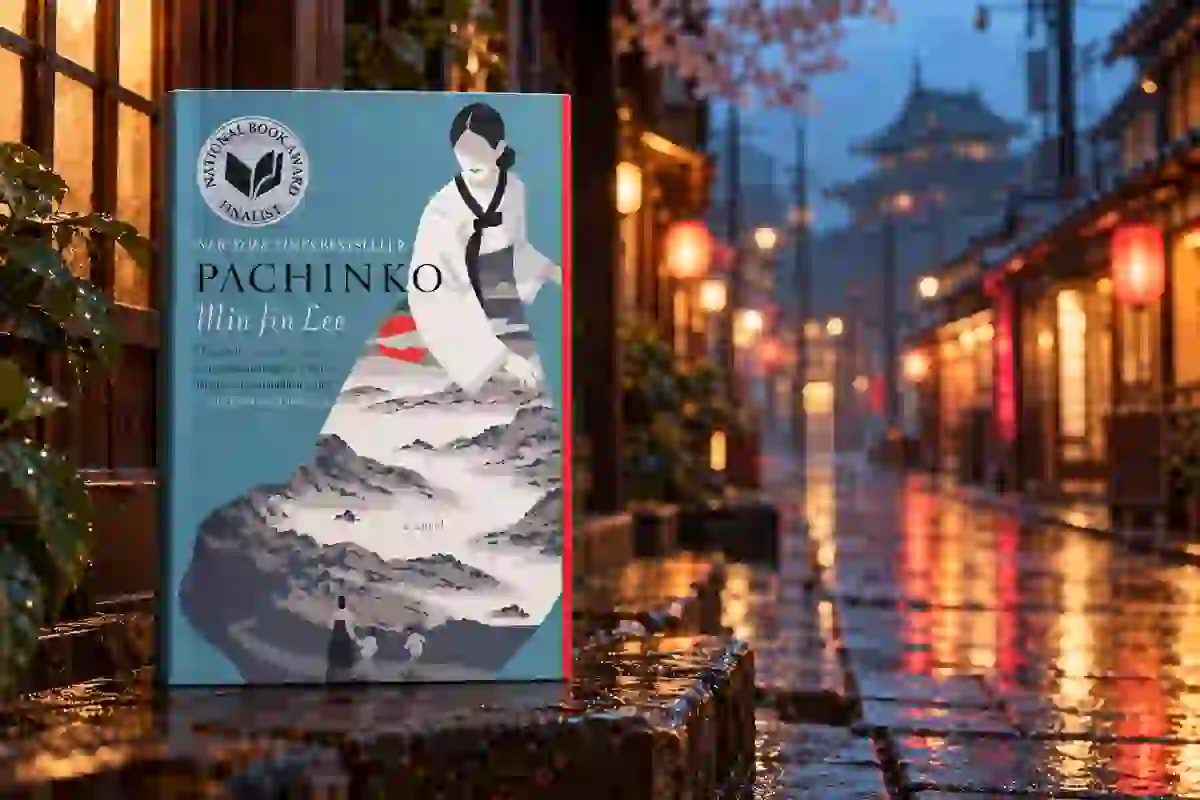
Pachinko by Min Jin Lee: A Family Saga About Belonging
This review of Min Jin Lee's Pachinko examines how four generations of a Korean family in Japan face colonialism, migration, labor, and exclusion. Its sweeping history is most persuasive in the ordinary choices that make survival possible.
Epic in scope yet firmly rooted in everyday life; layered characters; history, labor, and identity are woven together naturally.
A pachinko machine runs on probability, yet it gives the player the sensation of guiding the ball. That image is the most useful key to Min Jin Lee's novel. The characters in Pachinko choose, love, work, and sacrifice, but they make those choices on a board already tilted by colonial rule, war, poverty, gender, and ethnic discrimination. The novel does not claim that people are powerless. It asks a harder question: what does dignity look like when the game has never been fair?
For readers deciding whether to start Pachinko, its scale matters. The novel is a multigenerational family story rather than a single hero's rise through adversity. Its early choices echo across decades, and the historical setting is never detached from money, work, and belonging. Readers seeking a fast plot may find the shifts between generations demanding; readers interested in how private lives register public forces will find the breadth purposeful.
The story begins in Yeongdo, near Busan, while the Korean peninsula is under Japanese colonial rule. Sunja, the daughter of a family that runs a boardinghouse, becomes pregnant by Koh Hansu, a wealthy married man. When she learns the truth, she refuses to become his supported mistress. Isak, a Christian minister, offers to marry her and take her to Osaka. This is not a romantic rescue. It opens into decades of life in poor neighborhoods where Koreans do punishing work, face restricted opportunities, and often change their names to soften the contempt directed at them.
Pachinko's greatest achievement is its ability to turn history into pressure on ordinary life. Colonial policy does not remain in textbooks; it appears in who can rent a house, who may enter a university, and which name makes an employer reject an application. War is not simply a map changing color; it becomes the price of rice, news of the missing, and a meal stretched among too many people. Lee shows how history usually enters a family through unremarkable doors: employment, marriage, documents, and rumor.
Sunja is the novel's moral center, but she is not fashioned into a perfect emblem of endurance. She possesses fierce self-respect, and she also keeps silences that carry consequences. She makes kimchi, trades food, raises children, and keeps the family moving through labor that rarely appears in heroic chronicles. Care is not a soft background to the history of men here. It is the infrastructure of survival. Small coins, cooking pots, and exhausting working hours are the places where resilience is made.
Koh Hansu prevents the novel from dividing goodness and evil too neatly. He can protect Sunja and her children with money and connections, yet his protection always brings control. He understands the architecture of power better than almost anyone and learns to win within it instead of trying to change it. His attachment is real, but affection cannot erase the imbalance between the person free to leave and those forced to live with the consequences.
Sunja's sons, Noa and Mozasu, embody two responses to Zainichi Korean identity. Noa pursues education, flawless Japanese, and a personal history that conceals his origins. Mozasu enters the pachinko business, an industry capable of producing wealth but burdened with social contempt. One tries to earn acceptance by becoming beyond reproach; the other accepts that respectable doors may never open and builds a life at the margins. The novel does not declare either path correct. It shows that assimilation and resistance both exact a severe psychological price.
The book is especially perceptive about names. Korean names, Japanese names, names on documents, and names used at work are not mere labels. They determine whom other people think they see before a character has spoken. Concealing one's background can provide safety, but that safety is inseparable from the fear of discovery. Identity in Pachinko is therefore not a simple slogan of pride. It is a negotiation among truth, livelihood, and the right to live without explaining oneself every day.
Lee's storytelling is expansive, lucid, and deliberately classical. She crosses decades in a handful of pages while retaining the material details that keep the novel from turning into a history lecture. The cost of that scale is that some promising secondary characters recede too quickly. At times the reader wants to remain with a particular grief, but the story has already moved to the next generation. This is both a limitation and part of the design: one life may feel immense to the person living it while becoming only one link in a family's memory.
The novel also deserves to be read outside the frame of its television adaptation. A screen can emphasize romance, costume, and dramatic reversals; the book devotes more space to labor, religion, shame, and small compromises. Accumulation is Pachinko's method. No single event explains a destiny. A life takes shape through hundreds of constrained decisions.
Religion adds another layer to that accumulation. Isak's faith offers sanctuary, discipline, and a language of sacrifice, but it never operates outside politics. Christian community can sustain people whom the state excludes, while religious conviction can also ask families to absorb terrible personal costs. Lee treats belief much as she treats work: not as an abstract doctrine, but as something tested by hunger, danger, and obligation. The same is true of money. Economic security may protect a family from immediate suffering without buying social acceptance or freedom from shame. Prosperity changes the available choices, but it does not level the board.
This is why the title works as more than a symbol of chance. Pachinko is also an industry built in the space between formal exclusion and practical necessity. It offers employment and mobility to people shut out elsewhere, then marks them as disreputable for entering it. The contradiction exposes how a society can manufacture marginality and later blame marginalized people for the means by which they survive. Lee's characters are never reducible to that mechanism, but the mechanism is always present, shaping what success can look like and how much of oneself it may require.
Publishers Weekly makes a useful distinction about Pachinko: its historical reach is large, while individual scenes can be spare. That combination helps explain why an epic can feel intimate without offering continuous psychological explanation. Moving between generations lets readers see consequences that a character cannot yet recognize; restraint within a scene preserves the uncertainty of living through them. The critical test is whether that distance enlarges a person's life or turns it into an illustration of history. Lee's emphasis on work and household survival gives readers concrete ways to ask that question. Rather than treating endurance as an inherited virtue, we can examine who pays for another family member's education, freedom, or respectability. Belonging then emerges as a relationship with material costs, not simply a feeling attached to a homeland.
What remains after nearly five hundred pages is not a promise that hard work inevitably wins. Many characters work relentlessly and are still refused. Lee grants them a different victory: the chance to be seen in full, not merely as victims of history or illustrations of resilience. Pachinko reminds us that people denied the power to write history still inhabit it through their bodies, work, and memory. When fiction records those lives patiently, storytelling itself becomes an act of restoring dignity.
EDITOR’S VERDICT
Tale24’s assessment
Epic in scope yet firmly rooted in everyday life; layered characters; history, labor, and identity are woven together naturally.
Points to considerThe broad timeline leaves some secondary characters and major turns less fully developed than they deserve.
Best for: Readers drawn to multigenerational family sagas, East Asian history, migration, and questions of identity
Editorial method: This is Tale24’s original analysis of the published material and attributed criticism. The sources and evidence limits are listed below.
READING AND RESEARCH
Sources and scope
This essay combines the published material and the attributed sources below. It does not claim firsthand reading of the complete book.
- Publishers Weekly: PachinkoIndependent review
Sources checked November 5, 2026.
KEEP READING