Technology & Careers · TALE24 REVIEW
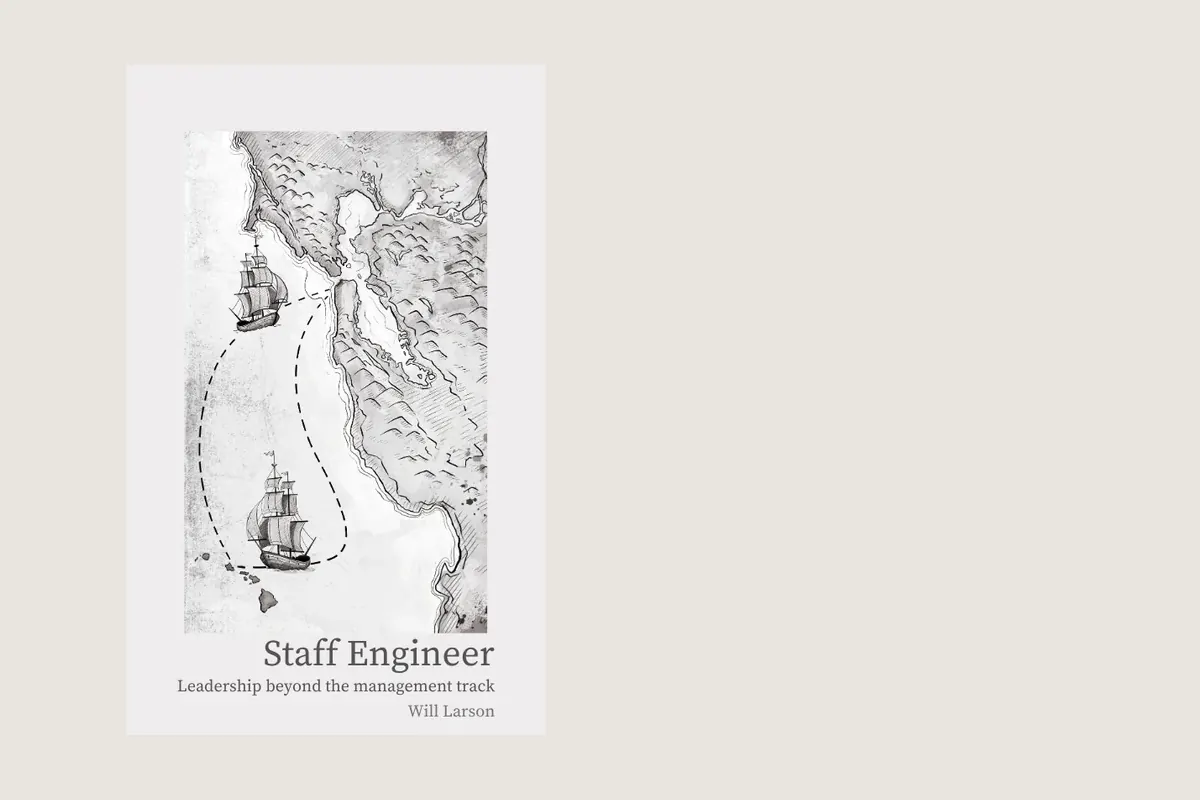
Staff Engineer: A Path to Technical Leadership Beyond Management
Will Larson’s Staff Engineer maps senior technical leadership beyond management through four archetypes, organizational leverage, and the trade-offs of staff-plus work.
Clarifies the many types of technical leadership and the role of organizational influence
The promotion path for software engineers often becomes hazy after the senior level. Management is visible, but the technical leadership route can look like a title without a job description. Will Larson's Staff Engineer addresses that uncertainty by asking what staff-level engineers actually do, how they choose consequential work, and how they operate without formal people-management authority. The book draws on guides and interviews with practitioners. Its value is in replacing a single heroic image of the senior individual contributor with several distinct ways to contribute. Its limitation is that the examples come largely from a particular technology-company environment.
Larson describes four recurring archetypes: Tech Lead, Architect, Solver, and Right Hand. A Tech Lead guides execution for a team or a focused set of teams. An Architect takes responsibility for a critical technical domain. A Solver works deeply on difficult, high-priority problems. A Right Hand extends the reach of a senior leader in a large organization. These are patterns, not a universal ladder. A company may need some and have no useful role for others. The distinction helps a reader ask whether an advertised staff position matches the work they enjoy and the influence the organization will actually grant.
The Tech Lead archetype is perhaps the easiest to recognize, yet it exposes a difficult transition. A strong senior engineer may earn trust by implementing hard features personally. At staff level, the most valuable act may be to align a team, delegate a project, or make a decision legible to several groups. That can feel less tangible than a large pull request. Larson's framing makes the trade-off clearer: individual output matters, but team effectiveness becomes a larger part of the result. A person who keeps solving every important problem alone can become a bottleneck even while producing excellent code.
The Architect archetype is useful because it challenges the stereotype of a distant diagram maker. A domain such as API design or data storage needs someone who understands technical constraints and business needs over time. Authority in that role must be earned through judgment and collaboration. An architect who issues rules without listening to teams may create resistance and poor fit. Conversely, a company that asks an architect to own a domain but gives them no decision path or access to product priorities is setting up the role to fail. The book encourages attention to both the work and the conditions that make it possible.
Solvers and Right Hands expose other limits of one-size-fits-all career advice. A Solver may be most effective when leadership has identified an important problem but no clear route through it. That role can suit someone energized by deep investigation, yet it may leave behind maintenance work for other teams. A Right Hand has broader organizational scope and borrowed authority; it depends on sustained alignment with a leader. That arrangement is unlikely to exist in a small company. Treating these roles as stages every engineer must pass would misread the taxonomy. They are descriptions of organizational needs, not badges of personal worth.
One of the book's strongest themes is work selection. Staff engineers are not simply assigned more tickets. They must identify where their time changes outcomes for other people. That requires understanding company priorities, spotting a technical constraint that blocks them, and choosing an intervention with a plausible path to adoption. Writing a strategy document that no team can execute is not impact. Neither is quietly fixing a local problem while a larger dependency remains unaddressed. The practical question is how to connect technical judgment to an outcome the organization can recognize without reducing every contribution to a short-term metric.
Influence without direct authority makes communication a technical skill. A proposal crosses team boundaries only if people understand the problem, the alternatives, and the costs. Staff engineers need to listen to maintainers and managers, build agreement, and make trade-offs visible. This is not a call to replace engineering with meetings. It is recognition that the effect of an architectural decision depends on whether the teams responsible for the system can use and sustain it. A brilliant design that is ignored or misimplemented has little practical value. The book helps readers see writing, negotiation, and relationship maintenance as part of engineering at this level.
The material on promotion is more useful when read as a way to clarify expectations than as a checklist of achievements. A promotion packet can gather evidence of scope and impact, but it cannot create a role that the company does not need or recognize. A senior engineer should ask what staff-level work looks like in their organization, who evaluates it, and what support exists for doing it. Managers should be equally explicit. Ambiguous criteria often push people into invisible labor that is praised informally but not rewarded. Larson's discussion makes this organizational responsibility hard to ignore.
The author's own site notes that much of the advice reflects Silicon Valley and United States technology companies. That boundary deserves more than a footnote. Smaller firms, public institutions, and teams with different career structures may combine responsibilities that the book separates. Some may have no staff title at all. A reader can still use the archetypes to name the work they perform, but should not assume their employer will adopt the same ladder or compensation model. The interviews provide examples to compare, not a template to impose without local evidence.
Staff Engineer is most helpful to senior engineers deciding whether the individual-contributor route suits them and to managers designing a real technical leadership role. It is less useful as a promise that a promotion will follow from performing a set of behaviors. The more honest conclusion is that senior technical leadership sits at the intersection of skill, organizational need, trust, and recognized impact. Use the book to ask sharper questions about that intersection, choose work that matters, and make the conditions for success explicit before chasing the title.
EDITOR’S VERDICT
Tale24’s assessment
Clarifies the many types of technical leadership and the role of organizational influence
Points to considerThe landscape favors large, fast-growing tech companies
Best for: Senior engineers consider the senior IC or engineering manager path
Editorial method: This is an independent assessment informed by the work and its official supporting information. AI tools may assist the drafting process; Tale24 reviews and takes responsibility for everything it publishes.
KEEP READING