Technology & Careers · TALE24 REVIEW
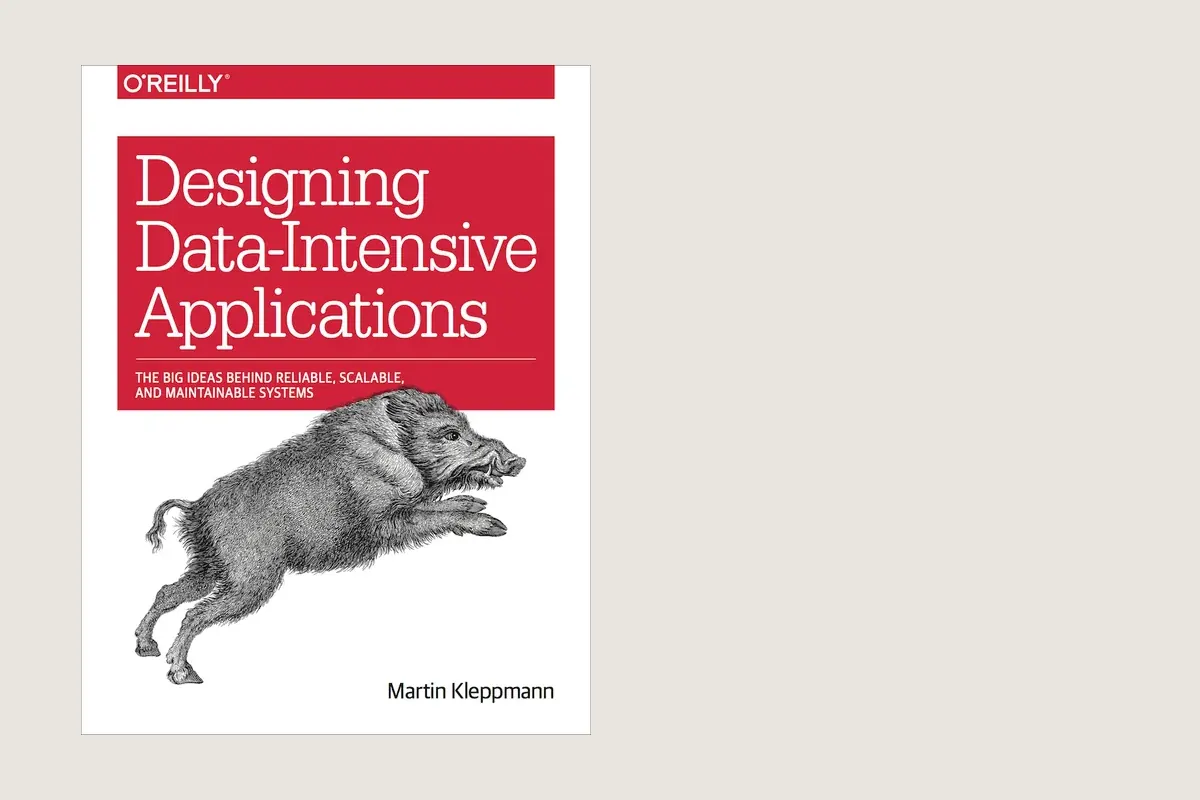
Designing Data-Intensive Applications: Principles Behind Reliable Data Systems
Martin Kleppmann’s Designing Data-Intensive Applications explains replication, partitioning, consensus, and the architectural trade-offs behind modern data systems.
Deep mechanics explanation, fair technology comparison, and focus on architectural trade-offs
A data system is easy to describe by naming its products and much harder to describe by naming the promises it must keep. Martin Kleppmann's Designing Data-Intensive Applications begins with reliability, scalability, and maintainability, then examines the machinery that makes those qualities possible or difficult. The first edition was published in 2017. Its strongest contribution is a set of questions that outlasts any particular database fashion: what happens to a write, what can a reader see, how does the system respond to failure, and what work will operators inherit? That makes the book a map for reasoning, not a shopping guide.
The chapters on data models and query languages show why representation is an architectural choice. A relational model can express relationships and constraints clearly; a document model can keep certain records together and simplify some access paths; graph-oriented approaches address other kinds of connection. The useful question is not which category is modern. It is which operations the product needs to perform, how often the data changes, and what complexity is shifted to the application. A model that makes one screen easy may make cross-record updates or reporting difficult. Kleppmann's comparative approach encourages the reader to state those consequences before choosing a store.
Storage and retrieval add another layer. Indexes make reads faster by requiring space and work on writes. Different structures behave differently under sequential writes, random reads, compaction, and large scans. A benchmark number is therefore meaningful only with a workload: record size, access distribution, update rate, and latency target. An application serving a few predictable queries may benefit from a simple database with well-chosen indexes more than from a complex distributed stack. A fast prototype can also become expensive if its data layout cannot support the access patterns that arrive later. The book's strength is making these costs visible as engineering trade-offs.
Encoding and schema evolution may sound like implementation details until a service changes while another still runs an older version. A stored record, an event in a queue, and a message sent between services can each outlive the code that produced it. A new field or altered meaning can break a reader even when the writer's unit tests pass. The book's discussion of formats and dataflow is valuable because it treats compatibility as a property of a system changing over time. Readers should ask who controls a schema, how long old data remains, and whether a migration can be rolled back. Those questions are often more consequential than the choice between two serialization libraries.
Replication and partitioning are where the book becomes demanding. Copies can improve availability and read capacity, but they raise questions about lag, conflict, and what happens during a network interruption. Partitioning can spread load while creating hot keys or complicating operations that cross partitions. A statement that a system is scalable is incomplete without saying which workload grows and which failure it must tolerate. For an illustrative product, a stale recommendation count might be acceptable for seconds, while a payment balance might not be. The same architecture cannot treat every data item as if it had identical consistency needs.
Transactions provide a way to preserve invariants, but they come with scope and operational limits. When an operation spans systems, an application must decide how partial progress is represented and repaired. A queue does not automatically solve that problem; it changes when and where failure appears. The useful exercise is to follow one record from request to durable storage, then through any copied or derived views. At each step, ask what happens if the process stops. This approach makes the book's many topics less like separate chapters and more like different points on one data journey.
The later chapters on batch and stream processing broaden that journey. A batch job can recompute a view from a stable set of inputs; a stream can update it as events arrive. Both require decisions about ordering, replay, late data, and correctness. A near-real-time dashboard may be valuable, but freshness is not free. It can make error handling and operational support more complex. The book is especially good at showing that derived data must remain tied to a source of truth and a recovery story. A team should know whether it can rebuild a view, how long that takes, and what users see while it is stale.
The first edition's breadth is also its obstacle. A reader new to databases may meet too many concepts at once, while an expert in one area may want more depth than a single chapter can provide. Some named tools and industry preferences have changed since 2017. That does not erase the conceptual value, but it means implementation choices should be checked against current documentation and the team's own measurements. The best reading plan is to pair each section with a real system diagram and a small set of requirements. Without that anchor, the book can become an impressive collection of terms rather than a decision aid.
A practical notebook for this book has five columns: user-visible requirement, expected load, acceptable staleness or data loss, failure recovery, and operating cost. Fill it before comparing technologies. If the team cannot state those requirements, it cannot honestly claim that a distributed option is necessary. If it can, the book offers a vocabulary for testing whether an option meets them. The important outcome is not to favor a single database or processing style. It is to make assumptions explicit enough that another engineer can challenge them and an operator can live with their consequences.
Designing Data-Intensive Applications is a demanding but durable guide for backend and data engineers who are ready to reason across storage, communication, and operations. Its value lies in slowing a technology decision at exactly the point when enthusiasm is most tempting. Read it to ask better questions about reliability and change, then validate the answers in the context of the actual product. A system is well designed when its data guarantees, limits, and recovery behavior are understood by the people who must build and run it, not when its architecture contains the newest set of components.
EDITOR’S VERDICT
Tale24’s assessment
Deep mechanics explanation, fair technology comparison, and focus on architectural trade-offs
Points to considerHigh density of knowledge, requires backend foundation and practice time to absorb
Best for: Backend engineer, data engineer, architect and distributed system operations engineer
Editorial method: This is an independent assessment informed by the work and its official supporting information. AI tools may assist the drafting process; Tale24 reviews and takes responsibility for everything it publishes.
KEEP READING