Literature & Thought · TALE24 REVIEW
The Dispossessed: A Utopia That Refuses to Declare Victory
Ursula K. Le Guin tests political ideals against the institutions and habits that grow around them, using two societies to make comparison itself an ethical practice.
Intellectually ambitious world-building, a rigorous political imagination, and a structure that keeps every social order open to criticism.
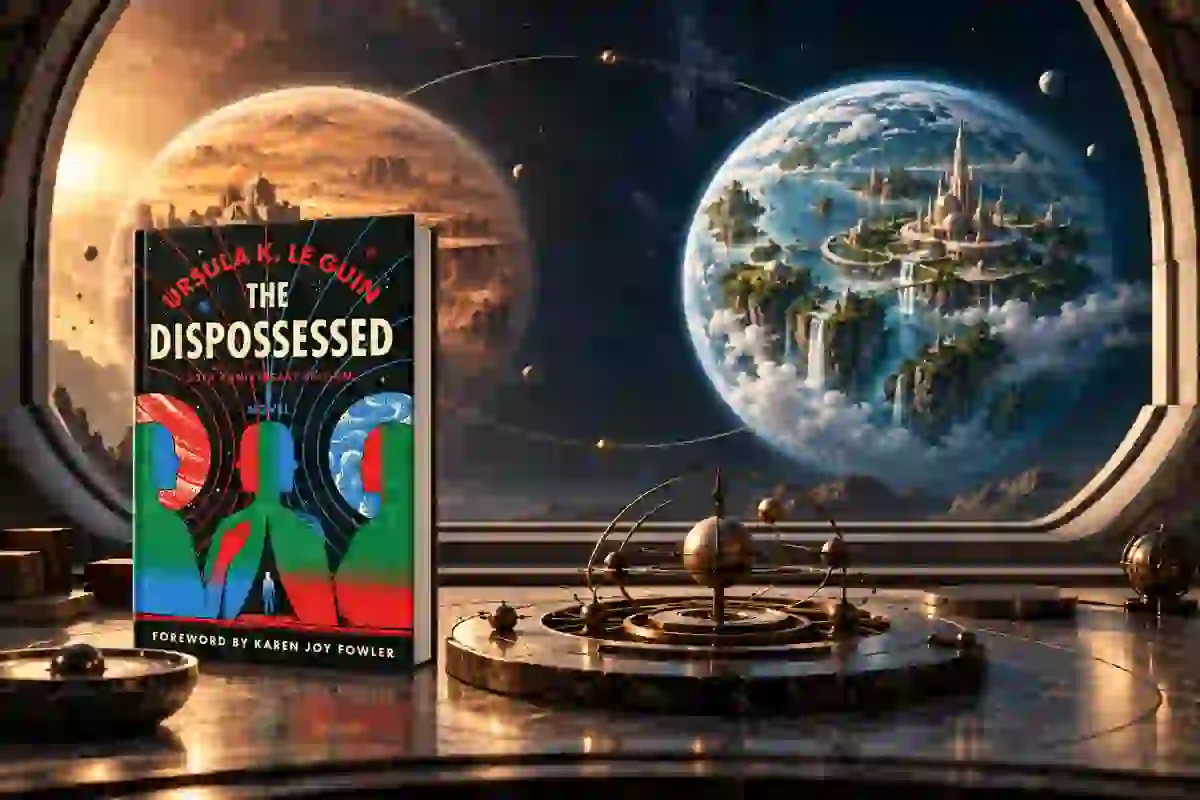
"The Dispossessed" by Ursula K. Le Guin is a seminal work of science fiction that delves deeply into the nature of political ideals and their practical implementations. Set on the moon Anarres and the planet Urras, the novel centers around the physicist Shevek, who travels between these worlds to explore a theory of time and promote freer intellectual exchange. Le Guin's research into pacifist anarchist writers and philosophies of time informs the novel's vision, creating a complex tapestry of political and social systems.
Le Guin's innovative structure, which alternates between the perspectives of Shevek on Anarres and his encounters with a wealthy and oppressive society on Urras, is both a strength and a challenge. The alternating viewpoints allow for a nuanced exploration of the consequences of different political systems, but it can also create a sense of emotional distance, as the reader is pulled between the stark contrasts of the two worlds. This form not only tests the reader's ability to empathize with characters from vastly different backgrounds but also underscores Le Guin's intellectual ambition in examining the practical realities of political ideals.
The Dispossessed by Ursula K. Le Guin is a seminal work in science fiction that delves into the complexities of political and social systems through the eyes of its protagonist, physicist Shevek. Le Guin's novel, first published in 1974, is a masterful exploration of what happens when an individual's pursuit of knowledge and truth is placed against the backdrop of different political ideologies. Through the alternating perspectives of Anarres and Urras, Le Guin presents a nuanced critique of both utopian and dystopian societies, inviting readers to ponder the nature of freedom and power.
Le Guin's methodical approach to storytelling is both a strength and a challenge. Her alternating structure, which shifts between the anarchist moon Anarres and the capitalist planet Urras, allows her to conduct a comparative analysis of the two societies. This method ensures that the reader is not simply presented with two opposing views but is encouraged to engage critically with the nuances and contradictions inherent in each system. The emotional distance created by this deliberate argumentative form can sometimes feel isolating, forcing readers to confront uncomfortable truths about the human condition. However, it also provides a powerful tool for self-reflection and critical thinking, prompting readers to question their own assumptions and beliefs.
Ultimately, The Dispossessed is a profound exploration of the human spirit's capacity for both rebellion and conformity. It challenges readers to consider what kind of society they want to live in and what kind of person they want to be. Through Shevek's journey, Le Guin invites us to imagine a world where the pursuit of knowledge and truth is not hindered by political ideology, and where individuals are free to shape their own destinies.
"The Dispossessed" by Ursula K. Le Guin is a seminal work that delves into the complexities of political and social structures through the lens of its alternate universe. Set on the moon Anarres and the planet Urras, the novel challenges readers to consider the nature of freedom, equality, and governance. Le Guin's research into pacifist anarchist thought and theories of time underpins the novel's exploration of a society where intellectual exchange is valued above all else. The alternating perspectives of the moon's inhabitants and the planet's ruling class expose the flaws and limitations of both systems, ultimately suggesting that true freedom lies not in the absence of hierarchy but in the ability to transcend it. This intellectual rigor and the novel's deliberate exploration of political ideals make "The Dispossessed" a groundbreaking work that continues to resonate with readers and scholars alike.
The Dispossessed, Ursula K. Le Guin's seminal work from 1974, stands as a profound exploration of political ideals and the human spirit through its innovative structure and compelling characters. Le Guin's vision of Anarres and Urras serves as a microcosm of larger societal dynamics, with the anarchist moon and the capitalist planet embodying contrasting forms of governance and consciousness. Shevek's journey across these worlds not only advances a complex theory of time but also serves as a bridge between the two societies, highlighting the challenges and possibilities of human cooperation and transformation.
However, the novel's deliberate argumentative form can sometimes create a sense of emotional distance, as the narrative's intellectual rigor may overshadow its emotional resonance. This approach may alienate readers seeking a more immediate, visceral engagement with the story's themes. Yet, for those willing to engage with the text on its intellectual terms, The Dispossessed offers a rich tapestry of ideas and characters that continue to resonate with readers decades after its initial publication. Its exploration of political ideals and the human condition remains as relevant and thought-provoking as ever, making it a cornerstone of science fiction literature.
The Dispossessed, Ursula K. Le Guin's seminal Hainish novel first published in 1974 with the subtitle "An Ambiguous Utopia," stands as a profound exploration of political ideals and their consequences. Through its ingenious alternating structure, Le Guin invites readers to compare the contrasting societies of the anarchist moon Anarres and the capitalist planet Urras, using this comparison as a method of moral inquiry. The novel's intellectual ambition is evident in its detailed world-building and complex characters, while the emotional distance created by its deliberate, argumentative form allows for a critical examination of the costs and benefits of different political systems. Le Guin's research into pacifist anarchist writers and philosophies of time adds layers of depth, making The Dispossessed not just a critique of political ideals but a rich tapestry of ideas that continue to resonate with readers today.
EDITOR’S VERDICT
Tale24’s assessment
Intellectually ambitious world-building, a rigorous political imagination, and a structure that keeps every social order open to criticism.
Points to considerIts argumentative density and emotional reserve demand patience, while some secondary figures mainly serve the philosophical design.
Best for: Readers of political fiction, social science fiction, anarchist thought, and philosophically demanding novels.
Editorial method: This is an independent assessment informed by the work and its official supporting information. AI tools may assist the drafting process; Tale24 reviews and takes responsibility for everything it publishes.