Literature & Thought · CRITICAL ESSAY
Black Bag: What Happens When a Person Becomes a Prop?
Luke Kennard's Black Bag turns an actor's anonymous university job into a contest over identity, labor, and online visibility. Publishers Weekly's account and Kennard's Booker interview ground this essay's argument about who profits from self-erasure.
An absurd comic hook that opens serious questions about work and visibility
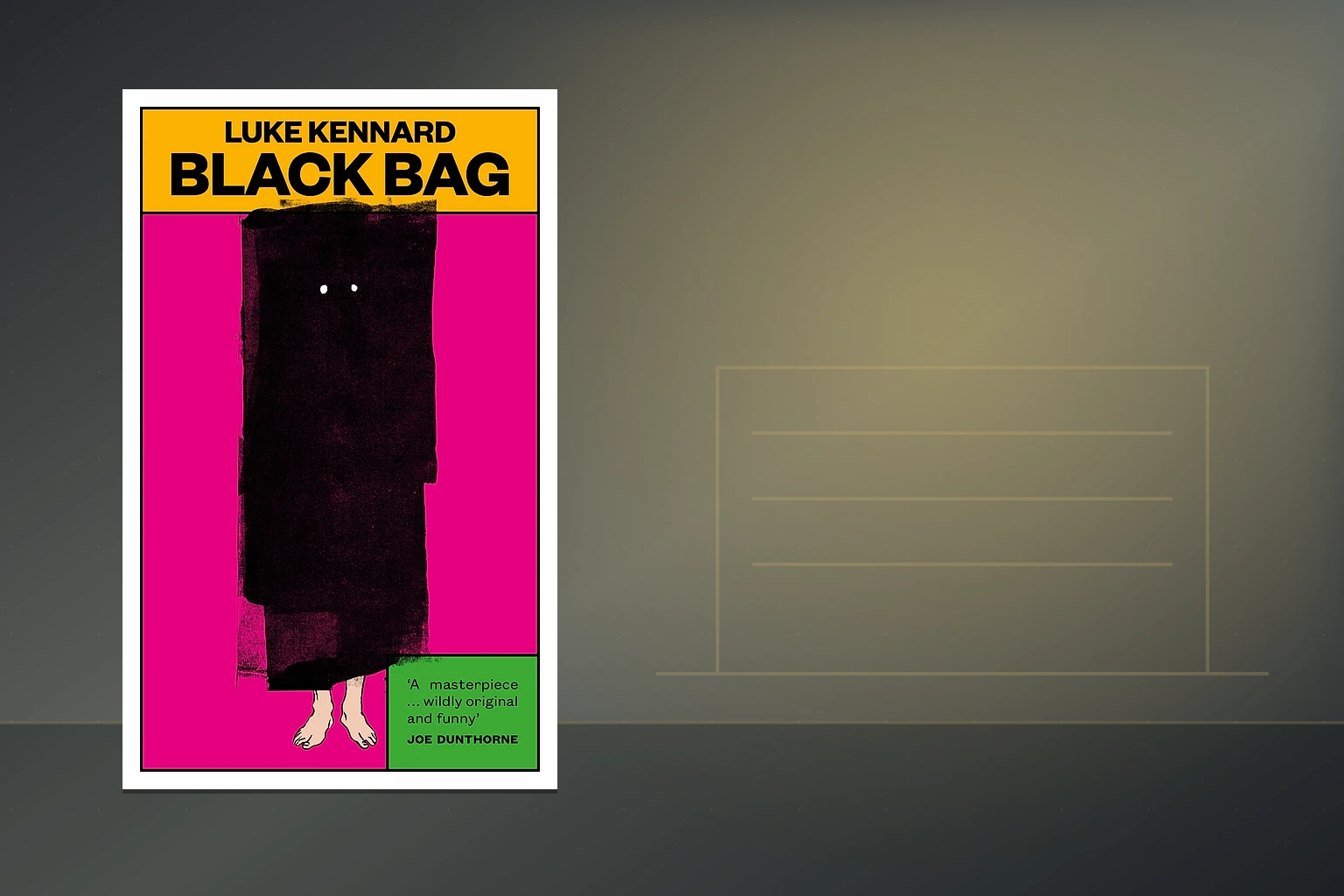
An actor normally wants to be noticed. In Luke Kennard's Black Bag, an out-of-work performer accepts a job that pays him to disappear inside an oversized bag at the back of university lectures. Professor Dr Blend has arranged a psychological experiment; the students become an audience for a person whose face and gestures they cannot see. The setup is funny because it treats an absurd object as a legitimate academic event. It is also unsettling. Once the actor has been turned into an anonymous presence, everyone around him can decide what that presence means.
Kennard tells the Booker that the performer interested him more than the results of the experiment that inspired the novel. His description of artistic work under economic pressure makes the bag legible as a job before it becomes a symbol. The man has time and a body to rent, even when the market has little use for his practiced talents. That gives the comedy a pressure a free-floating thought experiment would lack. Readers can ask whether the absurd role releases him from professional expectations or simply creates another employer's demand. The answer need not be consistent from scene to scene for the situation to remain revealing.
The classroom setting gives the experiment a particular kind of authority. Students are invited to react, while a professor controls the frame in which their reactions count. An audience might treat the hidden actor as a problem to solve or a surface onto which to project its own fears. The important fact is the asymmetry built into the arrangement. The students may study the bag; the person inside must live with being studied. That difference persists even when the premise is played for laughs.
Black Bag also tests what a performer is when performance loses its usual signs. No expression or costume detail can tell the audience how to read the actor. Yet the job is still theater in one sense: his presence changes the room and invites interpretation. The hidden body becomes more visible as a concept than the man might have been as himself. This paradox makes the novel's apparent silliness productive. It asks whether anonymity can protect a person, or whether it simply gives others greater freedom to define him without his participation.
The premise widens when a professor of post-humanism becomes interested in whether someone can love the person inside the bag. That is an odd romantic question, but it carries a serious ethical one. To love a stranger who cannot fully present himself might mean looking beyond conventional markers of attractiveness and status. It might also mean falling in love with an idea while ignoring the person who is required to sustain it. Kennard's setup allows both possibilities to remain uncomfortable. A thoughtful reader need not assume the experiment produces an inspiring lesson about unconditional love.
Publishers Weekly supplies a concrete form for the roommate's commercial enthusiasm: Claudio develops Bag Coin NFTs and lets followers track the actor's movements. The detail changes the satire's scale. An experiment organized around being unseen becomes a product organized around being continuously followed. The actor's silence does not protect him from interpretation; it makes his image available for a business others can describe on his behalf. This also connects the campus and online plots without pretending that academic inquiry and an influencer's scheme are identical. Both establish a frame around the performer, but they offer different explanations of who benefits. The question is less whether anonymity is good or bad than whether the person inside it retains any ability to define the terms of his participation.
The Booker judges have described Black Bag as satire about anonymity, online schemes, masculinity, and love. These subjects could be forced together into a thesis about modern life. Kennard's stranger achievement, at least as the premise suggests, is to let an absurd device hold them in one room. A man unable to secure conventional artistic work accepts a role that erases his artistic identity. Other people then find research, romance, or profit in that erasure. The situation exposes a familiar contradiction: culture celebrates individual expression while rewarding forms of visibility that individuals do not fully control.
Masculinity enters this contradiction through the actor's uncertainty about work and self-worth. Kennard has linked the book to the shame that can accompany precarious artistic life. The bag literalizes a wish to hide, but hiding does not end the demand to be useful or impressive. A comic novel can speak to that pressure without turning its central figure into a diagnosis of every contemporary man. The specificity of an unemployed actor matters. His training has taught him to offer his body and voice to an audience; this new role asks for his body while denying him most of the tools through which he might shape what the audience sees.
The same premise carries a risk for readers. If the satire relies too heavily on its initial oddity, the bag could become a one-note joke. If every surrounding character exists only to represent a social trend, the actor could disappear from the book as completely as he does from the classroom. A strong reading should therefore pay attention to tenderness and friendship alongside the cleverness. The judges' praise for the novel's humor and humane quality suggests that it aims to give its people more than a set of arguments to perform, though no prize citation should replace a reader's own judgment.
Shortlisted for the 2026 Booker Prize, Black Bag offers an accessible entry point into a literary satire with a genuinely strange hook. It should appeal to readers who like campus fiction, uncomfortable comedy, and stories about work that ask who benefits from a person's self-erasure. The image of an actor inside a bag is easy to remember. The harder thought is what happens after everyone else starts treating that image as permission to make use of him. Kennard's premise turns that thought into a comic experiment whose consequences reach far beyond the lecture hall.
CRITICAL PERSPECTIVE
Tale24’s assessment
An absurd comic hook that opens serious questions about work and visibility
Points to considerThe surreal premise may not suit readers seeking realistic campus fiction
Best for: Readers of campus satire and fiction about precarious creative work
Editorial method: This is Tale24’s original analysis of the published material and attributed criticism. The sources and evidence limits are listed below.
READING AND RESEARCH
Sources and scope
This essay combines the published material and the attributed sources below. It does not claim firsthand reading of the complete book.
- Publishers Weekly: Black BagIndependent review
- Booker: Luke Kennard interviewAuthor interview
Sources checked November 5, 2026.
KEEP READING