Literature & Thought · TALE24 REVIEW
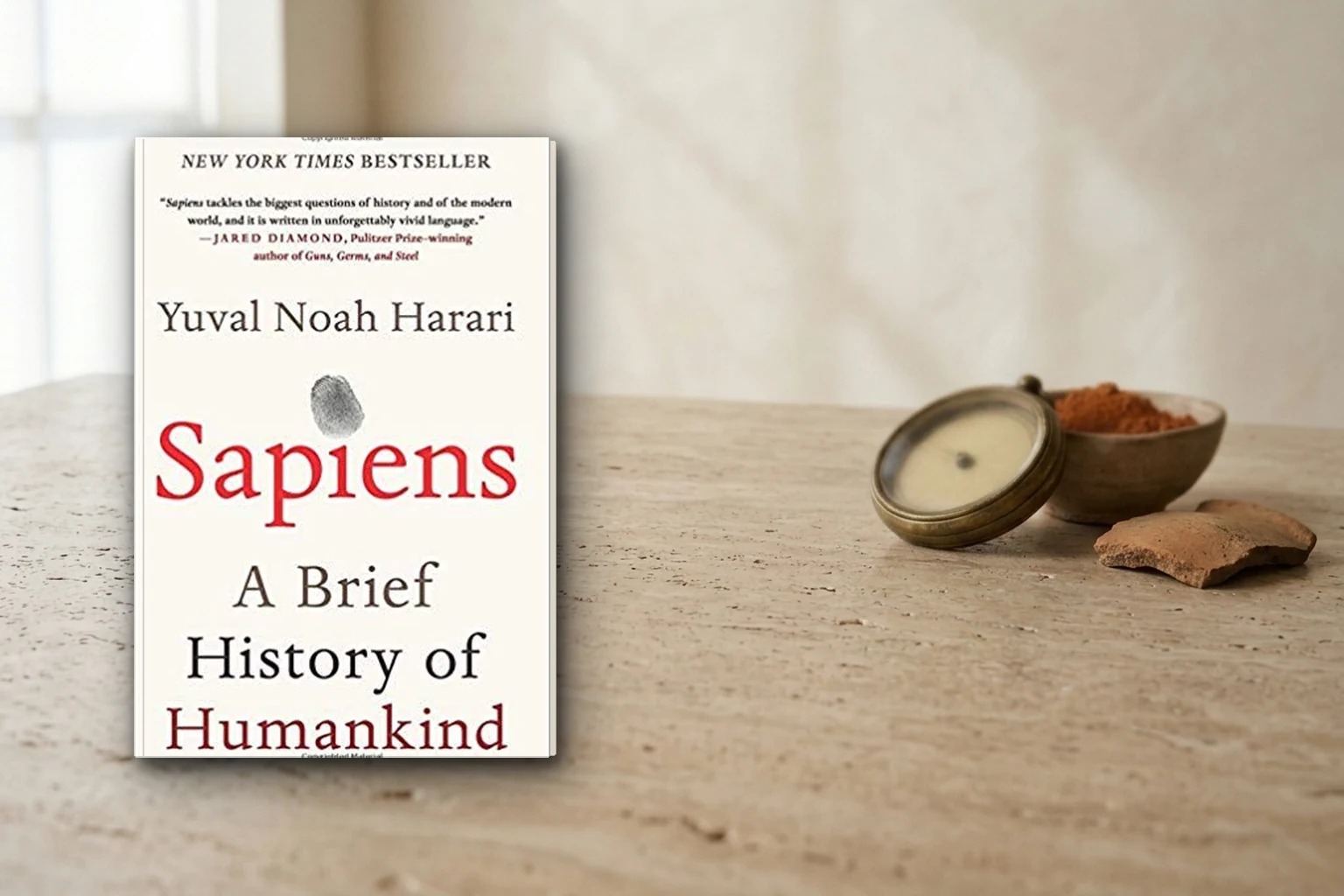
Sapiens: Reading a Sweeping History with a Critical Eye
Assess the narrative power of Sapiens, and show why grand generalizations need to be contrasted with specialized research.
Broad vision, engaging storytelling and asking many big questions about institutions and progress
Sapiens ambitiously recounts the very long journey of Homo sapiens in an easy-to-remember line: the cognitive revolution, the agricultural revolution, the unification of humanity and the scientific revolution. Yuval Noah Harari's greatest success is making giant questions about money, religion, empire and technology accessible to general readers.
The most pervasive idea is the ability to collaborate flexibly around common stories. Companies, countries or currencies exist thanks to networks of collective beliefs, although that does not mean they are fake or do not have material consequences. This interpretation helps readers see institutions as historical products that can change instead of as immutable natural orders.
The book also asks difficult questions about progress. Agriculture increases the total amount of food and the size of the population, but it does not necessarily make life easier for individuals. Technology creates additional capacity but does not automatically answer who that capacity serves. Such paradoxes make Sapiens go beyond a chronology and become an invitation to think about the costs of development.
The downside of the panoramic narrative is its very high level of generalization. Many communities, periods, and scholarly debates are compressed into a few pages to preserve narrative rhythm. When the author moves from synthesis of evidence to philosophical speculation, the boundary is sometimes not marked clearly enough. Readers are more likely to remember a good story than the solidity of the data behind it.
Therefore, Sapiens should be used as a map of questions, not a final encyclopedia. After each curious topic, readers can find in-depth works on archeology, anthropology, economics or regional history. The comparison doesn't detract from the experience; it turns the curiosity the book generates into more lasting understanding.
I like Sapiens because it makes the big questions hard to put down, but I'm wary of that same flow. The fairest reading is to allow yourself to be swept away by Harari's broad vision and then return to mark the areas that need to be examined. The book is a good door; It shouldn't be the only room we stayed in.
The panoramic method is both the book's invitation and its main risk. By moving quickly across biological, cultural, political, and economic history, Harari gives general readers a set of large questions that can connect otherwise separate fields. But a clean narrative can make contested explanations feel more settled than the underlying evidence warrants. Archaeological interpretation, the timing and effects of agricultural change, and claims about human well-being are subjects where methods and evidence matter; a brisk synthesis cannot show every debate in full.
Readers can make the book more useful by pausing at its broadest causal claims. What evidence would support the proposed explanation? Is the claim about all human societies or a particular region and period? Does the argument distinguish a measured observation from a thought experiment? These questions do not require rejecting synthesis. They help show when a memorable framework is orienting the reader and when it is standing in for a more specialized account.
The book's account of shared stories is similarly powerful when read as an analytical proposal rather than a claim that institutions are immaterial. Money, law, and political identities depend on collective recognition, but they also operate through coercive institutions, resource distribution, and material conditions. Keeping those dimensions together prevents the idea from becoming a single explanation for every social fact.
Sapiens is therefore a strong beginning for a reading path, especially when each chapter prompts a narrower follow-up. Pair a sweeping claim with a regional history, an archaeological study, or a specialist account, and note what changes when the scale changes. The result is not a verdict on one popular history book; it is a more durable habit of reading synthesis critically.
A further test for a grand narrative is whether it lets local variation alter the explanation. A broad account can help readers see connections among agriculture, institutions, trade, and belief, yet those processes did not unfold in identical ways everywhere. If a general claim is built from selected examples, the reader should ask how the examples were chosen and whether other cases complicate the pattern. This question is not a demand that a popular book include every region; it is a reminder that its scope determines what its conclusions can support.
The idea of progress also benefits from separating different measures. Population, production, life expectancy, autonomy, security, and subjective well-being do not move together in a simple line. A change can increase output while imposing costs on particular people or species. The book is strongest when it encourages readers to hold such tensions in view. It is weaker if a provocative phrase is repeated as though it settled a debate that depends on definitions and evidence.
Readers may find it useful to keep two columns while reading: the historical claim and the author's interpretation of its significance. A claim about when a practice emerged can be checked against specialist histories; a claim about what that practice means for human happiness is a broader argument that needs its own criteria. Separating the columns helps preserve the book's ability to provoke thought without treating its voice as the last word. The aim is not to turn leisure reading into an examination, but to let curiosity lead toward better-supported and more specific questions.
This method can keep disagreement productive. A reader may reject a chapter's conclusion yet still find that its scale forces a useful comparison across periods. Another reader may value the synthesis but want more regional detail before accepting a general pattern. Both responses can be reasoned if they identify which claim is under discussion and what kind of evidence would change the judgment. That is a better outcome than treating a sweeping history as either definitive truth or worthless speculation.
EDITOR’S VERDICT
Tale24’s assessment
Broad vision, engaging storytelling and asking many big questions about institutions and progress
Points to considerStrong generalizations, sometimes blurring academic debate and regional differences
Best for: Readers are introduced to world history and enjoy interdisciplinary thinking
Editorial method: This is an independent assessment informed by the work and its official supporting information. AI tools may assist the drafting process; Tale24 reviews and takes responsibility for everything it publishes.
KEEP READING