Psychology & Skills · TALE24 REVIEW
The Anatomy of Motive and the Limits of Profiling
John Douglas and Mark Olshaker ask why violent crimes happen. Their broad survey is most useful when motive is treated as an investigative question, not a predictive formula.
A wide range of cases makes the investigative question vivid and invites comparison across different forms of violence.
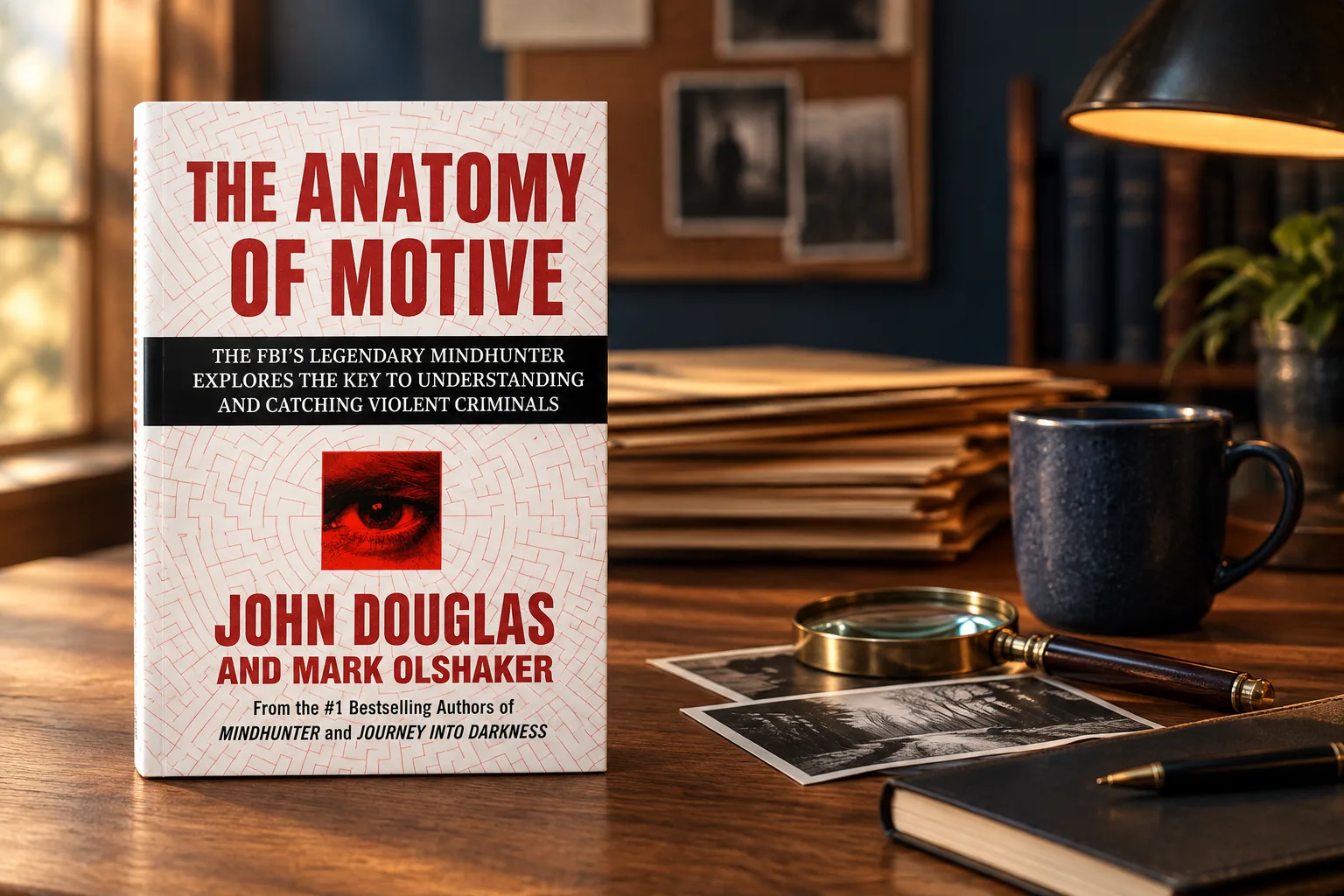
The Anatomy of Motive begins with an attractive promise: if investigators can understand why a violent offender acted, they can better understand what happened and what to look for next. John E. Douglas and Mark Olshaker carry that question across a wide field of crimes, from arson and bombing to assassination and serial murder. The range gives the book its energy. It also raises the question that should accompany every account of criminal profiling: when does a useful investigative hypothesis become a story that sounds more certain than the evidence allows?
Douglas writes from the tradition of the FBI's behavioral work, and Olshaker helps turn that professional perspective into a narrative for general readers. The publisher identifies real cases involving Lee Harvey Oswald, Theodore Kaczynski, and Timothy McVeigh among the book's subjects. These are not interchangeable examples of a single criminal type. They differ in ideology, opportunity, context, and the relationship between offender and victim. The book's central ambition is to find patterns without losing those differences. A reader will gain most from it by treating motive as a question to test in each case, rather than a hidden code that one expert can simply decode.
The distinction matters because motive is often reconstructed after the fact. Investigators can examine a sequence of actions, statements, preparations, and choices. They can ask which explanation fits that material and which does not. But a satisfying account of intention is not itself proof that a future offender will behave the same way. Nor does an apparent similarity between two crime scenes establish the same psychology behind them. Douglas and Olshaker's examples invite comparison; responsible reading also requires attention to the points at which comparison breaks down.
The book is especially interesting when it makes the investigative process visible. The familiar popular image of profiling is an almost magical portrait drawn from sparse clues. In practice, the more defensible idea is narrower: behavioral observations may help organize questions, prioritize lines of inquiry, or expose a contradiction in a working theory. That is a real contribution, but it operates alongside physical evidence, witness accounts, timelines, and ordinary detective work. The book's dramatic presentation can make its insights seem more complete than that collaborative process. Its strongest passages encourage curiosity about the evidence; its weaker tendency is to make interpretation feel like resolution.
One way to read the wide range of offenders is as a challenge to the word "motive" itself. A bombing may be tied to an articulated political program, while an apparently personal attack can involve grievance, fantasy, shame, control, or several pressures at once. Public statements can mislead, and silence can tempt speculation. No single psychological vocabulary is likely to cover these cases equally well. Douglas's broad canvas gives readers a chance to notice that problem even when the narrative presses toward a unifying answer. The variety is a strength precisely because it resists the simplest theory.
The authors also work within a genre that has long rewarded confidence. True crime often begins with a terrifying event and ends with a clear explanation. That shape offers relief, yet it can conceal how much uncertainty remains in any reconstruction of a person's inner life. Kirkus Reviews called this book an informative and provocative mix of profiling theory and criminal history while also describing it as sometimes unwieldy. That judgment points to a genuine tension in the project: a large catalog of cases supplies momentum, but it can leave little room to separate a documented observation from an interpretive leap. The reader has to keep that distinction alive.
The question of prevention makes this even more important. The publisher presents the book as teaching readers to anticipate potential violent behavior. Anticipation is a compelling promise, and some warning signs may indeed warrant careful attention in a particular investigation. But the path from explaining known cases to predicting unknown ones is a demanding one. A convincing retrospective story cannot by itself establish predictive accuracy. False positives have human costs: innocent people can be stigmatized, ordinary distress can be treated as menace, and attention can shift from concrete threats to a broad, misleading category of suspect personalities. Read the book as a record of investigative thinking, not a home guide to identifying dangerous strangers.
There is an ethical issue in the way such stories distribute attention. Offenders provide puzzles, strong characters, and dramatic explanations; victims can become the backdrop for those explanations. The book's subject almost guarantees a focus on the perpetrator, but readers can still ask what each case leaves outside the frame. What did investigators know at the time? Which details remain uncertain? How were the lives harmed by the crime represented? Such questions do not make the study of offenders less legitimate. They make its purpose clearer: understanding violence should serve accurate investigation and public safety, not fascination for its own sake.
The Anatomy of Motive is therefore best approached as a historically influential, highly readable statement of a particular investigative worldview. Douglas and Olshaker bring a practitioner's appetite for patterns to cases that resist easy classification. The result can be illuminating, especially for readers who want to understand why profiling became so powerful in public imagination. Its limits are part of the lesson. Motive can guide a question, but it should never outrun the record. Readers who hold both ideas together will find more in this book than a collection of notorious names: they will see how explanation is made, and how carefully it must be tested.
EDITOR’S VERDICT
Tale24’s assessment
A wide range of cases makes the investigative question vivid and invites comparison across different forms of violence.
Points to considerIts confidence about patterns and prevention needs more caution than a dramatic case narrative can always provide.
Best for: Readers interested in the history of FBI profiling who are willing to test its claims against evidence.
Editorial method: This is an independent assessment informed by the work and its official supporting information. AI tools may assist the drafting process; Tale24 reviews and takes responsibility for everything it publishes.