Psychology & Skills · TALE24 REVIEW
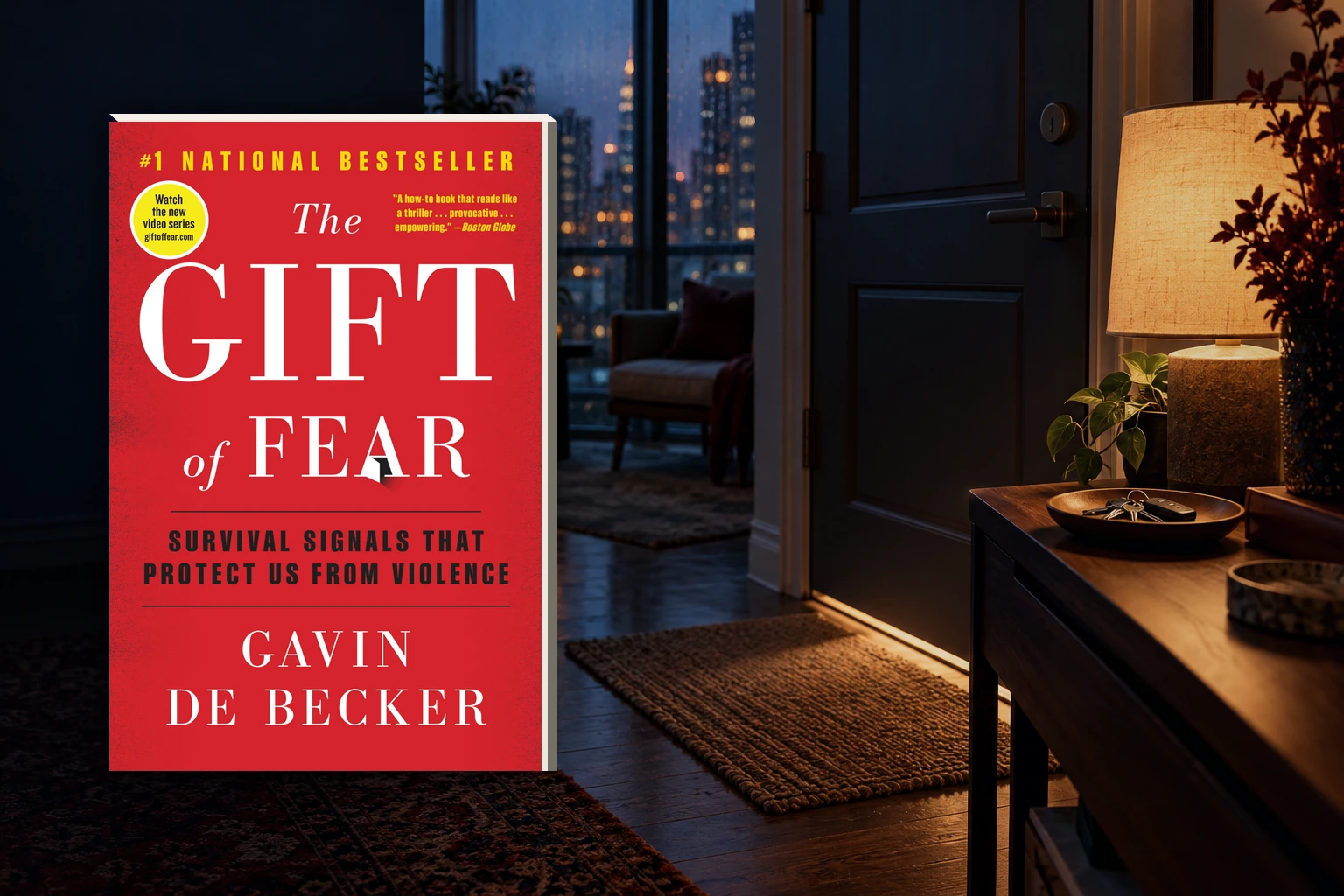
The Gift of Fear: Reading Risk Without Living in Fear
Gavin de Becker argues that fear can register patterns of threatening behavior before we can articulate them. The book is most useful when that insight becomes attentive judgment, not a promise of perfect prediction.
A concrete, behavior-centered framework for thinking about threats, boundaries, and the signals people sometimes discount.
Fear is usually treated as a feeling to suppress or a weakness to overcome. Gavin de Becker’s The Gift of Fear asks readers to consider a different possibility: unease may sometimes be the mind’s way of registering a pattern before the pattern can be stated clearly. The book’s practical appeal lies in that reversal. It invites attention to conduct, boundaries, and context in situations that may turn dangerous. Its most important question, however, is how to use such attention without turning every uneasy feeling into a verdict about another person.
De Becker approaches violence through the lens of prevention. The publisher frames the book around signals that may precede threats, including stalking and behavior by people already known to the potential target. This scope matters. Popular images of crime often focus on a stranger arriving without warning. Many decisions about safety are less cinematic: whether to accept persistent contact, how to respond to a boundary being ignored, or when a pattern of escalation deserves outside help. The book is strongest when it moves the reader from a dramatic image of danger toward observable behavior.
Its account of intuition can be read as a claim about information processing. People notice tone, repetition, pressure, and inconsistency even when they cannot immediately name each element. An uncomfortable reaction may therefore justify a pause and closer attention. It does not, on its own, prove intent. That distinction keeps the book’s premise useful. One need not diagnose a stranger or decide that a feared outcome is certain in order to decline an interaction or seek a safer setting. Practical judgment can operate under uncertainty.
The language of a gift is memorable because it gives fear a positive function. Yet it also risks suggesting that fear is always clear and trustworthy. Human threat perception is shaped by experience, culture, stress, and prejudice. Some alarms are false; some real threats produce no immediate alarm. A reader who treats every instinct as a factual conclusion may become less discerning rather than more. The stronger lesson is to respect an uneasy signal enough to investigate one’s options while testing any claim about a person against specific actions and context.
That is why the book’s attention to boundaries is more valuable than a promise of prediction. A repeated refusal to accept a clear no is an action that can be described. Unwanted contact after a request to stop can be documented. These behaviors offer more stable grounds for a safety decision than an attempt to infer a hidden personality type. De Becker’s subject is often described as criminal psychology, but its practical center is relational: who respects another person’s autonomy, what changes when that respect is absent, and how a pattern develops over time.
The examples that give such a book urgency also create a problem of selection. Accounts of threats that became violent are vivid because the outcome is known. Similar moments in which no violence followed are less likely to be told. A reader can therefore come away with the impression that a warning sign is more predictive than the available evidence demonstrates. The book should be read as a guide to taking reasonable protective steps, not as a statistical instrument for assigning danger to individuals. Case narratives sharpen attention; they do not calculate probabilities for every reader’s circumstances.
Fear can also be a scarce and costly resource. Constant vigilance has psychological consequences, particularly for people whose work, housing, or relationships already limit their choices. Advice that sounds simple from a distance may be difficult or dangerous to follow in a coercive relationship. Leaving, refusing, or reporting may carry immediate risks. A good reading of The Gift of Fear therefore treats its principles as aids to judgment rather than universal commands. Safety decisions depend on resources, local support, and the details of a situation that no general book can know.
This point is essential to the book’s ethics. No survivor should be told that a missed signal caused the harm done to them. The responsibility for violence belongs to the person who commits it. Preventive advice can be empowering when it expands options; it becomes unjust when it is used after the fact to audit a victim’s choices. De Becker’s emphasis on signals should be applied prospectively and with humility. It cannot guarantee that harm will be avoided, and failure to predict another person’s actions is not a moral failure.
There is a valuable psychological insight in the book’s insistence that politeness can conflict with safety. Social rules encourage people to keep an interaction smooth, explain a refusal, and avoid seeming suspicious. In some circumstances, those habits make it harder to end an unwanted exchange. The book gives readers permission to prioritize a boundary over the appearance of graciousness. The practical strength of this advice is that it does not require certainty about another person’s motives. One may simply decide not to continue the exchange.
The danger is that a useful permission can become a generalized suspicion. If every awkward social encounter is interpreted as predatory, readers lose the ability to distinguish discomfort from credible threat. The book is best read with a double discipline: take persistent boundary violations seriously, and resist turning appearance, identity, or a single ambiguous moment into evidence of criminal intent. This combination requires more work than an easy list of red flags. It also respects both personal safety and fairness to other people.
The Gift of Fear earns its reputation by making a difficult subject practical. It shifts attention from the fantasy of identifying a dangerous personality to the concrete question of what someone is doing and what choices remain available. Its case-based style can heighten the felt certainty of intuition, so readers should keep its limits in sight. Fear may be a useful prompt to pause, document, seek advice, or leave. It is neither an oracle nor a diagnosis. Read with that qualification, the book offers a humane way to take risk seriously without organizing an entire life around dread.
EDITOR’S VERDICT
Tale24’s assessment
A concrete, behavior-centered framework for thinking about threats, boundaries, and the signals people sometimes discount.
Points to considerCase-driven examples can make intuition appear more accurate and universally available than it is in everyday life.
Best for: Readers interested in violence prevention, threat perception, and the psychology of personal safety.
Editorial method: This is an independent assessment informed by the work and its official supporting information. AI tools may assist the drafting process; Tale24 reviews and takes responsibility for everything it publishes.