Psychology & Skills · TALE24 REVIEW
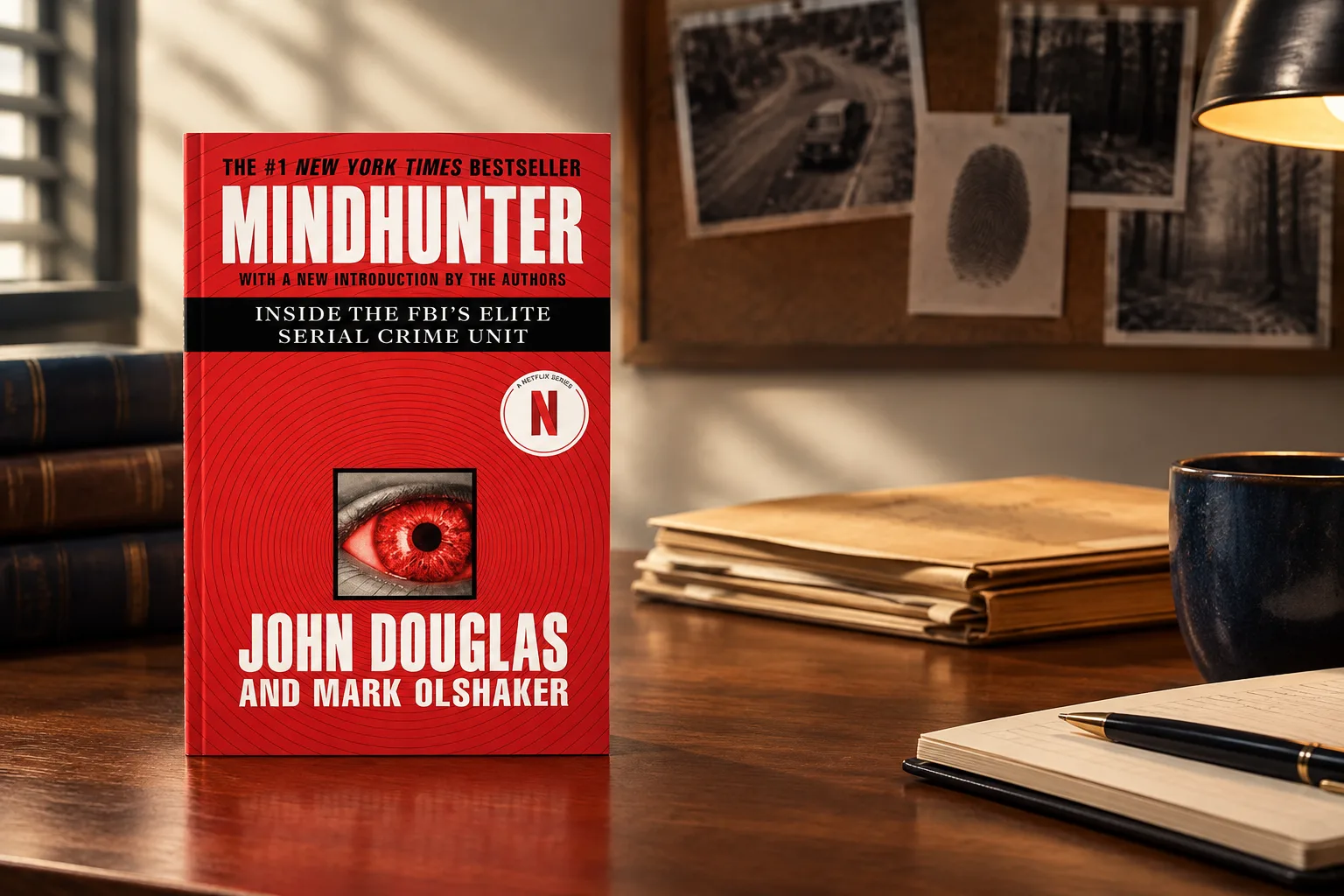
Mindhunter and the Limits of Reading a Killer
John E. Douglas and Mark Olshaker make behavioral profiling compelling by showing it as investigative work. The book is strongest when its insights are treated as testable leads, not proof.
Vivid account of investigative reasoning; clear sense of how interviews and behavioral clues can guide questions.
The most seductive promise of criminal profiling is that a careful observer can read a crime scene as if it were a confession. Mindhunter, by former FBI investigator John E. Douglas and writer Mark Olshaker, helped make that promise familiar to a wide audience. Its more interesting subject, though, is the gap between an informed hypothesis and proof. The book is most rewarding when read as a history of investigative judgment under pressure, rather than as a manual for identifying a stranger from a handful of clues.
Douglas recounts work in the FBI's behavioral investigation world, including interviews with violent offenders and efforts to connect patterns of behavior to investigative decisions. The publisher presents the book as a behind-the-scenes account of his career. That perspective gives the narrative its force: the reader follows an investigator trying to reduce uncertainty when ordinary leads are scarce. It also sets a clear limit on what the account can establish. A practitioner's retrospective can explain how he thought; it cannot, by itself, measure how often the method succeeded across every case in which it was used.
The book's enduring appeal lies in its attention to questions rather than supernatural insight. Why might an offender choose a particular place? What can repeated conduct suggest about planning, opportunity, or risk? How should investigators decide which possibilities deserve attention first? Such questions can help organize a difficult inquiry. They do not turn psychological inference into an identification. That distinction matters because the cultural image of the profiler often skips the slow work of comparing possibilities against witness accounts, physical traces, and later developments.
Douglas's position inside the institution also gives the narrative a distinctive rhythm. The cases are not presented as puzzles floating free of context. They emerge from interviews, professional relationships, investigative priorities, and the pressure to make something useful from incomplete information. The sense of proximity can be gripping, especially for readers accustomed to crime stories that reveal the answer with perfect timing. Here the appeal is the working process: a hypothesis becomes valuable when it changes what investigators can ask or check next.
That same proximity creates the book's central critical problem. A memorable profile that points toward a suspect naturally receives more narrative attention than a vague one, a misleading one, or one that fits several people. Publishers Weekly's review of Mindhunter observed that profiles can focus an investigation while also fitting many possible suspects; it warned that the technique cannot replace hard evidence. This is a useful lens for the book. Its dramatic successes may illuminate how experienced investigators reasoned, but the reader should resist treating each success story as a general accuracy rate.
The distinction is more than academic. Criminal investigation affects real people, including victims' families, suspects, and communities exposed to fear. If a profile narrows attention too aggressively, other plausible leads may receive less scrutiny. If it is treated as a flexible working theory, it can be revised when facts disagree. Mindhunter is therefore most illuminating when the reader asks what each inference would let an investigator test, and what evidence would force that inference to change. The difference between a lead and a conclusion is an ethical difference as well as a methodological one.
The offender interviews raise another question. Their value in the book is not that every criminal becomes transparent once asked the right question. People can misremember, boast, conceal, or shape the story they tell about themselves. Yet interviews can still offer clues about recurring choices and self-presentation. Douglas's account invites readers to think about the relationship between what an offender says, what an offender did, and what investigators can independently verify. That tension gives the book more depth than a parade of notorious names would have offered.
For a contemporary audience, Mindhunter also exposes how much of the public fascination with violent crime depends on proximity to the investigator. The book keeps the investigative mind near the center of the frame. That choice generates suspense, but it can pull attention away from the people harmed. A reader interested in victim-centered true crime may find the institutional viewpoint limiting. The book's most responsible use is to understand one strand of investigative history, not to treat violence as a spectacle or the profiler as its inevitable hero.
Its style is accessible and case-driven, which makes technical uncertainty easier to follow. The tradeoff is that a narrative shaped by dramatic cases may leave less space for systematic comparison. Readers seeking a current research survey of behavioral analysis or a careful evaluation of its predictive power will need other sources. The book is an account of how a notable practitioner understood and narrated his work, not a substitute for independent empirical assessment. That limitation does not erase its importance; it clarifies the kind of knowledge it offers.
The book also rewards a slower kind of reading than its reputation might suggest. Instead of asking whether a particular offender seems monstrous, the reader can track how categories are made: which observed actions are grouped together, which alternative explanations are set aside, and what would count as a mistake. This turns the narrative into an exercise in intellectual humility. The most persuasive passages are those that make uncertainty visible, because that is where the distance between crime storytelling and accountable investigation can be felt most clearly.
Mindhunter remains compelling because it places a human mind against incomplete and disturbing evidence. Its best lesson is not that the mind of a killer can be decoded on command. It is that interpretation may help investigators ask better questions, provided they keep testing the answers. Read with that caution, Douglas and Olshaker's book becomes a study of judgment: useful when provisional, dangerous when certainty arrives too early.
EDITOR’S VERDICT
Tale24’s assessment
Vivid account of investigative reasoning; clear sense of how interviews and behavioral clues can guide questions.
Points to considerRetrospective case selection cannot establish the overall accuracy of profiling; the investigator-centered view gives victims less space.
Best for: Readers of true crime and investigative history who want to examine both the appeal and limits of behavioral profiling.
Editorial method: This is an independent assessment informed by the work and its official supporting information. AI tools may assist the drafting process; Tale24 reviews and takes responsibility for everything it publishes.