Literature & Thought · TALE24 REVIEW
Black Bag: What Happens When a Person Becomes a Prop?
Luke Kennard’s actor sits unseen inside a bag, exposing how work, research, romance, and profit can all make use of a hidden person.
An absurd comic hook that opens serious questions about work and visibility
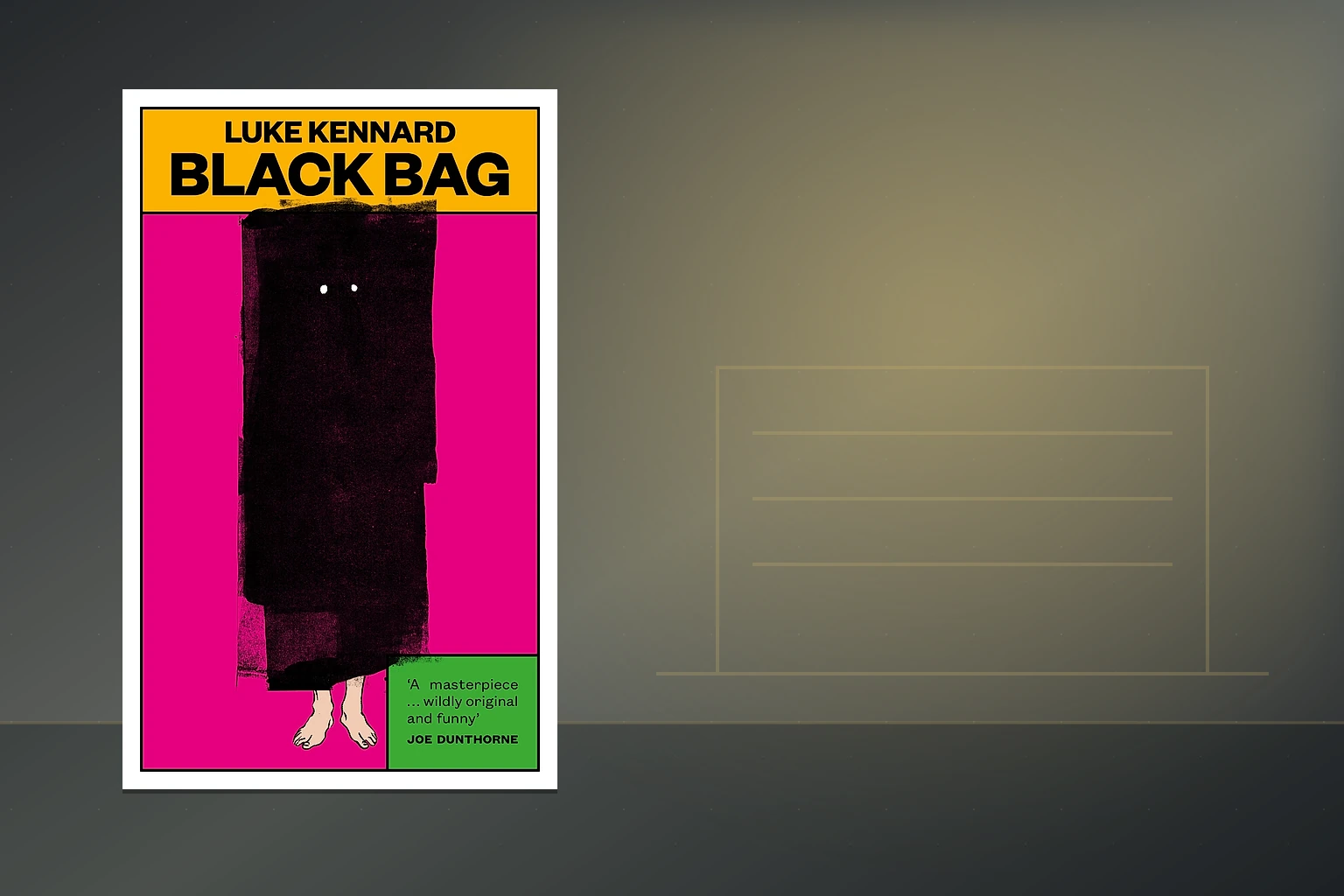
An actor normally wants to be noticed. In Luke Kennard's Black Bag, an out-of-work performer accepts a job that pays him to disappear inside an oversized bag at the back of university lectures. Professor Dr Blend has arranged a psychological experiment; the students become an audience for a person whose face and gestures they cannot see. The setup is funny because it treats an absurd object as a legitimate academic event. It is also unsettling. Once the actor has been turned into an anonymous presence, everyone around him can decide what that presence means.
The actor's financial position makes the joke sharper. He takes the job because he is penniless and unable to find the work he trained to do. Sitting unseen may look easier than a demanding performance, but it still requires a body, time, and consent. Kennard has said he was less interested in the results of the real black bag experiment that inspired him than in the person occupying the bag. That shift moves the book from a clever thought exercise toward a question about labor. What does it cost someone to make himself available as material for another person's idea?
The classroom setting gives the experiment a particular kind of authority. Students are invited to react, while a professor controls the frame in which their reactions count. An audience might treat the hidden actor as a problem to solve or a surface onto which to project its own fears. The available synopsis does not specify their responses, and it would be dishonest to invent them. The important fact is the asymmetry built into the arrangement. The students may study the bag; the person inside must live with being studied. That difference persists even when the premise is played for laughs.
Black Bag also tests what a performer is when performance loses its usual signs. No expression or costume detail can tell the audience how to read the actor. Yet the job is still theater in one sense: his presence changes the room and invites interpretation. The hidden body becomes more visible as a concept than the man might have been as himself. This paradox makes the novel's apparent silliness productive. It asks whether anonymity can protect a person, or whether it simply gives others greater freedom to define him without his participation.
The premise widens when a professor of post-humanism becomes interested in whether someone can love the person inside the bag. That is an odd romantic question, but it carries a serious ethical one. To love a stranger who cannot fully present himself might mean looking beyond conventional markers of attractiveness and status. It might also mean falling in love with an idea while ignoring the person who is required to sustain it. Kennard's setup allows both possibilities to remain uncomfortable. A thoughtful reader need not assume the experiment produces an inspiring lesson about unconditional love.
The actor's childhood friend and roommate sees another possibility: monetizing the situation. Once the bag attracts attention, his friend imagines turning that attention into income. The move makes sense in a culture that encourages every strange experience to become a product or a personal brand. It also changes the meaning of the actor's consent. A paid university role has a defined task, however bizarre; a public spectacle can keep expanding beyond the person at its center. The official description does not disclose the friend's scheme in detail, but the fact that he considers one is enough to connect the novel's comedy with contemporary economic pressure.
The Booker judges have described Black Bag as satire about anonymity, online schemes, masculinity, and love. These subjects could be forced together into a thesis about modern life. Kennard's stranger achievement, at least as the premise suggests, is to let an absurd device hold them in one room. A man unable to secure conventional artistic work accepts a role that erases his artistic identity. Other people then find research, romance, or profit in that erasure. The situation exposes a familiar contradiction: culture celebrates individual expression while rewarding forms of visibility that individuals do not fully control.
Masculinity enters this contradiction through the actor's uncertainty about work and self-worth. Kennard has linked the book to the shame that can accompany precarious artistic life. The bag literalizes a wish to hide, but hiding does not end the demand to be useful or impressive. A comic novel can speak to that pressure without turning its central figure into a diagnosis of every contemporary man. The specificity of an unemployed actor matters. His training has taught him to offer his body and voice to an audience; this new role asks for his body while denying him most of the tools through which he might shape what the audience sees.
The same premise carries a risk for readers. If the satire relies too heavily on its initial oddity, the bag could become a one-note joke. If every surrounding character exists only to represent a social trend, the actor could disappear from the book as completely as he does from the classroom. A strong reading should therefore pay attention to tenderness and friendship alongside the cleverness. The judges' praise for the novel's humor and humane quality suggests that it aims to give its people more than a set of arguments to perform, though no prize citation should replace a reader's own judgment.
Shortlisted for the 2026 Booker Prize, Black Bag offers an accessible entry point into a literary satire with a genuinely strange hook. It should appeal to readers who like campus fiction, uncomfortable comedy, and stories about work that ask who benefits from a person's self-erasure. The image of an actor inside a bag is easy to remember. The harder thought is what happens after everyone else starts treating that image as permission to make use of him. Kennard's premise turns that thought into a comic experiment whose consequences reach far beyond the lecture hall.
EDITOR’S VERDICT
Tale24’s assessment
An absurd comic hook that opens serious questions about work and visibility
Points to considerThe surreal premise may not suit readers seeking realistic campus fiction
Best for: Readers of campus satire and fiction about precarious creative work
Editorial method: This is an independent assessment informed by the work and its official supporting information. AI tools may assist the drafting process; Tale24 reviews and takes responsibility for everything it publishes.