Literature & Thought · TALE24 REVIEW
Braiding Sweetgrass: Nature Is Not a Silent Storehouse of Resources
Robin Wall Kimmerer braids botany with Potawatomi knowledge to propose a fundamental shift: from seeing the living world as a resource to treating it as a community of reciprocal relationships.
Lyrical writing grounded in science; ecology, history, and ethics are powerfully connected; many images genuinely change how the reader sees the living world.
A botanist trained in the Western scientific tradition learns to observe with precision and avoid attributing human qualities to the object of study. Robin Wall Kimmerer received that training, but she is also a citizen of the Citizen Potawatomi Nation, a community whose language and knowledge do not reduce plants to objects. Braiding Sweetgrass grows from the tension between these ways of knowing. It does not demand a choice between science and Indigenous tradition. It asks what becomes possible when accurate data stands beside gratitude, responsibility, and a long relationship with the land.
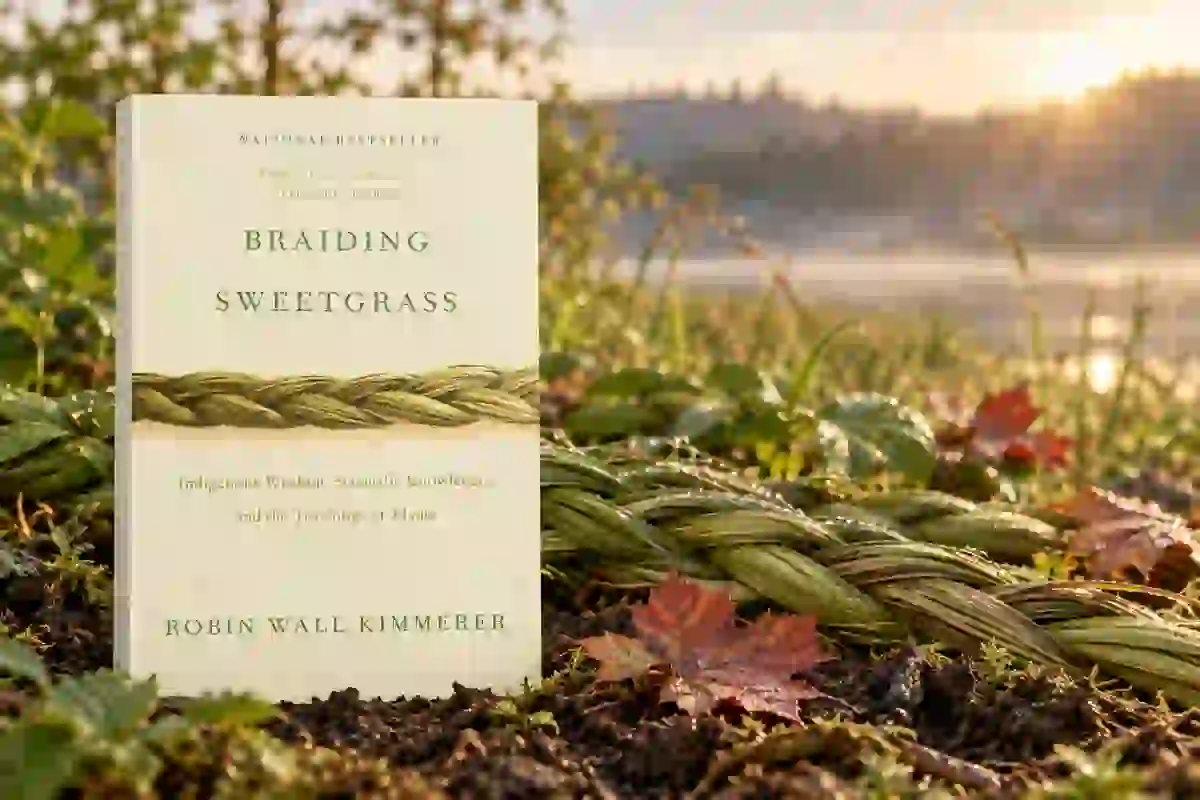
The title refers to sweetgrass, a plant of cultural and ceremonial significance, and describes the structure of the book. Three strands are woven together: Indigenous knowledge, botany, and personal story. Kimmerer moves from laboratory to garden, from colonial history to raising children, from forest ecology to picking strawberries. These movements are not lyrical decoration around the scientific material. They show that knowledge always exists within a relationship: who is observing, for what purpose, and how that person will respond to what has been received.
Reciprocity is the book's central idea. In a commodity system, a gift is quickly converted into price and ownership. In a gift economy, receiving creates relationship and an obligation to care. People may still use berries, sap, wood, or medicine, but use does not grant permission for limitless extraction. Kimmerer returns readers to an old question: if the land sustains us, what will we give in return? This is more than symbolic courtesy. It can alter how we harvest, consume, and make public decisions.
The passages on language are especially powerful. English often calls a tree “it,” the pronoun reserved for objects. In Potawatomi thought, the world contains far more living subjects. Grammar alone cannot turn anyone into a conservationist, but it influences what we imagine may be treated as a thing. When a river is only a water source, the main question is how much can be taken. When the river is understood as a living relation, rights and responsibilities enter the question together.
Kimmerer does not romanticize Indigenous science as a store of mystical intuition. She describes knowledge accumulated through extended observation, experiment, community memory, and responsibility across generations. Nor does she deny the power of scientific method. Some of the book's most beautiful moments occur when two systems reach compatible conclusions by different paths. The problem is not the microscope or statistics. It is the claim by one knowledge system that it alone can decide what counts as real.
The “Honorable Harvest” turns philosophy into conduct: take only what is given, never take the first or the last, take no more than needed, minimize harm, use everything taken, and express gratitude. The principles sound simple, yet they challenge an economy that depends on continuous growth. Kimmerer does not offer a complete policy blueprint. She provides an ethical foundation for judging policy: which systems make receiving without returning seem normal?
The strongest chapters often begin with small work. Kimmerer builds a pond for her daughters, teaches students outdoors, restores a stand of plants, or collects maple syrup. Care is repetitive, sustained, and rarely dramatic. That rhythm strengthens the argument. Ecological crisis requires more than moments of awakening; it requires habits of attention and maintenance. Loving nature without learning the names, seasons, and limits of the place one inhabits can easily stop at attractive feeling.
The book also carries histories of land theft, assimilationist boarding schools, and the suppression of Indigenous languages. Gratitude in this context is not a demand that injured people accept injustice. Kimmerer connects ecological restoration to cultural recovery and sovereignty. Readers who borrow Indigenous ceremony as a green lifestyle while ignoring colonial history repeat the extraction the book opposes. The lesson is not to imitate someone else's identity, but to discover how to act responsibly where one actually lives.
The work's limitation is its length and repetition. Ideas about gifts, gratitude, and reciprocity return many times; some readers will find the meditative pace slow or the prose overly earnest. Yet repetition resembles the way ecological understanding is learned: not through a single definition, but through seasons and examples until perception changes. This is a book to read in sections, with pauses, rather than race through like a manual.
Its most demanding implication is that attention must lead beyond private virtue. Gratitude can become sentimental if it never confronts property, law, pollution, or unequal exposure to environmental harm. Kimmerer repeatedly returns to restoration because damaged relationships require material repair, not only a better attitude. Planting, teaching, recovering language, and defending land are different forms of that repair. The book's gentle tone should not obscure the political challenge contained within it: an economy organized around endless taking cannot be transformed merely by more respectful vocabulary.
At the same time, Kimmerer avoids treating despair as proof of seriousness. Wonder is not an escape from ecological crisis; it is one reason to remain answerable to the world. Scientific description can intensify that wonder by revealing cooperation, succession, and adaptation at scales the casual observer misses. Indigenous teaching adds questions science alone may not ask: what is owed, who has the authority to take, and what responsibilities follow knowledge? Their meeting does not dissolve all disagreement. It expands the range of truths required for responsible action.
Braiding Sweetgrass does not promise that loving plants will solve climate change. Its value lies in repairing the moral imagination beneath our technical choices. Every tool still needs an answer to the question of what relationship with the world it is meant to protect. If nature is merely a storehouse, a green solution can become a more efficient method of extraction. If humans are members of a living community, efficiency must be joined by limits, justice, and return. A leaf remains a leaf after this book, but it becomes much harder to regard it as silent scenery for human life.
EDITOR’S VERDICT
Tale24’s assessment
Lyrical writing grounded in science; ecology, history, and ethics are powerfully connected; many images genuinely change how the reader sees the living world.
Points to considerLong and thematically repetitive; it should be read slowly so Indigenous concepts are not detached from their historical context and reduced to slogans.
Best for: Readers interested in environmentalism, ecology, Indigenous knowledge, gardening, and nature writing
Editorial method: This is an independent assessment informed by the work and its official supporting information. AI tools may assist the drafting process; Tale24 reviews and takes responsibility for everything it publishes.