Literature & Thought · TALE24 REVIEW
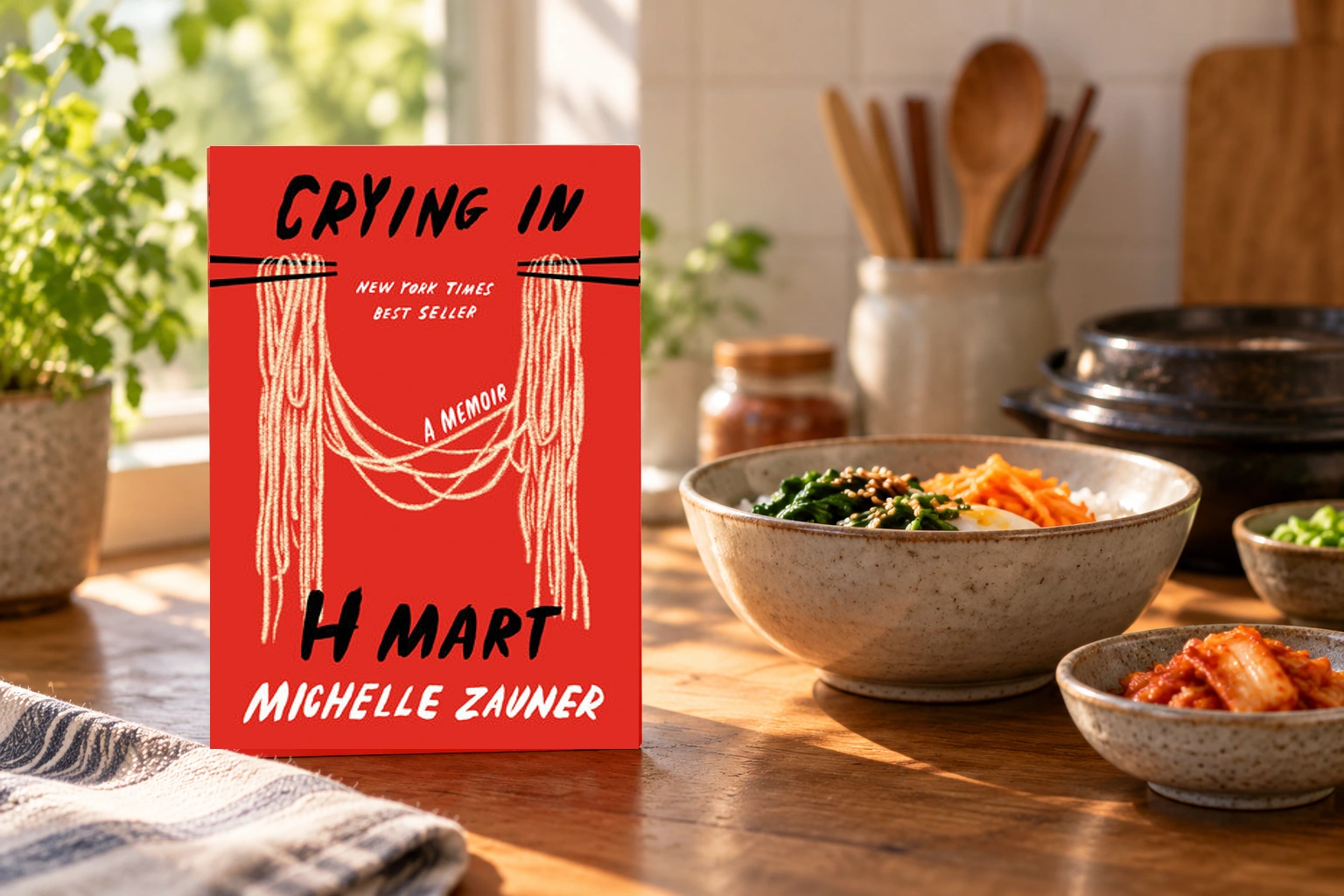
Crying in H Mart: Food as a Language of Grief
Michelle Zauner writes about food as a way to remember her mother and negotiate a Korean American identity that grief makes newly urgent.
Sensory precision and an unsentimental account of love, conflict, and cultural inheritance
The title of Michelle Zauner’s Crying in H Mart places grief in a public grocery store. That setting matters. An aisle of familiar ingredients can hold memories that a formal memorial cannot: a parent’s habits, the sound of a shared language, and the small decisions involved in making a meal together. Zauner’s memoir, written after the death of her mother, returns to food because it gives loss a material form. A dish can be prepared again, but the person who taught its meaning cannot be replaced. The book lives in that gap between repetition and absence.
Zauner writes about growing up Korean American and about a mother-daughter relationship marked by love as well as friction. The memoir does not need to make either woman flawless for their bond to be compelling. Closeness can create expectations that are difficult to meet; cultural inheritance can feel precious and restrictive at the same time. By returning to everyday exchanges rather than a polished ideal of family harmony, Zauner shows how affection often arrives through instruction, criticism, provision, and routine. Readers who have known such mixed signals will recognize why grief does not erase old tensions, even as it changes their scale.
Food gives the narrative a way to move between those feelings. A recipe is both practical knowledge and a record of attention. Someone must remember an ingredient, judge a texture, and know when a taste is right. These acts may seem too ordinary to carry a cultural identity, yet they are precisely how an inheritance survives outside ceremonies and official histories. For Zauner, preparing Korean food becomes a way to approach the mother she can no longer question. It is an imperfect form of conversation: the hands can repeat an action while the missing voice remains missing.
The memoir’s sensory method gives it unusual clarity. Food is often used in personal writing as a comforting symbol of home. Here it can be comforting, but it can also sharpen the fact that home has changed. A familiar flavor may bring back a moment with painful force and still fail to restore it. That double movement protects the book from easy nostalgia. Zauner can value what she received without pretending that a meal resolves bereavement or that cultural authenticity can be measured by a perfect version of a dish.
The Korean American dimension adds another layer to the question of inheritance. When a parent connects a child to a language, a set of customs, and relatives across distance, losing that parent can feel like losing a route to part of oneself. The memoir does not suggest that identity is granted or withdrawn by one person. It does show how much cultural knowledge is carried relationally, through exchanges too small to register as lessons at the time. After a death, recovering those exchanges becomes an act of care and an acknowledgment that some parts of the past will remain inaccessible.
Zauner’s public life as the musician behind Japanese Breakfast could invite readers to treat the book as a celebrity origin story. Its stronger interest is elsewhere. Artistic success does not give a person a privileged way to grieve, and the memoir’s emotional center is not the making of a career. What matters is the difficulty of telling a mother’s story without making her merely a source of the narrator’s identity. Zauner’s account has to hold together the person she loved, the person with whom she argued, and the person she can now know only through memory and what others remember.
That challenge is also formal. A memoir orders experiences after their outcome is known, but living through them offered no such clarity. The reader should notice how retrospective writing can connect a meal, an argument, and a later loss without claiming that their meaning was obvious when they happened. Zauner’s strength is her willingness to let ordinary details retain their texture instead of using every one as a lesson. The most affecting passages in a grief memoir often arise from the refusal to explain a person completely. Love leaves unfinished questions, and writing cannot tidy them all away.
There is a limit to the book’s intimate scale. Readers hoping for a broad study of migration, Korean food traditions, or the social structures around illness will find those subjects mostly in the background. The memoir’s focus is the particular relationship between a daughter and her mother. That focus can make the cultural stakes more vivid, but it also means one family’s experience should not be asked to represent an entire community. The right way to value the book is to take its specificity seriously, rather than turning its details into general claims about how any family should remember.
Crying in H Mart is most persuasive when it understands cooking as neither cure nor performance. The act can keep memory active, create a connection with living people, and make room for grief without promising to end it. Its account of identity is similarly open: inheritance is something received, practiced, revised, and sometimes mourned. Zauner gives readers an intimate language for loss while showing why the simplest tasks can become difficult after a parent dies. There is tenderness in that refusal to promise closure, and it gives the memoir its quiet emotional honesty. The book’s lasting insight is that remembrance may be made of ordinary actions repeated with new awareness, even when no repetition can bring back the person who first made them matter.
EDITOR’S VERDICT
Tale24’s assessment
Sensory precision and an unsentimental account of love, conflict, and cultural inheritance
Points to considerThe intense focus on one family leaves broader social context mostly outside the frame
Best for: Readers of memoirs about food, family, identity, and bereavement
Editorial method: This is an independent assessment informed by the work and its official supporting information. AI tools may assist the drafting process; Tale24 reviews and takes responsibility for everything it publishes.