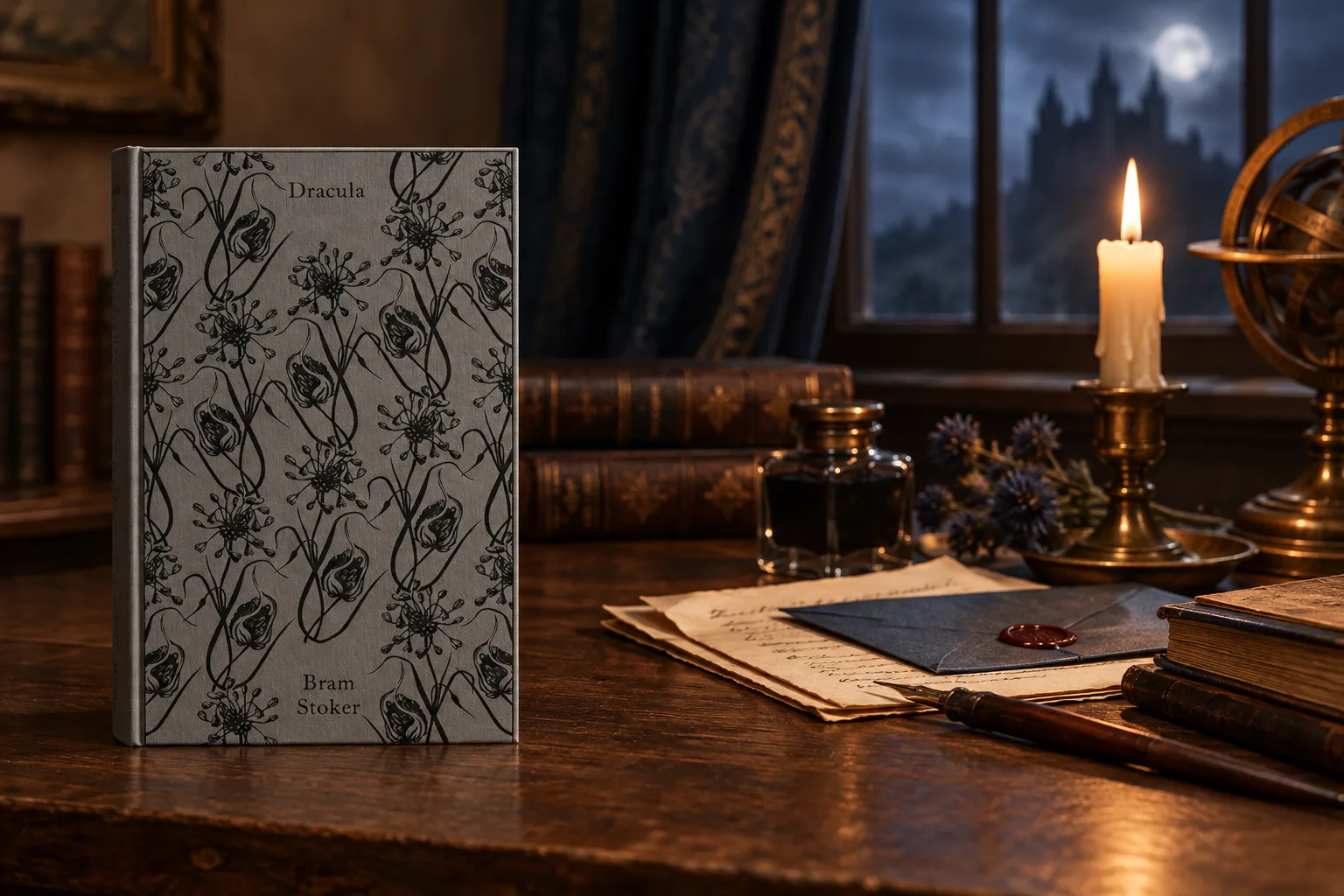
Literature & Thought · TALE24 REVIEW
Dracula: The Vampire Novel That Turns Reading into Investigation
Bram Stoker’s Dracula is more than the source of a familiar monster. Told through journals, letters, reports, and recordings, it turns horror into an investigation shared by imperfect witnesses. Its inventive form and attention to gender reward careful reading, even as its Victorian fear of foreignness calls for scrutiny.
An inventive documentary structure; suspense built through collective investigation; vivid Gothic atmosphere; a revealing treatment of gender, authority, and evidence.
Bram Stoker’s Dracula is often reduced to an emblem: the cape, the castle, the invitation to cross a threshold. The novel itself is more restless than that icon. It makes horror out of the way a group of people gathers, sorts, and interprets evidence. Its vampire is frightening, but so is the possibility that no single witness can understand what is happening in time. Read now, this Victorian novel feels less like a monster’s biography than an improvised investigation whose tools are letters, diaries, telegrams, newspaper clippings, and phonograph records.
That documentary structure is the book’s central invention. Stoker does not give readers an all-knowing narrator who explains the supernatural. Jonathan Harker’s journal first confines us to his limited view of a Transylvanian castle and its unnerving host. The account is intimate and uncertain: a traveler records what he can observe, then struggles to make observation add up to safety. When the story moves to England, other voices accumulate. Mina and Lucy’s letters, Seward’s records, and news reports form a file assembled after the danger has already begun. The question shifts from “Is this possible?” to “Which details must be taken seriously, and who has the authority to say so?”
This form can make the novel feel unusually modern. Its characters rely on the communications technologies of their moment to reproduce, compare, and circulate information. A diary can be copied; a telegram can close a distance; recorded speech can preserve an account for later examination. The methods are not incidental period decoration. They turn private experience into shared evidence, letting the group act across separate places and partial understandings. At the same time, the documents never become neutral. Each carries its maker’s fears, assumptions, and gaps. The reader performs the same work as the characters: arranging fragments and testing whether one explanation accounts for them all.
Stoker also makes collaboration a condition of survival. No single character possesses the necessary combination of access, expertise, and nerve. The investigation depends on people who listen to one another and allow a strange possibility to revise what they thought they knew. Mina’s intellectual labor is indispensable to the group’s record keeping and pattern recognition. That contribution complicates any simple reading of the novel as a story in which men alone command knowledge, even as its social world assigns authority unevenly. The drama asks whether a community can recognize a person’s insight while still trying to contain the person who offers it.
The book’s treatment of gender makes that tension especially visible. Lucy and Mina are not interchangeable symbols of innocence. Their different circumstances expose how closely the novel links women’s safety to reputation, medical supervision, courtship, and the management of desire. The vampire’s attack is terrifying partly because it makes intimate vulnerability public and difficult to explain in the period’s respectable language. Yet the men’s protective behavior can be both caring and controlling. The horror is therefore not limited to a supernatural predator. It also arises from a culture in which women’s bodies are interpreted by others, and help can arrive with rules about how a woman should behave.
The novel’s atmosphere is built through a sharp geography of movement. Harker’s journey to Transylvania crosses from the familiar into the unfamiliar; the ship carrying Dracula toward England turns passage into a sealed, dwindling space; Whitby’s exposed coast makes the arrival of the uncanny feel both spectacular and strangely ordinary. Once the threat reaches English homes and institutions, the supposed distance between modern security and ancient danger collapses. Stoker understands that fear gains force when it enters routines readers recognize: travel, lodging, illness, correspondence, domestic care.
That geography also reveals a limitation that contemporary readers should not ignore. Dracula’s eastward menace draws on Victorian fears of invasion and cultural difference. The story’s suspense depends in part on treating the foreign as a source of contagion and disorder. Its imagined contrast between a threatened English community and an outsider can reproduce the xenophobic assumptions of its period. Recognizing that frame does not erase the novel’s craft; it clarifies what kind of social boundary the horror is designed to defend. A critical reading can admire how the book unsettles the home while also asking why the stranger is made to carry so much of the culture’s fear.
Stoker’s pacing is uneven by contemporary thriller standards. The opening in the castle has a concentrated, claustrophobic power; later sections pause for extended records, explanations, and repeated decisions. The documents create a deliberate sense of evidence gathering, but their accumulation can slow momentum, particularly when characters revisit information the reader already understands. Readers looking for a lean sequence of shocks may find the middle stretches patient to a fault. The novel’s architecture rewards attention more than speed.
That patience, though, is part of the experience the book offers. Fear grows not only from what is glimpsed but from the lag between an observation and a usable explanation. The characters must decide whether to trust one another before they can prove every claim, then coordinate action without the comfort of complete knowledge. The suspense is collective: it depends on whether partial testimony can become a shared account strong enough to guide a response. This is why the papers matter. They make reading itself a survival skill.
Dracula remains an especially fitting Halloween choice because it combines a recognizable monster with a form that still invites participation. The reader is not simply waiting for the Count to appear; the reader is helping to assemble the case against him. Stoker’s novel is a landmark of Gothic horror, but it is also a study of mediated knowledge, social authority, and the uneasy boundaries a culture draws around danger. Its dated assumptions deserve scrutiny, and its documentary pace asks for patience. In return, it offers a richer question than whether vampires are frightening: when a crisis first seems impossible, how does a community learn to believe its own evidence?
EDITOR’S VERDICT
Tale24’s assessment
An inventive documentary structure; suspense built through collective investigation; vivid Gothic atmosphere; a revealing treatment of gender, authority, and evidence.
Points to considerThe record-based middle can slow the momentum, and its portrayal of foreignness reflects xenophobic Victorian assumptions that need critical context.
Best for: Readers of Gothic fiction and literary horror who enjoy piecing together multiple accounts and discussing how culture shapes the image of a monster.
Editorial method: This is an independent assessment informed by the work and its official supporting information. AI tools may assist the drafting process; Tale24 reviews and takes responsibility for everything it publishes.