Literature & Thought · TALE24 REVIEW
How to Do Nothing: Attention as a Civic Practice
Jenny Odell treats attention as a social and ecological choice, offering a demanding alternative to the metrics of the digital attention economy.
Original connections among art, ecology, place, and digital life
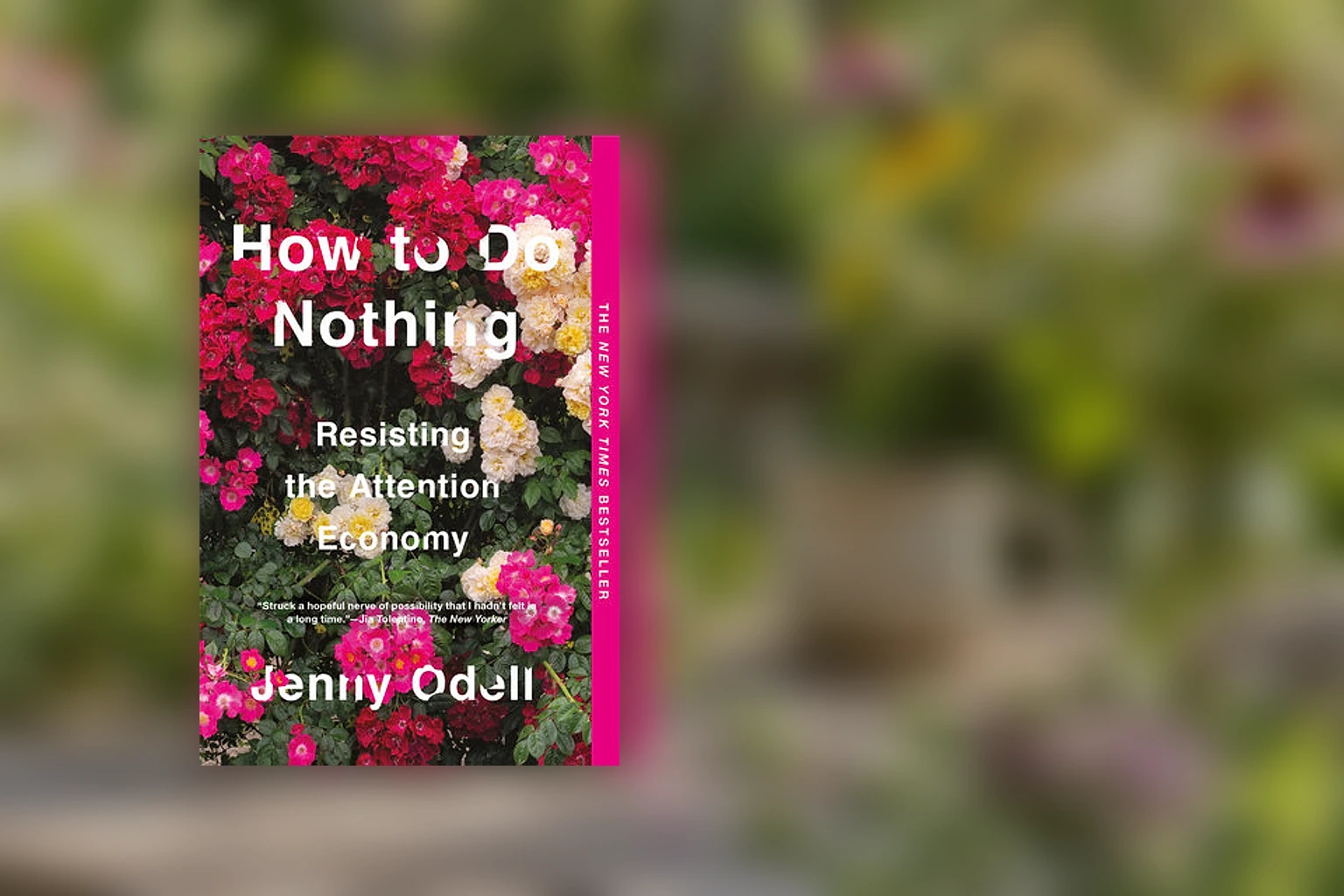
Jenny Odell’s title, How to Do Nothing, promises an escape from demand. The book offers something less restful and more interesting: a way to ask who benefits when every moment of attention must be recorded as productive, visible, or profitable. Odell, an artist and writer, examines the pressures of the attention economy without suggesting that a person can simply switch off modern life. Her central move is to change the scale of attention. Instead of measuring a day by output or online response, she asks what becomes perceptible when we attend to a place, its living systems, and the people sharing it.
That shift is neither a productivity trick nor a vague appeal to mindfulness. A productivity trick would turn observation into another technique for getting more done. Odell is skeptical of precisely that conversion. To look closely at an environment can be worthwhile even if the act produces no report, improvement metric, or post. The claim is modest but politically charged because platforms and workplaces often compete to define attention as a resource to be captured. The book asks readers to retain some power over what counts as significant before those systems tell them where to look.
Odell draws together art, ecology, and local experience. Those connections are useful because they show that attention is not only an individual mental state. It has an object and a setting. Noticing a bird or a patch of urban habitat may lead to questions about land use, care, and the relationships hidden beneath familiar surroundings. Art can interrupt automatic perception in a similar way. Neither practice solves a public problem by itself. Both can make it harder to accept the thin description of a place that is convenient for a map, an advertisement, or an efficiency plan.
The book is particularly strong when read as a challenge to the idea of withdrawal. If the attention economy is a social arrangement, personal restraint cannot be the whole answer. Someone can close an app and still face a job that rewards constant availability, a community that conducts its public life online, or a household whose needs allow little discretionary time. Odell’s account of attention points toward collective questions: what spaces support sustained encounter, who can access them, and what conditions let people participate in public life without being continuously measured?
This is also where the book’s limitations become visible. A reflective practice may seem easy to recommend to readers with secure work and flexible hours, and far less accessible to someone juggling shifts, caregiving, or financial pressure. The criticism does not make close observation trivial. It means the freedom to pay attention should be considered a shared condition to build, rather than a personal virtue possessed by the sufficiently disciplined. Odell’s argument becomes stronger when readers connect its perceptual work to the material question of who has room to perform it.
The title’s provocation helps expose an inherited assumption: if an activity cannot be counted, it is liable to be dismissed as doing nothing. Conversations without an agenda, time spent learning a neighborhood, and a patient look at a work of art can all fall into that category. Yet they may change what a person notices later and whom they consider part of their world. Such changes are difficult to prove in the language of immediate results. Odell’s refusal to provide a simple before-and-after calculation is part of the point, although readers seeking a direct plan may find it frustrating.
The book also avoids an easy story in which technology is the sole villain. Tools can make connection possible, document harm, and help people organize. The problem is a narrower set of incentives that reward speed, novelty, and measurable reaction over sustained relation. This distinction matters because a total rejection of digital life is neither feasible nor desirable for many readers. Odell instead invites scrutiny of the habits that make certain forms of attention feel compulsory. The useful question is not whether a screen is present, but whether the interaction leaves room for judgment, reciprocity, and memory.
As a work of criticism, How to Do Nothing moves by association rather than by a tightly numbered program. Its range is both an asset and a demand. Readers willing to follow the connections between artistic practice, local ecology, and political life will find a distinctive account of how perception shapes citizenship. Readers expecting a concise set of steps for reducing screen time may leave unsatisfied. That is a fair response to the book’s loose method. Its value lies in changing the criteria by which a “solution” to distraction would be judged.
This perspective also changes how readers might think about rest. Rest is often sold as preparation for another round of output, which leaves the original demand intact. Odell’s argument makes space for a less instrumental pause: time that belongs to a relationship or a landscape without first having to justify itself as recovery. That is a difficult idea to defend in a culture accustomed to asking what every hour produced.
The most durable idea is that attention creates obligations. Once a person sees the layered life of a place or understands the labor behind a relationship, indifference becomes less effortless. Odell does not guarantee that better looking will produce better politics. She does show why a politics that begins with shallow, interchangeable impressions will struggle to care for particular people and environments. How to Do Nothing is a demanding invitation to stop treating one’s time as empty space awaiting capture and to see attention as a practice that can be directed, shared, and defended.
EDITOR’S VERDICT
Tale24’s assessment
Original connections among art, ecology, place, and digital life
Points to considerIts reflective approach offers fewer immediate steps for readers under severe time pressure
Best for: Readers interested in attention, technology, art, ecology, and public life
Editorial method: This is an independent assessment informed by the work and its official supporting information. AI tools may assist the drafting process; Tale24 reviews and takes responsibility for everything it publishes.