Literature & Thought · TALE24 REVIEW
Foundation: Can History Leave Room for Human Agency?
Asimov turns centuries of political change into suspense, while his fictional science of prediction leaves difficult questions about who controls the future.
A distinctive crisis structure, large historical scale, and lively questions about institutions
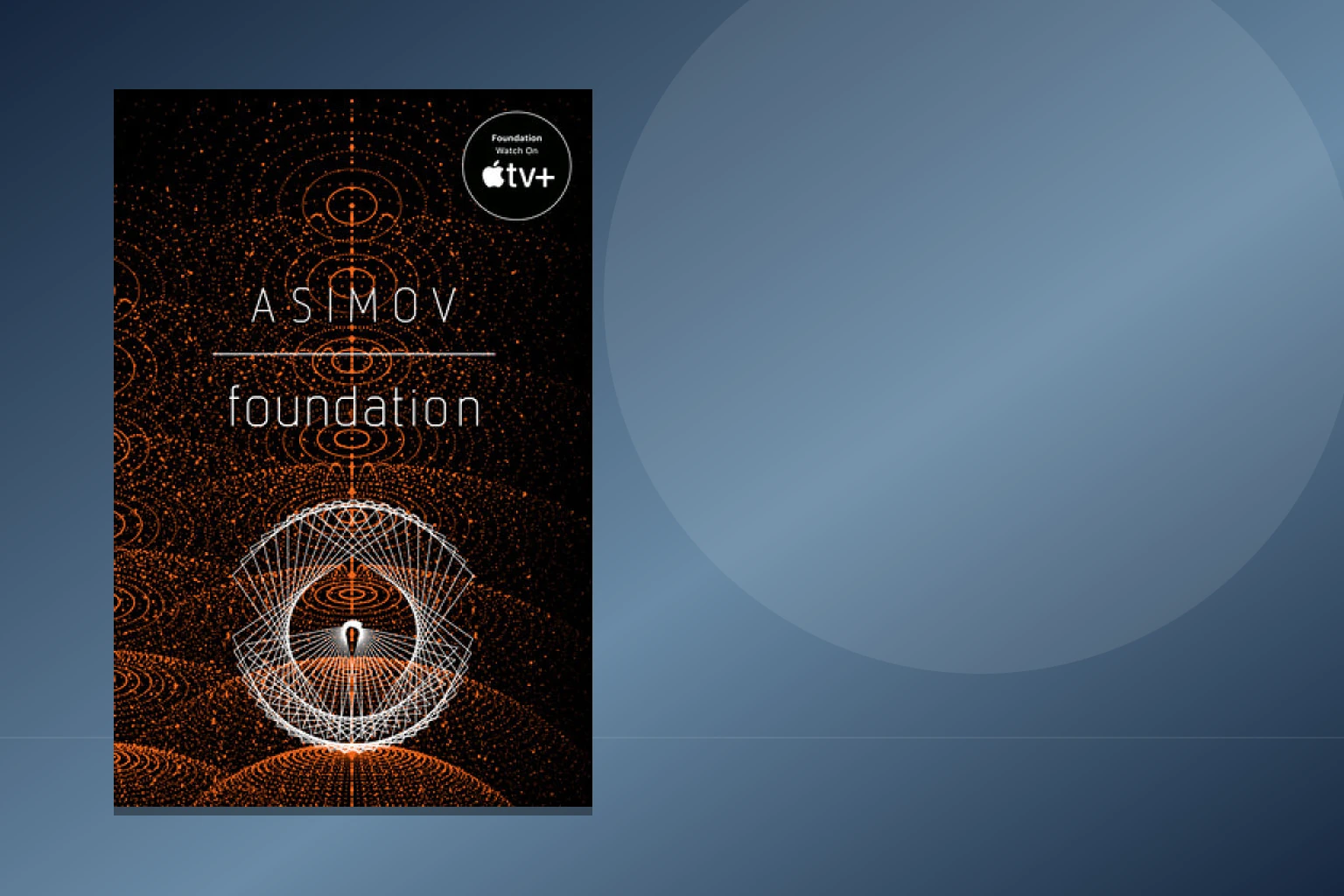
The audacious device in Isaac Asimov’s Foundation is not a faster spaceship. It is a way to make history into a plot. Hari Seldon’s psychohistory claims to forecast the behavior of very large populations even when no one can reliably predict a single person. Faced with the Galactic Empire’s decline, he establishes a repository of knowledge meant to reduce the length of the disorder that follows. The premise invites the reader to watch a civilization change rather than wait for one exceptional protagonist to save it. It also raises a question the book cannot settle as neatly as Seldon’s equations might suggest: who gets to decide what counts as a better future?
Foundation moves through connected crises across generations. The people who matter in one episode may have disappeared by the next, while the institution named in the title persists. That structure is more than an efficient way to cover a long time span. It makes continuity itself dramatic. A political decision, a habit of exchange, or a useful piece of expertise can outlive the person who introduced it. Readers accustomed to a single hero’s emotional journey may find the transitions abrupt. The gain is a rare sense that the conditions facing each generation have been made by people who are no longer present to explain themselves.
Psychohistory gives this narrative its unusual tension. Seldon’s forecasts suggest that the broad outline of events has already been mapped, but his successors must still interpret the particular crisis in front of them. A prediction is not an instruction manual. It can inspire patience and strategy, yet it can also tempt people to mistake their preferred course for historical necessity. Asimov thus creates a productive gap between knowing that a challenge is coming and knowing how to respond to it. The reader is invited to look for the pressure beneath an apparent emergency: what resources, loyalties, or assumptions have quietly changed?
This makes Foundation a novel about institutions as much as ideas. Preserving knowledge sounds admirable in the abstract, but knowledge has to be stored, taught, defended, and made useful. The Foundation cannot simply possess information and expect a damaged political order to repair itself. Its place among neighboring powers changes, and so do the means by which it maintains influence. The story’s interest lies in these shifts from one kind of authority to another. Even when an episode turns on a clever individual, the cleverness matters because it recognizes a wider arrangement of incentives that another person might have missed.
The book was assembled from stories, and that origin remains visible in its rhythm. Each crisis can feel like a compact intellectual contest: the terms are established, a familiar assumption becomes unstable, and a new distribution of power emerges. This gives the novel momentum without asking every chapter to stage a battle. It also gives some characters less room to develop beyond the problem they are there to solve. Readers looking for intimate relationships and sustained psychological change may find the book cooler than its reputation as an epic suggests. Its primary emotional scale is collective: anxiety about what a society can keep, and what it will lose.
There is a serious limitation in the seduction of psychohistory itself. A model of mass behavior can make the future appear legible from above, especially when the narrative rewards those who correctly read a historical pattern. Real societies include dissent, accident, unequal power, and the experiences of people who never enter a strategist’s calculation. Foundation is most interesting when read with that discomfort in view. Its science is fictional, and the novel should not be recruited as proof that social change can be engineered with mathematical certainty. The speculative device lets Asimov ask how people behave when they believe the long view belongs to them.
That belief has a political edge. If a small group says it understands the direction of history, others may be asked to accept decisions without seeing the evidence. Seldon’s plan can be understood as an attempt to spare future generations suffering, but benevolent intention does not remove questions about authority. Who is permitted to revise the plan when circumstances change? What would count as evidence that it has failed? The novel does not need to answer these questions in the language of contemporary governance to make them available to the reader. Its enduring force comes partly from the friction between an elegant design and the unruly people who inhabit it.
The language is usually direct, and the dramatic emphasis falls on argument, negotiation, and reversal. Readers who enter through modern screen adaptations should expect a different kind of spectacle on the page. Asimov is less invested in describing the texture of every world than in setting pressures against one another until a society has to adapt. That economy can feel thin when a scene calls for personal grief or sensory depth. It can also be liberating: the book trusts a change in political leverage to be as consequential as a change in hardware.
Foundation remains a useful starting point for readers who like speculative fiction built around systems, long horizons, and difficult choices. Its limitations are bound to its strengths. The large design can make individual lives seem small, while the story’s best moments show that no design carries itself out. People still have to make judgments with partial information and with institutions they did not build alone. Asimov’s central wager is that a civilization can become a compelling character. The novel earns attention when it makes that character’s survival feel contingent, even under the shadow of a supposedly predictable future.
EDITOR’S VERDICT
Tale24’s assessment
A distinctive crisis structure, large historical scale, and lively questions about institutions
Points to considerCharacter psychology and sensory detail are secondary to the ideas
Best for: Readers who enjoy political thought experiments and science fiction about societies
Editorial method: This is an independent assessment informed by the work and its official supporting information. AI tools may assist the drafting process; Tale24 reviews and takes responsibility for everything it publishes.