Psychology & Skills · TALE24 REVIEW
The Mind of a Murderer and the Hard Work of Asking Why
Richard Taylor asks why people kill from inside forensic psychiatry. His memoir is strongest when it keeps clinical explanation, legal judgment, and moral responsibility in view at once.
The clinical perspective makes the work of assessment and its institutional consequences more visible.
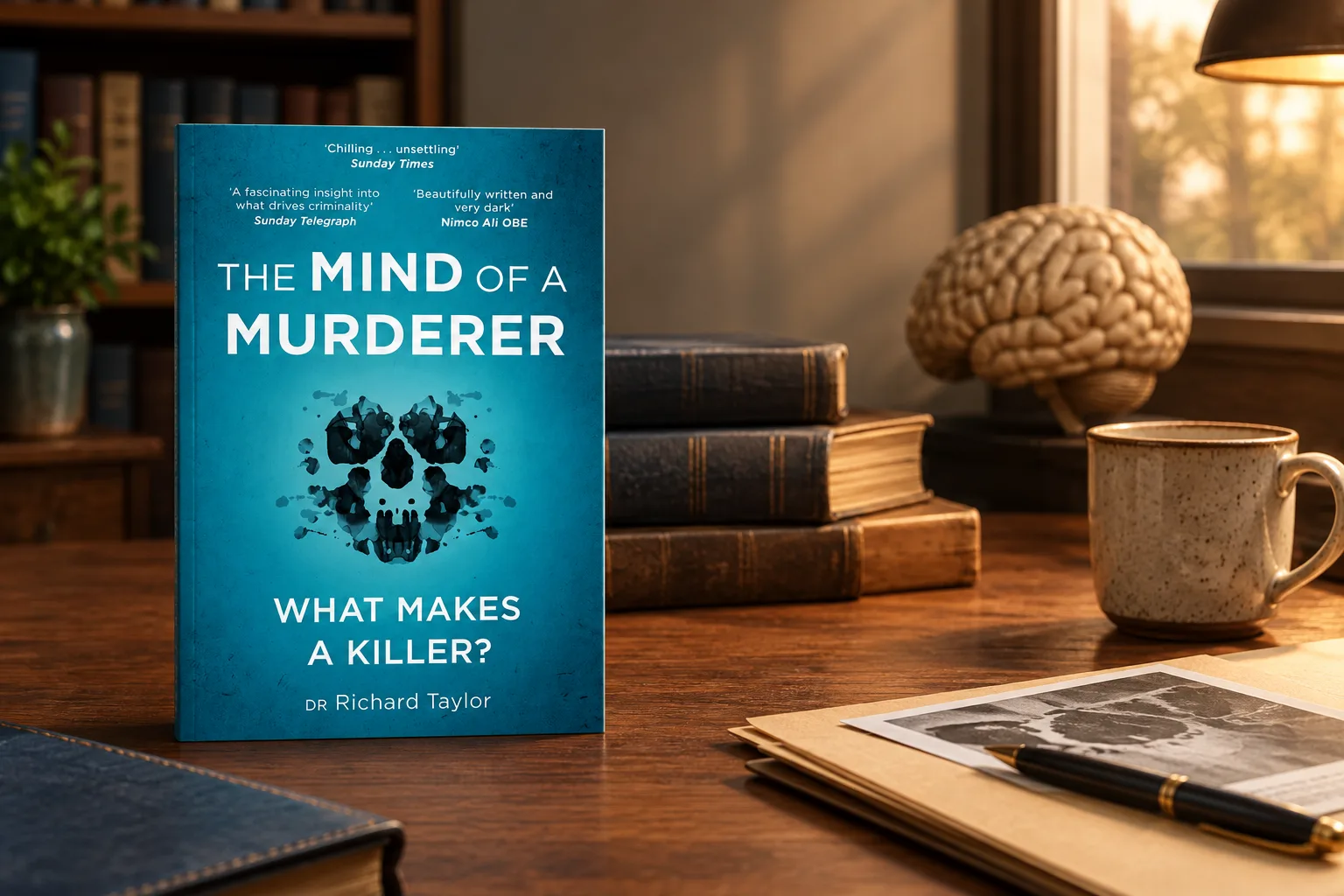
The Mind of a Murderer is built around a question that crime stories often answer too quickly: why did this person kill? Richard Taylor approaches it as a forensic psychiatrist who has worked on more than a hundred murder cases over twenty-six years, according to his publisher. His memoir brings together assessments of people accused of killing, patients he has treated, and elements of his own family history. The result is an invitation to examine the reasons people give, the explanations experts construct, and the limits that remain after both have spoken.
The difference between "who" and "why" is crucial to the book's angle. A detective must identify what happened and who is responsible. A psychiatrist may be asked about mental state, treatment, risk, or a person's ability to participate in legal proceedings. Those questions overlap with a murder investigation, but they are not identical. Taylor's profession puts him near the point where a legal account of an act meets a clinical account of a person. His cases therefore offer more than a tour of frightening minds. They reveal how explanation changes depending on who is asking, what evidence is available, and what decision must follow.
The publisher describes Taylor as drawing on tragic and illuminating cases and on a difficult family past. Such a combination can make the expert narrator seem like both guide and subject. That is a promising form for a book about judgment. If the person interpreting violence has a history of his own, the reader is less likely to imagine an entirely detached mind issuing final answers. Personal material can bring humility to the analysis. It can also create a risk: a moving autobiographical thread may feel like evidence for a broad psychological theory when it is really one life among many. The balance between those uses is part of the book's interest.
Taylor's question also resists one of true crime's most persistent habits: dividing people cleanly into ordinary observers and incomprehensible monsters. A violent act demands moral clarity about harm, responsibility, and the lives affected. It does not follow that a person can be understood only through a single label. Clinical work must attend to history, thought, circumstance, illness where relevant, and the possibility that several explanations coexist. That approach can feel uncomfortable because it keeps a person in view without softening what happened. The difficulty is an ethical strength, not an evasion.
At the same time, psychological understanding has boundaries. An interview may reveal how someone now narrates an act, not necessarily everything that caused it. Memory changes, self-presentation matters, and some motives are mixed or poorly understood even by the actor. A diagnosis may be relevant to a particular question without being a complete story of violence. Taylor's experience gives his account weight, but expertise cannot eliminate these limits. Readers should resist turning a case history into a simple rule about other people, especially when the subject involves mental health and public fear.
The book also sits inside a larger debate about what follows from assessment. Courts and hospitals have distinct duties; punishment, treatment, and public protection cannot be collapsed into one goal. The publisher quotes a review describing the memoir as a criticism of cuts to mental-health services. That policy dimension matters because it moves the question beyond the individual offender. If care is scarce, opportunities for assessment and treatment may be constrained long before a crisis reaches a courtroom. The book's cases can make those pressures visible, though anecdotes alone cannot settle which policy would produce a safer or more humane system.
This is where Taylor's position differs from the profiler's popular image. The drama of a profile comes from the promise of identifying an unknown person. The forensic psychiatrist more often meets a person already in custody or care and must decide what an explanation can responsibly support. That work is quieter, and its success is harder to stage as a revelation. The Mind of a Murderer is useful when it lets readers dwell in that slower time: listening, testing, revising, and accepting that understanding a deed does not erase its consequences. It asks for patience from an audience trained to expect a twist.
There are hazards in any collection of extreme cases. The most memorable incidents may dominate a reader's picture of psychiatric practice. Individual stories can also tempt us to infer a general connection between mental illness and homicide that the book's premise does not establish. Responsible reading requires remembering that clinical populations and crimes are varied, and that a case selected for a memoir has been selected for narrative reasons. Taylor's voice can illuminate the questions a clinician faces; it cannot turn a finite set of stories into a universal map of murderous behavior.
The book's most durable challenge is to hold two truths together. Killing has victims whose loss should not disappear behind the offender's interior life. Yet the effort to understand what happened may be necessary for treatment, legal judgment, and prevention. Taylor does not need to make every case intelligible for that effort to matter. Readers who want a neat taxonomy of killers may be dissatisfied. Readers who want a serious account of why forensic psychiatry asks difficult questions, and why those questions resist tidy answers, will find a compelling framework here. The mind of a murderer is neither a spectacle nor a puzzle with one key; it is a human subject examined under grave moral and evidentiary pressure.
EDITOR’S VERDICT
Tale24’s assessment
The clinical perspective makes the work of assessment and its institutional consequences more visible.
Points to considerMemorable case histories can invite overgeneralization if readers treat them as a map of all violent behavior.
Best for: Readers interested in forensic psychiatry, criminal justice, and the limits of psychological explanation.
Editorial method: This is an independent assessment informed by the work and its official supporting information. AI tools may assist the drafting process; Tale24 reviews and takes responsibility for everything it publishes.