Psychology & Skills · TALE24 REVIEW
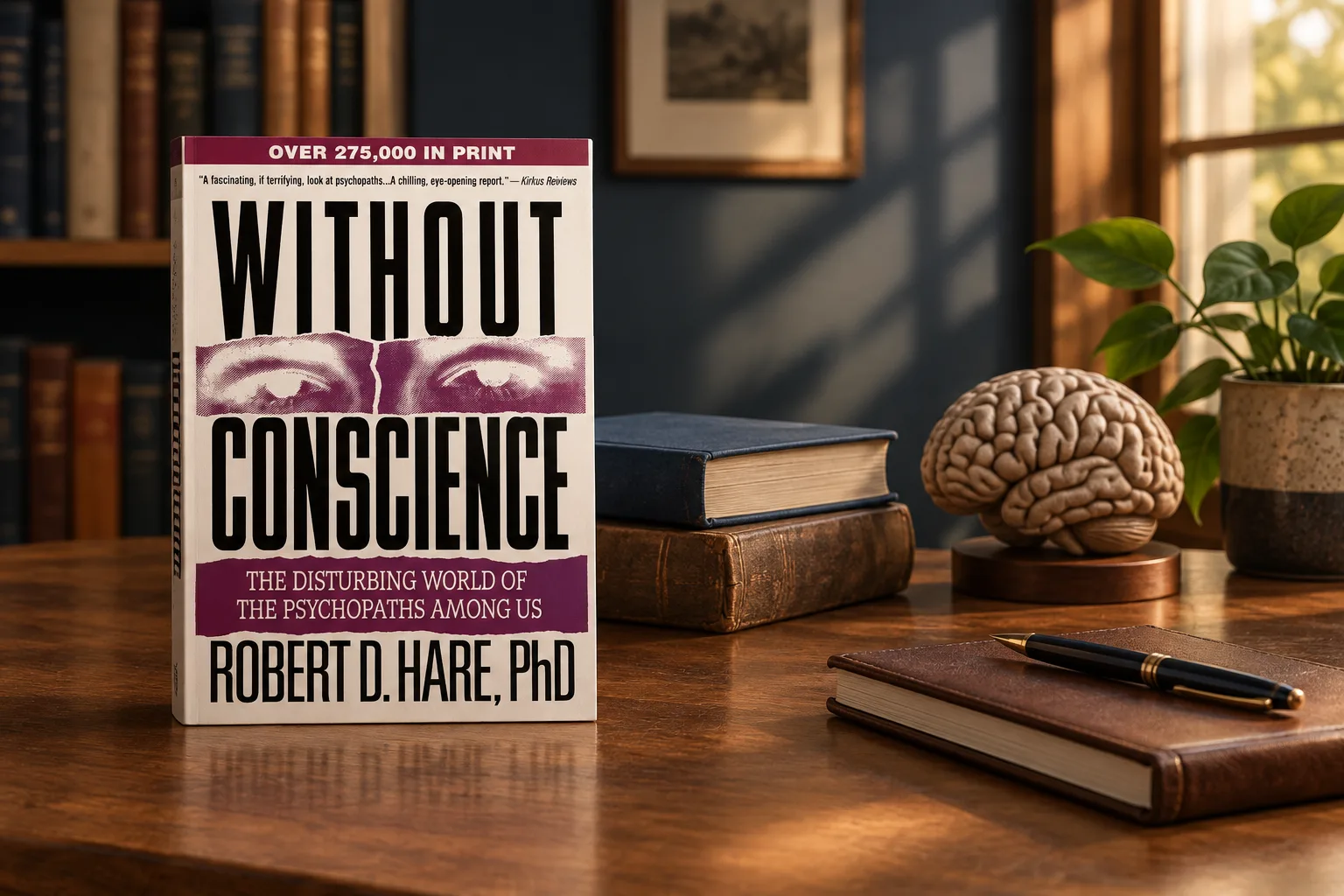
Without Conscience and the Ethics of Naming Psychopathy
Robert D. Hare gives readers a language for persistent exploitation. The book also shows why recognizing harmful behavior is different from diagnosing a person at a distance.
Clear explanation of recurring traits; connects clinical ideas to conduct beyond sensational crimes.
The word psychopath arrives in popular culture already carrying a verdict. It suggests a person beyond ordinary moral feeling, perhaps even beyond change. Robert D. Hare's Without Conscience offers a more structured account of the traits behind that image, but its most useful contribution for a general reader may be the question of what happens when a clinical vocabulary escapes the setting that gives it meaning. The book is compelling when it replaces a movie monster with a pattern of conduct. It becomes more demanding when the reader asks how such a pattern should be recognized responsibly.
Hare writes from a long research career in psychology. Guilford Press identifies him as the developer of a widely used instrument for assessing psychopathy. The publisher's description emphasizes manipulation, deceit, remorselessness, and disregard for others. It also makes a crucial point for a true-crime audience: violence is one dramatic possibility, but the behavior Hare discusses is not confined to murder. The table of contents moves from feelings and relationships through lifestyle, white-collar conduct, the ethics of labeling, and a final survival guide. That architecture broadens the subject while making the stakes of classification harder to ignore.
The book's first strength is conceptual. In ordinary speech, a frightening act can seem to explain an entire personality. Hare instead invites attention to recurring features across settings and time. A reader is asked to consider the gap between a single lie and a durable pattern of exploitation, or between a cold response and a sustained lack of concern for another person's welfare. Such distinctions do not make harm less serious. They keep the explanation from becoming a reflex. The result is a vocabulary that can sharpen observation when used carefully.
The second strength is its refusal to make the subject exclusively a matter of spectacular crime. A chapter on white-collar psychopathy, announced in the contents, signals that social polish and harmful conduct can coexist. That contrast is unsettling because it removes the easy visual signs on which crime fiction often relies. Yet it also creates a risk for casual reading. If apparent charm becomes suspicious in itself, almost anyone can be made to fit a story. A framework intended to identify a severe pattern should never turn everyday disappointment or conflict into a diagnosis.
This is where the book's practical appeal and its ethical challenge meet. Readers often come to writing about psychopathy after being deceived or frightened. A name for destructive behavior may help them think clearly about boundaries. But naming a disorder in another person is a different act from describing actions that caused harm. Without formal assessment, collateral information, and professional judgment, a reader cannot establish that a colleague, partner, or public figure meets a clinical threshold. The chapter titled 'The Ethics of Labeling' is therefore central to the book's value, not a small caution attached to its main argument.
Hare's case-based popular style also affects how the evidence feels. Vivid examples make abstract traits memorable, especially for readers new to the subject. They can show how manipulation unfolds over time and why a target may not recognize it quickly. The same vividness can narrow perspective. Extreme or memorable cases are easy to recall, while ordinary counterexamples remain invisible. Readers should resist moving from a dramatic illustration to a numerical belief about how common a trait is, or assuming that any one episode predicts a person's future.
The book is also a product of its moment. The listed paperback edition dates to 1999, and a general reader seeking the current state of research, treatment, or forensic use should pair it with newer work. This observation does not erase Hare's influence. It helps separate a foundational public account from an up-to-date clinical review. Terms, evidence, and institutional practices continue to be debated. The most responsible reading treats Without Conscience as an important intervention in public understanding, while leaving room for later evidence to qualify its claims.
A further tension sits in the survival-guide promise. Guidance for protecting oneself can be empowering when it focuses on concrete conduct: repeated deception, coercion, disregard for boundaries, or financial exploitation. It is less reliable when translated into a game of spotting hidden identities from gestures or charm. People can make safer decisions without solving another person's inner life. They can document what happened, seek support, and set limits based on observable behavior. In that sense, the book's practical value need not depend on a lay reader applying a diagnostic label correctly.
For a reader of criminal psychology, Hare's subject differs from the investigative puzzles of profiling memoirs. He is less interested in reconstructing one crime scene than in presenting a pattern of personality and behavior that can appear in several domains. That wider frame can deepen a conversation about harm, responsibility, and institutions that reward confidence or dominance. It can also encourage overreach if readers take a broad category as an explanation for every difficult person. The book is strongest when it slows that leap.
Without Conscience remains readable because it joins research authority to clear examples and questions that matter outside the laboratory. Its limitation is inseparable from its reach: a persuasive popular account can make a specialist term feel easy to wield. The best way to honor the book's seriousness is to hold two ideas together. Patterns of exploitation deserve attention, and the people involved deserve descriptions grounded in evidence rather than a label assigned at a distance. That balance makes the book valuable as an introduction and cautionary as a tool for judgment.
EDITOR’S VERDICT
Tale24’s assessment
Clear explanation of recurring traits; connects clinical ideas to conduct beyond sensational crimes.
Points to considerVivid cases may tempt casual readers to overapply the label; the 1999 edition needs newer research alongside it.
Best for: Readers interested in criminal psychology and the ethics of describing manipulative behavior without casual diagnosis.
Editorial method: This is an independent assessment informed by the work and its official supporting information. AI tools may assist the drafting process; Tale24 reviews and takes responsibility for everything it publishes.