Psychology & Skills · TALE24 REVIEW
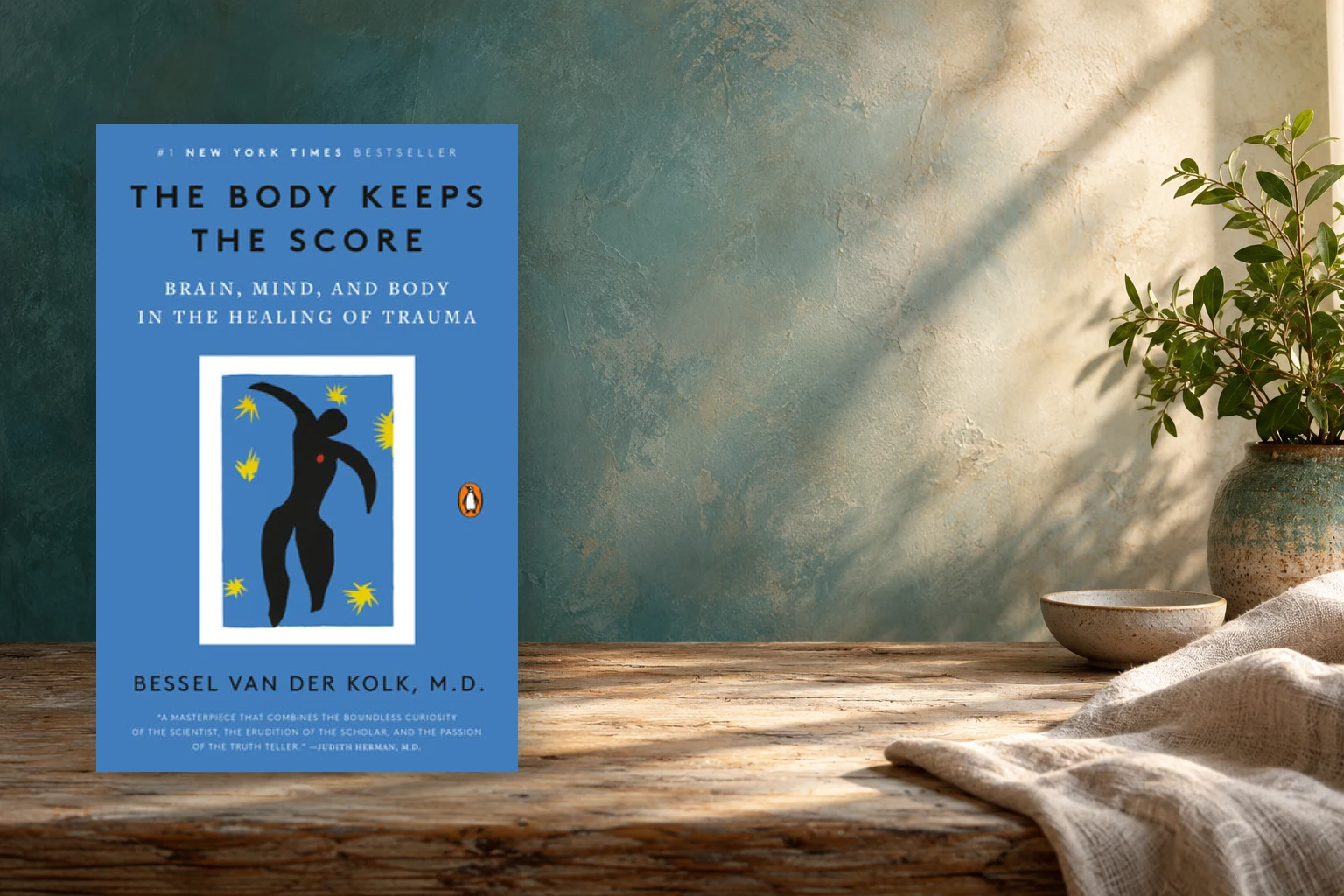
The Body Keeps the Score: Listening to Trauma, Testing the Claims
Bessel van der Kolk asks readers to take the bodily and relational effects of trauma seriously. The book’s humane reach remains powerful, though some sweeping claims about the brain and treatment need closer scrutiny.
Vivid clinical storytelling broadens public attention to trauma, bodily experience, and relationships.
A person can understand an event in words and still feel its effects in a racing pulse, a sudden withdrawal, or a difficulty trusting another person. Bessel van der Kolk’s The Body Keeps the Score brought this gap between explanation and lived experience to a wide audience. Drawing on clinical stories and research, it argues that traumatic stress involves bodily responses, memory, attention, and relationships, not just a narrative waiting to be told correctly. That insistence has made the book influential. It has also made its strongest formulations unusually important to examine, because readers may carry them into decisions about care.
The book’s ethical appeal begins with its refusal to treat symptoms as failures of character. Responses that appear irrational from outside can become more intelligible when placed in the context of threat and survival. A person who freezes, scans for danger, or feels detached may be responding through patterns shaped by experience. Van der Kolk’s writing gives such patterns a history. This can make room for compassion without romanticizing suffering. It also reminds readers that a diagnosis alone does not describe the social and bodily texture of a life.
Clinical storytelling is central to the book’s force. Individual cases turn abstract discussions of stress into encounters with people whose lives cannot be summarized by a test result. They show why trust, safety, and the pace of treatment matter. Yet a case can illuminate a possibility without proving a general rule. Readers are moved by a particular recovery or obstacle precisely because it has a human shape. The transition from a memorable story to a claim about what works for everyone needs another kind of evidence. The book’s narrative power sometimes makes that transition feel smoother than it is.
The body in the title is a helpful corrective to the idea that distress is only a matter of choosing better thoughts. Sleep, posture, breath, pain, arousal, and the capacity to feel present can all be part of how a person experiences the aftermath of threat. Van der Kolk widens the reader’s attention to these dimensions. He also places relationships near the center: people can be hurt within relationships and may need reliable connection in recovery. This is more than a technical point. It changes the moral tone of the conversation from asking why a person will not simply move on to asking what conditions make safety possible.
Still, a memorable metaphor can become misleading when treated as a literal map. The phrase “the body keeps the score” does not mean that every sensation reveals a hidden traumatic memory, or that trauma leaves one uniform mark in every brain. A later scholarly appraisal of the book’s neurobiological and treatment claims cautions against overstating the certainty of these explanations. Research on traumatic stress is substantial, but its findings do not justify a simple story in which one kind of experience produces one fixed bodily signature. The gap between a useful image and an established mechanism matters for readers who may be trying to understand themselves.
Treatment is the other area where careful distinctions are essential. The publisher describes the book’s interest in approaches that include movement, yoga, drama, meditation, and neurofeedback. These possibilities broaden the public imagination beyond a single style of talk therapy. That openness can be welcome, especially when a person has not benefited from one approach. But enthusiasm for a method is not the same as comparative evidence that it is best for a given condition or person. Research quality, access, practitioner skill, preferences, and safety all matter. The book should start informed questions with a qualified professional, not settle them on behalf of a reader.
This caution does not erase the value of the book’s challenge to narrow clinical habits. Institutions can be slow to notice the ways fear shapes concentration, behavior, and the ability to ask for help. Van der Kolk presses readers to see a whole person rather than a collection of symptoms. His history of changing ideas about trauma also shows that scientific and medical categories develop through argument, evidence, and experience. The trouble comes when a challenge to old certainty hardens into a new certainty of its own. A more durable lesson is to remain curious about what a person reports and disciplined about what a treatment claim can support.
Readers should also consider the emotional demands of the material. The book discusses severe experiences and their aftermath in direct, sometimes distressing terms. Its breadth may make it tempting to interpret many ordinary reactions through a trauma lens. For some, the language will clarify a longstanding difficulty; for others, it may be too broad or too intense. Reading slowly, setting it aside, or seeking a different resource can be reasonable choices. The book’s influence does not create an obligation to find oneself in every case it presents.
The Body Keeps the Score remains a consequential work of public psychology because it asks people to take suffering seriously in the body, in memory, and in relationships. Its compassionate framing and vivid prose can change how readers listen. Its limitations are equally consequential: striking metaphors and case histories can outrun the strength of particular scientific or treatment claims. No single story in the book should become a template for another person's history or recovery. The most responsible way to read it is with both responses intact. Let its human attention expand the questions, then bring the best available evidence and individual clinical judgment to the answers.
EDITOR’S VERDICT
Tale24’s assessment
Vivid clinical storytelling broadens public attention to trauma, bodily experience, and relationships.
Points to considerSome neurobiological explanations and treatment claims are presented with more confidence than the evidence supports.
Best for: General readers interested in trauma history and clinical ideas who will read treatment claims critically.
Editorial method: This is an independent assessment informed by the work and its official supporting information. AI tools may assist the drafting process; Tale24 reviews and takes responsibility for everything it publishes.