Literature & Thought · CRITICAL ESSAY
Missing Molly and the Cost of Being Found
Natalie Barelli puts a woman in the newsroom investigating her own disappearance. The setup asks whose interests a true-crime story serves when its missing subject has built a life out of sight.
A reversal of the missing-person premise gives the podcast and the home life competing stakes.
A missing-person story usually asks its audience to imagine the relief of a reunion. The premise of Natalie Barelli’s Missing Molly turns that expectation inside out. The public wants a missing girl to be found. The woman who was that girl needs the search to fail. Between those desires stands a local newspaper with a microphone, a deadline of its own, and no reason at first to understand what a successful investigation could cost its employee. The dilemma gives a familiar thriller setup a sharper question. What if the ending listeners have been taught to hope for is the outcome the person at the center fears most?
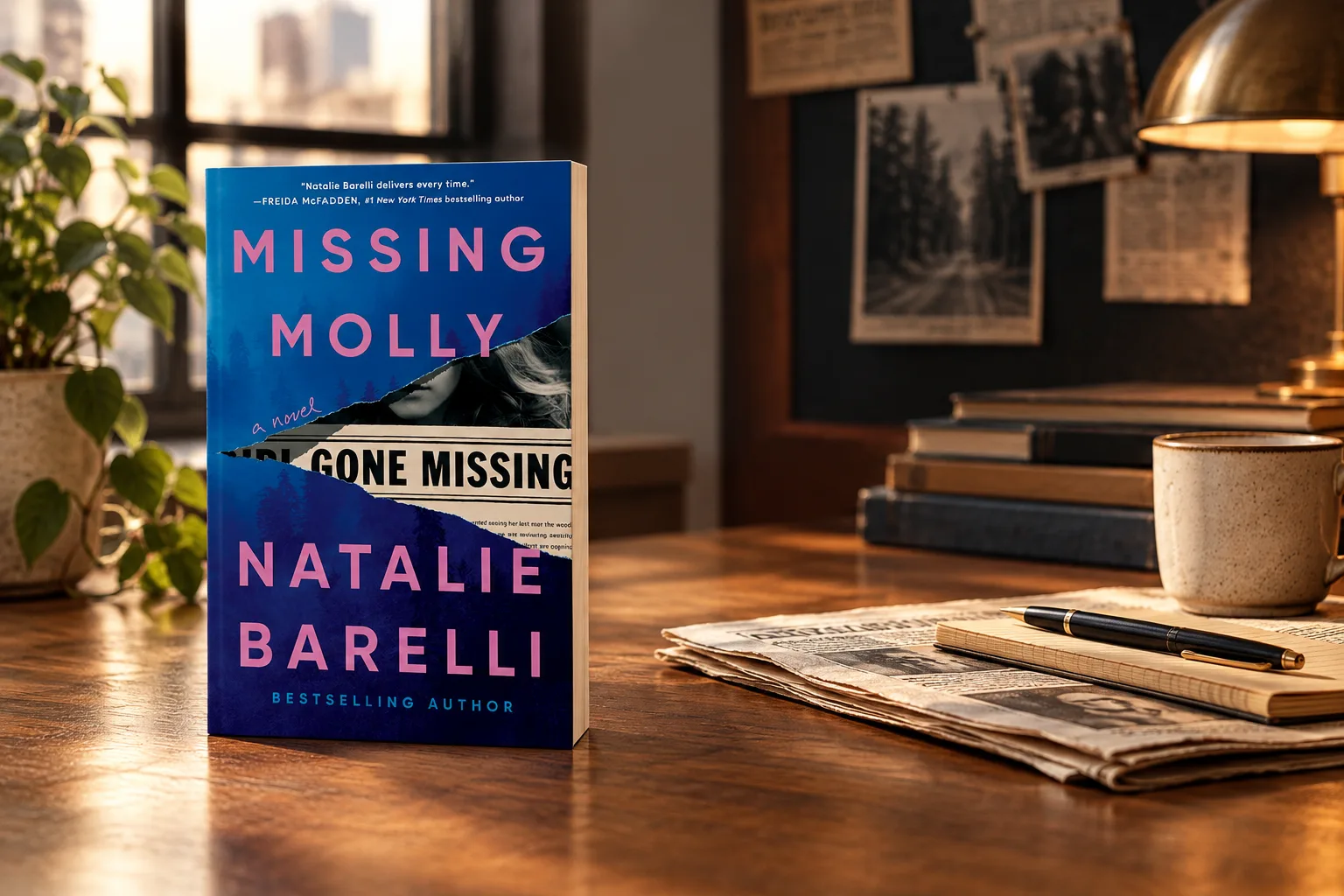
The publisher and Barelli both disclose the premise that Rachel Holloway is Molly Forster, so this reading discusses that setup and leaves the ending alone. It draws on the official descriptions and Lori L. Lutes’s published account of reading an advance copy, with the analysis limited to what those sources establish. The edition considered here is the Poisoned Pen Press paperback listed by Sourcebooks under ISBN 9781464247514.
Rachel has a partner, a daughter, and work at a London newspaper. These details give the risk a scale a cold-case headline cannot easily convey. A listener can imagine the missing child returning to public view as if the intervening years were an empty stretch of the timeline. For Rachel, those years are where most of her adult life happened. The name under which she lives belongs to ordinary routines, relationships, and obligations. Treating it as a disguise that can simply be peeled away would overlook why the premise makes being found feel like a loss. Once two names become publicly connected, other people can circulate that connection without her permission.
Placing Rachel inside the newspaper changes what the reporting can mean to her. She knows the project exists because it is part of her working life. Her colleagues, meanwhile, can discuss the case in front of her as a story about a stranger. The knowledge gap gives an ordinary workplace exchange two possible readings. A question that sounds like a sensible editorial decision to one person can sound like a warning to another. The setup can generate suspense out of the distance between the information people have, even before anyone makes an overt threat.
There is also a difference between wanting a case solved and wanting its subject publicly identified. One concerns the accuracy of an account and the responsibilities of the people investigating it. The other concerns who gains access to a living person. The questions may point in the same direction, but the premise is strongest when it lets their answers diverge. Rachel’s reasons for withholding information matter even when secrecy has consequences for other people. The reporters’ interest in revisiting the case can likewise be intelligible even as their work poses a danger they did not anticipate. Both sides can act from reasons that make sense within the lives they know.
Lutes reports that the novel includes written podcast scripts and credits the short chapters with sustaining momentum. The presence of scripts interests me because it creates a place for the case to become an account intended for strangers. An episode needs to select what is relevant, decide how much uncertainty to disclose, and bring an audience along. Rachel has to live through the consequences of those choices after the episode has done its work. Even a careful account can invite its listeners to ask for more. A person deciding how much of her past to disclose has no comparable obligation to keep the story moving for an audience.
That difference gives the book a way to use the podcast beyond its familiarity as a suspense device. A recording is made to be repeated and shared. What sounds like a manageable disclosure among colleagues can become something else when it is given a title, an audience, and an identifiable subject. This is the part of the premise that stays with me. Once the story is public, correcting a detail may be possible, but returning the subject to obscurity is a much harder undertaking. The people who decide to tell the story and the people who bear that cost can be different groups.
The setup also depends on a difficult balance. Rachel’s proximity to the reporting creates tension, yet the closer she is to decisions about the podcast, the more the story must persuade readers that her influence is plausible. Lutes found the novel engaging but questioned aspects of Rachel’s ability to steer the investigation and found some turns harder to accept. That is one reader’s judgment. It identifies a useful question for anyone deciding whether to pick up the book. Is the friction of the newsroom part of the appeal, or is the newsroom chiefly a way to put Rachel under pressure? Readers drawn to the mechanics of a credible investigation may care more about the distinction than readers who come for the hazards of maintaining a double identity.
Missing Molly is an appealing prospect for readers who like domestic suspense to spill into a public setting. The family stakes give the search consequences beyond solving a puzzle, and the newspaper gives private decisions an audience Rachel cannot choose. The premise offers an especially good reason to read if you are interested in the gap between an investigator’s idea of closure and the life that continues after the story ends. The question that makes me curious about Barelli’s novel is what Rachel might owe the truth when others get to decide how widely it travels.
CRITICAL PERSPECTIVE
Tale24’s assessment
A reversal of the missing-person premise gives the podcast and the home life competing stakes.
Points to considerOne advance-copy reviewer questioned some turns and the plausibility of Rachel’s influence at the newspaper.
Best for: Readers drawn to domestic suspense, dual identities, and the ethics of true-crime storytelling.
Editorial method: This is Tale24’s original analysis of the published material and attributed criticism. The sources and evidence limits are listed below.
READING AND RESEARCH
Sources and scope
This essay examines the published premise and attributes observations about the novel's form and plausibility to a reviewer who disclosed receiving an advance copy.
- Sourcebooks: Missing Molly, Poisoned Pen Press paperbackPublisher's information
- Natalie Barelli: Missing MollyAuthor's information
- Lori L. Lutes: Missing MollyAdvance-copy review
Sources checked November 6, 2026.