Literature & Thought · TALE24 REVIEW
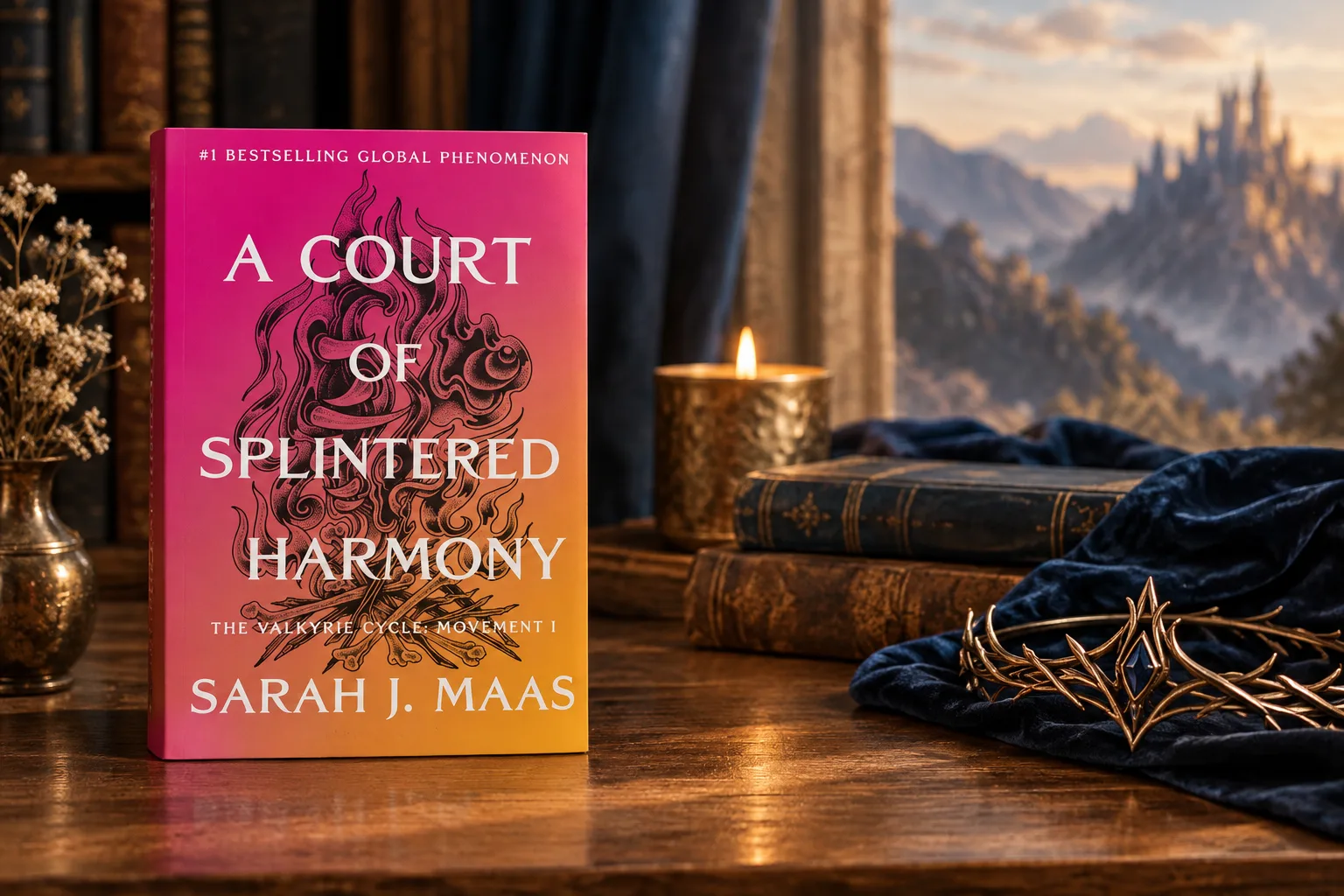
When a Bestseller Is Only Movement I: A Court of Splintered Harmony
Amazon's current #1 bestseller returns to Prythian as the first movement of a story still in progress. This opening-week assessment weighs the promise of a fractured court against early reviewers' concerns about delayed payoff, drawing on Bloomsbury's synopsis and published reviews rather than claiming firsthand reading.
The publisher’s premise aligns political fracture with damaged trust; early reviewers note vivid character debates and a frank depiction of new motherhood; the serial structure gives established fans an active field for speculation.
This opening-week assessment is based on Bloomsbury’s published synopsis and the first reviews available after publication; it does not claim firsthand reading. That boundary matters for a book whose title, A Court of Splintered Harmony, sounds like a promise of repair, while its subtitle, The Valkyrie Cycle, Movement I, signals that repair will unfold across volumes. Sarah J. Maas has returned the Night Court to the center of a story whose largest conflict is still being assembled. The question is whether this first movement gives its own fractures enough shape to feel satisfying before the next installment arrives.
Bloomsbury’s premise links political danger to private distrust. Koschei the Deathless is stirring, threatening the human lands, while Prythian remains unsettled after the Hybern War. The Night Court needs allies, but betrayals and new truths have left its own circle divided. This is a promising fantasy structure: a coalition cannot confront an outside threat until it addresses the ruptures within. The title makes that connection explicit. Harmony is not simply a mood to restore; it is the political resource the court lacks.
The risk is that an installment can announce a meaningful conflict without moving it far enough. The first reviews suggest that some readers experienced the book less as a complete novel than as an opening segment. Garri James, writing a spoiler-free review for The Everygirl, finds that viewpoints return to unresolved emotional disputes and that the plot advances slowly between them. Booklist Queen likewise describes the volume as a prelude whose buildup may outpace its payoff. These are individual critical responses, not a consensus, but they identify the central formal challenge: when a larger story is divided into movements, the first volume still needs a compelling shape of its own.
There is a case for the delay. In a long-running series, the emotional history among characters can be the event. Trust, resentment, divided loyalties, and old decisions give the fantasy conflict a human scale; fans who have followed these relationships may value seeing them remain difficult rather than being neatly resolved on cue. A volume devoted to reassembling alliances can also prepare a later crisis with care. The subtitle invites readers to treat this as an opening movement rather than a finale, and the publisher’s copy does not pretend that the external threat is already settled.
But expectation is part of form. A book can be one part of a larger design and still offer a local arc: a decision made, a relationship altered, a danger newly understood. If too many scenes circle the same wounds without changing what the characters can do, deliberate suspense may feel like postponement. James’s criticism is useful here because it distinguishes investment in future books from satisfaction with this one. Her review remains interested in where the romantic triangle involving Azriel, Elain, and Lucien may lead, even as she finds the present volume’s pace and closure frustrating. The fact that readers are eager for the next book is evidence of an active series, but not by itself proof that this installment lands.
A separate early response points to a more distinctive source of texture. In Harper’s Bazaar, Jenna Rosenstein focuses on the book’s depiction of breastfeeding and new motherhood. She argues that the physical labor of nursing is rendered with unusual frankness for romantasy, and that maternal identity is allowed to coexist with desire and public responsibility. That interpretation suggests a productive tension with the epic setting: magical power does not erase the ordinary demands of care. It is a specific critical reading, not a substitute for a broader assessment of the novel’s execution, but it helps explain why the book’s domestic details may matter alongside its court politics.
The series knowledge required is another practical part of the experience. This is book six in A Court of Thorns and Roses, and early coverage indicates that links to Maas’s Crescent City books may shape how some developments read. Existing readers may welcome that shared-world continuity as added context. Readers arriving here from the bestseller list alone may find that names, allegiances, and unresolved history carry more weight than a standalone synopsis can convey. The book is not an ideal entry point, and anyone who wants immediate closure may prefer to wait until A Court of Forgotten Melody, the next volume, is available.
The Amazon ranking explains why the release is hard to miss: on November 1, 2026, the US product page places it at #1 in Books and shows #1 positions in several fantasy categories. That is a strong signal of attention, supported by a large number of customer ratings in the first week. Bestseller status tells us that readers are showing up; it cannot settle the question of whether the structure works. The early critical picture is mixed in a useful way: anticipation has translated into discussion, but discussion includes frustration with pacing and uncertainty about how much of the promised story this volume delivers.
A Court of Splintered Harmony appears best suited to readers who already know Prythian and enjoy relationship-driven romantasy, shifting loyalties, and the speculation that follows an unfinished arc. Its core design has potential: the political problem mirrors the emotional one, and the attention to motherhood may broaden the series’ sense of what power and intimacy require. The limitation, as the first reviews describe it, is that preparation for a later installment can make the current one feel under-resolved. The title names a real thematic aim; whether the full harmony arrives is a question the series has left for its next movement.
That combination of strengths and limits argues for a measured verdict rather than a reaction to the chart position. Amazon's #1 rank documents unusual attention at launch, while the available reviews already show that attention splitting into different expectations: some readers value character revelations and intimate detail; others want more plot movement and a clearer stopping point. Those reactions are not contradictory. They reflect a series balancing two promises—an ongoing world for long-time fans and a satisfying experience in each book. This volume appears strongest when it treats fractured relationships as the story's central problem; it is more vulnerable when its larger conflict waits for a future installment to become concrete.
EDITOR’S VERDICT
Tale24’s assessment
The publisher’s premise aligns political fracture with damaged trust; early reviewers note vivid character debates and a frank depiction of new motherhood; the serial structure gives established fans an active field for speculation.
Points to considerEarly reviews raise concerns about slow movement and deferred payoff; the first volume may not feel complete on its own, and continuity from the earlier ACOTAR and Crescent City books can make it a difficult entry point.
Best for: Readers already familiar with A Court of Thorns and Roses who enjoy character-led romantasy, unresolved emotional conflict, and ongoing series speculation. Newcomers and readers who prefer self-contained plots may want to wait for the next installment.
Editorial method: This is an independent assessment informed by the work and its official supporting information. AI tools may assist the drafting process; Tale24 reviews and takes responsibility for everything it publishes.