Literature & Thought · TALE24 REVIEW
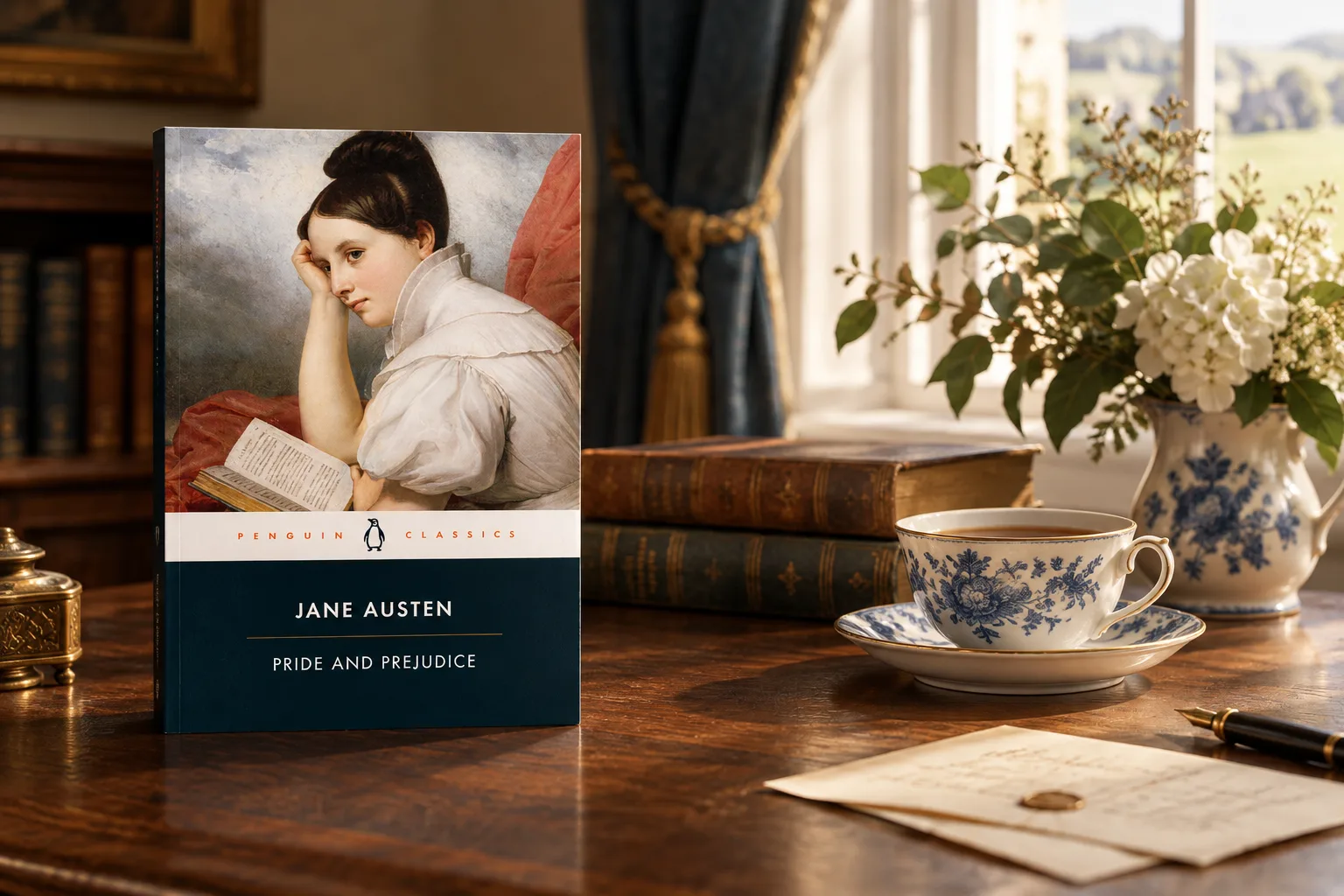
Pride and Prejudice: Love Under the Rules of Money and Manners
Elizabeth and Darcy’s romance lasts because Austen makes every first impression answer to family pressure, financial security, and the limits of judgment.
Witty dialogue, layered social satire, and a romance built on genuine change
Pride and Prejudice is often sold as a love story about two people who learn to set aside a bad first impression. That description is true, but it leaves out the mechanism that makes Jane Austen's novel so durable. Elizabeth Bennet and Fitzwilliam Darcy misjudge each other in a society where a mistake about character can have material consequences. Marriage determines security, inheritance favors men, and a family's reputation can change the choices available to its daughters. The romance works because Elizabeth's wit and Darcy's reserve meet inside a system that gives neither of them the luxury of being simply private.
Elizabeth's first advantage is also her first risk: she is quick to notice absurdity. Her sharp observations make the novel funny, especially when social ritual allows vanity or self-interest to masquerade as good manners. Yet being able to expose another person's foolishness is different from understanding that person fully. Elizabeth's dislike of Darcy begins with his arrogance at a dance, and he does little to make a better impression. Austen lets the reader enjoy Elizabeth's judgment before asking whether enjoyment has made it too easy to accept. The book's title applies to both central characters, though not in identical ways.
Darcy's wealth and standing give his pride a social force that Elizabeth's prejudice does not possess. He can be rude without immediately threatening his future. Elizabeth cannot afford the same freedom from consequence, even when she is morally right. This imbalance keeps their exchanges from becoming an abstract lesson about two equally stubborn personalities. His change matters because it has to be expressed through conduct, not merely through a more attractive declaration of feeling. Her change matters because it requires intellectual honesty without demanding that she surrender her independence of mind.
The Bennet household makes those stakes visible. With no son to inherit the family estate, the daughters face a future that their father cannot fully secure. Mrs. Bennet's anxious pursuit of marriages can be exhausting and comic, but the pressure beneath it is real. Austen's skill lies in refusing to make practical concerns disappear when love enters the room. A proposal is also an offer of housing, income, and position. The reader may laugh at the family's maneuvering while seeing why it takes place. That double response is central to the novel's comedy of manners.
Charlotte Lucas offers one of the clearest tests of an easy romantic reading. Her choice of a secure marriage differs sharply from Elizabeth's hopes, yet Austen does not need to portray her as a woman incapable of feeling. Charlotte understands the options available to her and makes a calculation. Elizabeth's objections remain meaningful; so does Charlotte's need for a life she can sustain. Their friendship prevents the novel from pretending that every intelligent woman can reject a poor match and wait for a better one. The love story is therefore framed by an uncomfortable question: how much freedom does conviction require?
The plot's movement through letters, visits, dinners, and overheard opinions also makes reading itself a subject. People in this world assemble character from partial evidence. A confident account can travel faster than a careful correction, and a polished manner can make a dubious person seem trustworthy. Elizabeth's growing knowledge does not come from becoming less observant. It comes from revisiting what she thought she had observed. Austen gives the reader a parallel task: to notice when a pleasing explanation fits the available facts too neatly. The novel's suspense is partly the suspense of interpretation.
Lydia Bennet's situation shows why interpretation cannot remain a private game. A younger sister's conduct threatens the family's reputation, and the consequences would fall unevenly on all the daughters. Modern readers may resist a world that makes women bear such collective costs. The novel gives them reason to resist it. Its social rules are not decorative obstacles placed between a couple and a happy ending; they organize vulnerability. Darcy's response to the crisis matters because it enters that unequal world of consequences. The point is not that money buys virtue, but that a privileged man can choose whether to use his resources responsibly.
Austen's style is part of the pleasure, and also part of the challenge for a first-time reader. Her irony is precise rather than loud. An apparently polite sentence may reveal an entire social judgment, while a comic conversation can carry a serious argument about power. Readers expecting continuous romantic confession may find the opening social rounds slow, and some of the economic rules require attention. The reward is that every encounter does more than advance a courtship. It tests what people believe they know and what their circumstances permit them to say.
There is a reason the novel survives adaptation after adaptation. Elizabeth and Darcy offer a satisfying pattern of mutual correction, but Austen never isolates their feelings from sisters, parents, neighbors, and money. The book invites readers to want a good marriage while asking them to see the social arrangements that make a bad one tempting. It is funniest when someone mistakes status for character, and most moving when someone quietly acts against that mistake. These strengths are more interesting than a promise that the leads are perfectly suited from the start.
Pride and Prejudice is an excellent choice for readers who enjoy character-driven romance with an alert, skeptical narrator. Its famous couple may be the reason to open the book, but Charlotte, the Bennets, and the wider marriage market are the reasons to keep thinking about it. Austen offers the delight of watching two people change their minds. She also asks what it costs to form a judgment in the first place, especially when society is eager to tell you what that judgment should be.
EDITOR’S VERDICT
Tale24’s assessment
Witty dialogue, layered social satire, and a romance built on genuine change
Points to considerThe social rules and leisurely opening require attention from modern first-time readers
Best for: Readers who enjoy intelligent romance, family comedy, and sharp social observation
Editorial method: This is an independent assessment informed by the work and its official supporting information. AI tools may assist the drafting process; Tale24 reviews and takes responsibility for everything it publishes.