Literature & Thought · TALE24 REVIEW
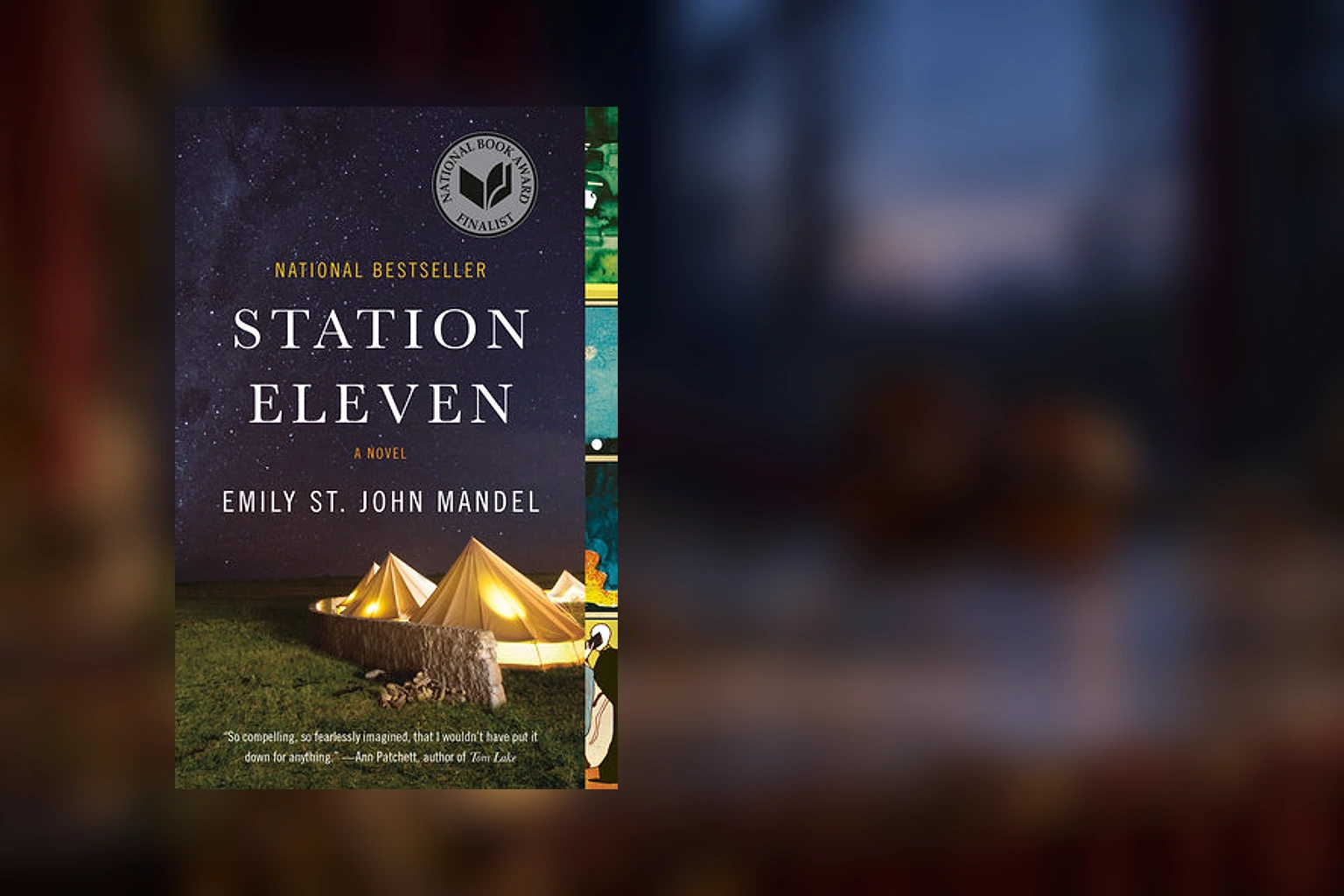
Station Eleven: Why Art Survives the End of a World
Through a traveling theater company and a fractured timeline, Emily St. John Mandel asks what culture preserves when ordinary systems disappear.
Elegant time structure and an unusually humane view of post-collapse culture
Many stories about catastrophe ask what people would do to stay alive. Emily St. John Mandel’s Station Eleven asks what survival is for. Fifteen years after a flu pandemic has devastated civilization, Kirsten travels through the Great Lakes region with the Traveling Symphony, performing music and Shakespeare for scattered communities. The premise is not an argument that art can replace food, shelter, or security. It is an inquiry into the human needs that remain once those necessities are met, however precariously. A performance can connect strangers to a past they did not all share and to a future they might still imagine together.
The Symphony gives the novel a moving center, but Mandel does not confine the story to the post-pandemic road. She moves between periods before and after the collapse, allowing earlier relationships and objects to acquire new weight. This structure changes the usual suspense of an end-of-the-world narrative. Readers are not merely waiting to learn how the disaster unfolds. They are asked to notice how much of ordinary life becomes precious in retrospect: a routine encounter, a cultural habit, a piece of work whose meaning was not evident at the time. The fragmented timeline makes memory an active force rather than a storehouse of background information.
Kirsten’s work as an actor gives this interest in memory a practical form. Theater is carried by bodies and repeated in front of other people; it cannot simply be preserved in a sealed archive. The troupe’s performances depend on rehearsal, cooperation, travel, and the willingness of an audience to gather. In that sense, art is not a luxury object left over from a richer world. It is a social practice that briefly creates a public. Mandel does not have to claim that Shakespeare cures trauma for the performances to matter. Their value lies partly in the chance to spend time with something other than fear.
The contrast between the world before the pandemic and the world afterward is handled with a light touch. The former had enormous material capacity but often scattered attention across fame, work, and private disconnection. The latter has fewer conveniences and far greater danger; it also makes the work of sustaining community impossible to overlook. The novel is strongest when it avoids treating either era as morally pure. Collapse is not a cleansing event. Nor does technological abundance guarantee that people will understand what they possess. The alternating periods expose blind spots in both kinds of life.
Mandel’s elegiac style helps explain the book’s appeal. Its catastrophe is vast, yet the prose directs attention to relationships and artifacts rather than a catalogue of ruined infrastructure. This choice gives Station Eleven an intimacy that many speculative novels set aside. It also creates a limit. Readers who want a detailed account of agriculture, governance, health care, or the material process of rebuilding will find much of that work outside the frame. The book is interested in how people make meaning within a changed world, not in supplying a complete model of how such a world could function.
That emphasis becomes more complicated when the Traveling Symphony encounters a dangerous self-proclaimed prophet. Shared stories can sustain a community, but they can also be used to claim authority and narrow what others are allowed to believe. The presence of this threat keeps the novel from treating culture as automatically benevolent. A performance offered to an open audience differs from a story imposed by someone who demands obedience. Station Eleven asks readers to attend to the conditions in which a narrative circulates: who may speak, who may leave, and whether imagination enlarges or confines the lives of others.
The novel’s nonlinear form is more than a decorative puzzle. It makes the reader perform a small act of reconstruction, holding separate times in mind until connections emerge. That experience echoes the characters’ effort to assemble a usable sense of the past. Importantly, the past is never fully recoverable. Those born after catastrophe inherit stories, objects, and customs whose original settings are partly lost. Their task is not simply to reproduce an earlier world. It is to decide what deserves to travel forward, and how a fragment can acquire new meaning without erasing where it came from.
Station Eleven was a National Book Award finalist and won the Arthur C. Clarke Award. Those honors recognize a novel that crosses literary and speculative traditions with unusual ease. Yet the book should be approached with the right expectations. Its quiet transitions and broad web of connections ask for patience; its vision of collapse is shaped more by feeling and memory than by technical prediction. Some readers will want a fuller account of collective labor and political organization. That reservation is fair, especially because art itself relies on material support and on people whose work is less visible than a performance.
The book’s best passages ask readers to see continuity where a disaster narrative would emphasize rupture. A phrase learned in one life can be carried into another; a familiar story can be performed for people whose circumstances are wholly different. Continuity here is never perfect. It is made through repeated acts of interpretation, each of which acknowledges loss while refusing to let loss be the only inheritance.
What remains persuasive is Mandel’s insistence that culture has a life beyond prestige or entertainment. In the Traveling Symphony, it becomes a way to meet, remember, disagree, and briefly share a place. The novel does not pretend that a play can make disaster bearable for everyone. It suggests something narrower and more durable: when people keep making and receiving art, they keep practicing forms of attention to one another. Station Eleven turns that practice into a reason to think about survival as a beginning, not an adequate end.
EDITOR’S VERDICT
Tale24’s assessment
Elegant time structure and an unusually humane view of post-collapse culture
Points to considerReaders wanting detailed survival logistics may find the practical world lightly drawn
Best for: Readers of literary speculative fiction, theater, and stories about cultural memory
Editorial method: This is an independent assessment informed by the work and its official supporting information. AI tools may assist the drafting process; Tale24 reviews and takes responsibility for everything it publishes.