Psychology & Skills · TALE24 REVIEW
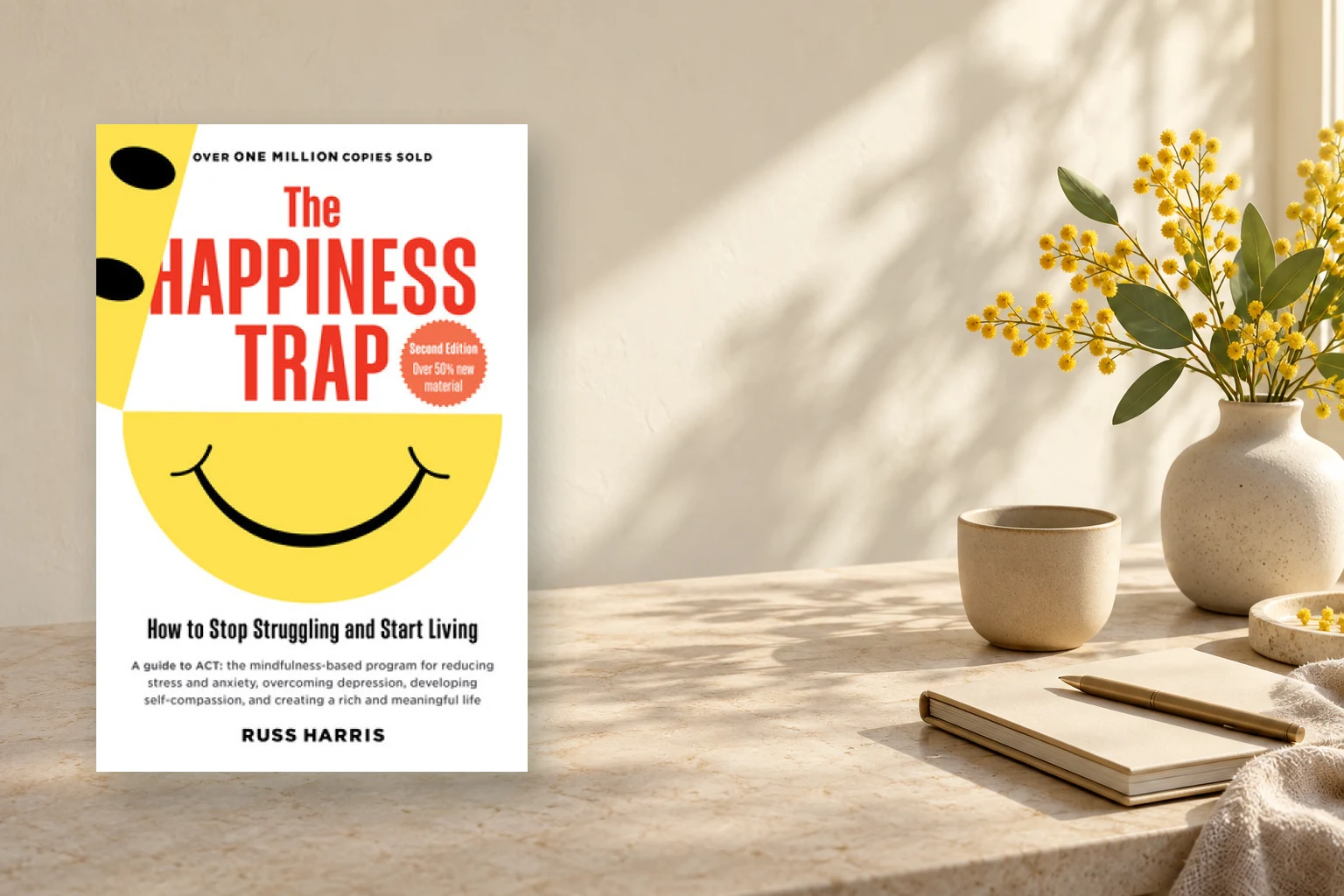
The Happiness Trap: A Life Larger Than Feeling Good
Russ Harris turns the pursuit of happiness into a question about how we respond to difficult feelings. His ACT exercises offer a useful vocabulary for living by values, with limits that self-help readers should keep in view.
Clear, repeatable exercises make psychological flexibility feel practical rather than abstract.
A promise to make us happy can become one more demand we fail to meet. Russ Harris builds The Happiness Trap around that uncomfortable observation. In its revised second edition, the book presents acceptance and commitment therapy, or ACT, for general readers: a set of ways to notice thoughts, make room for difficult feelings, and act on what matters. Its strongest move is to change the question. Instead of asking how to feel good more often, Harris asks what kind of life we can build while feelings continue to change. That shift gives the book more substance than its inviting self-help title suggests.
The trap is not pleasure itself. Harris does not argue that joy is suspect or that pain should be welcomed for its own sake. The difficulty begins when a person treats a pleasant inner state as the condition for participating in life. Worry then becomes evidence that a plan is failing; sadness becomes a defect to remove before calling a friend or taking a risk. Attempts to control every thought can occupy so much attention that they crowd out the action the person wanted to take. Harris gives this familiar cycle a name, which can be useful precisely because it is ordinary rather than exotic.
ACT offers a different relationship to mental events. A thought can be noticed as a thought without being treated as an instruction or a verdict. The practice often called cognitive defusion creates a little distance between a sentence in the mind and the choice that follows it. That distance does not settle whether the sentence is true. It allows a reader to ask a more immediate question: is following this thought helping me move toward the life I value? The book's examples and exercises make that question easier to remember when abstract advice about positive thinking would offer little help.
The emphasis on acceptance can be misunderstood. In this context it does not mean approval of injustice, resignation to avoidable harm, or refusal to seek treatment. It concerns the energy spent fighting sensations and emotions that are already present. A person can acknowledge fear and still prepare for a conversation; grief and still take care of a small obligation. Harris is persuasive when he presents acceptance as an active form of attention. The point is to gain room for a response, not to declare pain a hidden gift. Readers facing serious distress will need more than a paperback exercise, and the book works best when its scope stays clear.
Values give the method its direction. The publisher highlights clarifying values as a central part of the expanded edition, and that emphasis prevents the exercises from becoming mere techniques for tolerating discomfort. A value is not a finish line that can be crossed and forgotten. It is a quality of action that can be expressed repeatedly, whether the chosen direction is care, curiosity, honesty, or steadiness. This distinction also guards against turning ACT into another performance system. One can practice a value imperfectly on an anxious day; the act remains meaningful even when the feeling does not improve on schedule.
The book's practical design is both its appeal and its constraint. Brief exercises lower the threshold for trying an unfamiliar idea. A reader can return to a page, test a prompt, and observe what happens in a particular situation. That repeatability matters more than a dazzling explanation of the mind. Yet the same accessible pace can make change appear tidier on the page than it feels over months of habit, stress, and competing demands. An exercise may create a moment of flexibility without resolving the circumstances that make a person exhausted. Harris's tools are most convincing as a beginning of practice, not as a complete account of a life.
Self-compassion is another valuable part of the revised edition. Popular advice often turns awareness into monitoring: notice the mistake, correct the thought, track the result. Harris's framework makes space for a gentler response when the old pattern returns. That matters because the wish to be psychologically flexible can itself harden into a rule. If a reader judges every lapse as failure, the book's central lesson has been inverted. The better measure is whether the practice supports a more workable response over time. Compassion here is not a reward for success; it is part of how one stays engaged.
There is a fair question about the genre's reach. The publisher presents applications to relationships, work, insecurity, loss, and illness. Such breadth helps readers see that the underlying habits are not confined to a clinic. It also asks one framework to travel across very different conditions. The book cannot determine whether someone's difficulty is primarily a passing habit, a clinical problem, an unsafe relationship, or an exhausting environment. Its suggestions should therefore invite reflection rather than replace assessment. A reader should be especially wary of using acceptance language to endure a situation that requires protection, practical change, or outside help.
The Happiness Trap succeeds when read as an invitation to experiment with psychological flexibility. It gives readers language for a subtle but consequential distinction: unpleasant thoughts and feelings can be present without being placed in charge. Its memorable exercises, plain style, and focus on values make that distinction usable. Its limits are those of a broad self-help guide, which cannot know a reader's history or promise a particular result. Harris offers no credible route to permanent happiness. The more interesting possibility is a life that does not have to wait for permanent happiness to begin.
EDITOR’S VERDICT
Tale24’s assessment
Clear, repeatable exercises make psychological flexibility feel practical rather than abstract.
Points to considerIts brisk self-help format can make sustained practice and individual differences seem simpler than they are.
Best for: Readers seeking an accessible introduction to ACT and a values-based approach to everyday distress.
Editorial method: This is an independent assessment informed by the work and its official supporting information. AI tools may assist the drafting process; Tale24 reviews and takes responsibility for everything it publishes.