Literature & Thought · TALE24 REVIEW
The Left Hand of Darkness: When Gender Stops Being a Ready-Made Answer
Ursula K. Le Guin uses a winter planet to dismantle familiar assumptions about gender, revealing that the greatest barrier between people may be not biology but the habit of treating one's own perspective as universal.
Deep world-building; an exceptional union of politics, anthropology, and emotion; the Genly–Estraven relationship develops with remarkable subtlety.
The Left Hand of Darkness is often introduced through its famous premise: on the planet Gethen, people have no fixed sex for most of the month. During kemmer they develop sexual characteristics and may become a father at one time and a mother at another. Yet reading the novel only as an experiment about gender misses its larger achievement. Ursula K. Le Guin does not build a world to supply an answer. She creates enough distance for readers to recognize assumptions they have carried as though those assumptions were simply nature.
Genly Ai arrives on Gethen as an envoy of the Ekumen, a federation of human worlds. His mission is to persuade its inhabitants that they are not alone in the universe and might join a wider network of exchange. In theory, Genly represents an advanced civilization. In practice, he repeatedly misunderstands the Gethenians because he interprets them through his own categories. He associates decisiveness with masculinity, gentleness with femininity, and distrusts qualities that do not fit either box. The diplomat sent to connect worlds must first learn to step outside his own frame.
Estraven, a former political figure in Karhide, is the novel's emotional center. Genly initially regards Estraven as evasive, obscure, and untrustworthy. Readers gradually see that much of the apparent mystery comes not from conspiracy but from cultural distance. Shifgrethor—a system of prestige, face, and indirect communication—makes political behavior on Gethen impossible to translate directly into Genly's diplomatic language. Le Guin demonstrates that knowing the definition of a word is not the same as understanding the worldview that produced it.
Karhide and Orgoreyn represent contrasting forms of power. Karhide appears disorderly and personal, vulnerable to the king's temperament. Orgoreyn is more orderly, administrative, and at first seemingly easier for a modern envoy to navigate. Then its rational apparatus reveals its capacity to imprison, erase names, and turn people into files. Le Guin avoids a simple contrast between bad tradition and good modernity. Violence can wear the theatrical face of a tyrant, she suggests, or operate quietly through forms and committees.
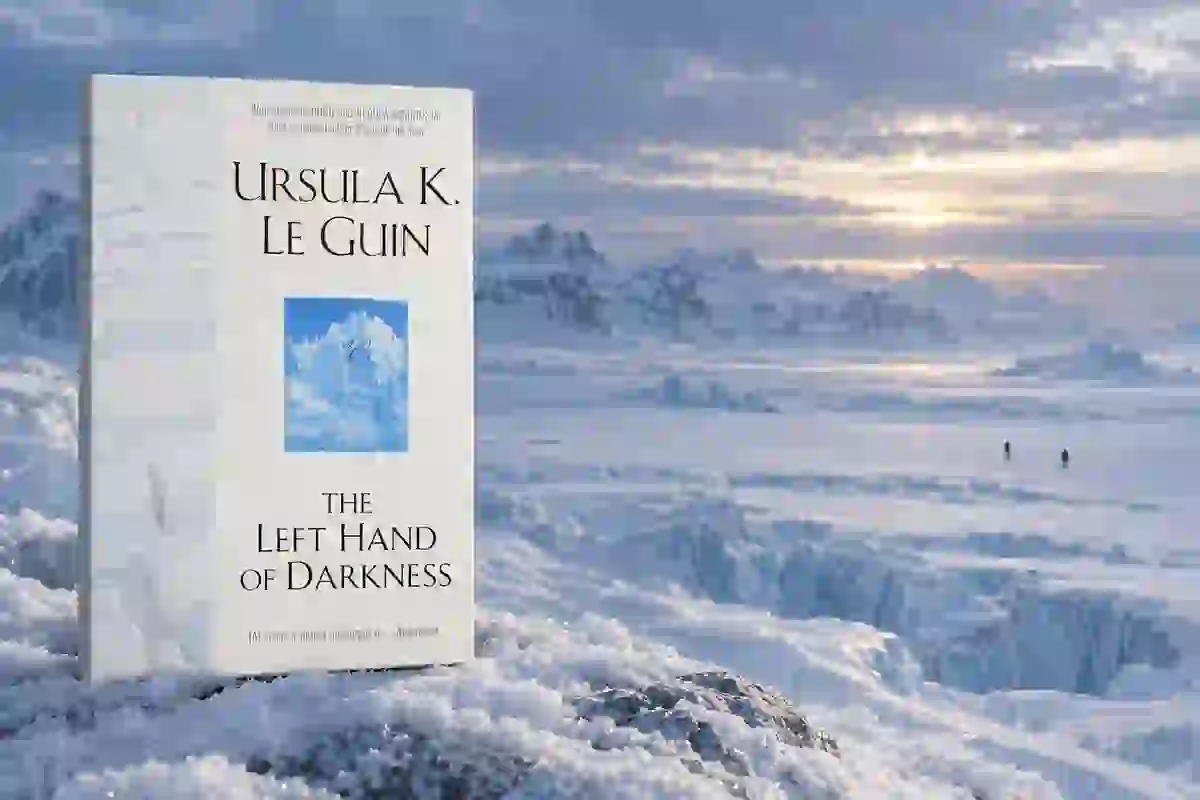
Winter is more than a setting. Cold shapes architecture, travel, food, and even the pace of politics. A society that must spend much of its energy surviving a hostile season will not develop like one in a temperate climate. Genly and Estraven's crossing of the ice is the novel's most celebrated sequence because every large idea is returned to the body. They must raise a tent, ration food, read the snow, and trust each other in every motion. Only when social roles are erased by white wind can their relationship change.
That friendship gives the book its unusual emotional force. Genly begins to see Estraven as a whole person rather than a riddle about gender. The change comes not through a speech but through shared cold, exhaustion, and dependence. Understanding is not projection: we do not need to turn another person into a version of ourselves in order to come close. We need to tolerate the unsettling possibility that our familiar categories are no longer sufficient.
For all its boldness, the novel also carries the limits of its period. Le Guin mainly uses masculine pronouns for Gethenians, so her nonbinary world is sometimes filtered through male language. She later criticized this decision herself and continued experimenting with gender in subsequent writing. That limitation need not disqualify the novel. It allows us to read a classic as an unfinished opening move. Progressive literature often matters most when it creates questions that it cannot completely answer.
The structure interweaves reports, myths, journals, and folktales. These shifts may feel slow to readers accustomed to adventure pacing, but they prevent Gethen from becoming decorative scenery for an outsider's journey. The planet has its own mythology, religion, and experience of time. Science fiction here approaches anthropology: technology is chiefly the means of placing humanity inside a different system of reference.
The title comes from a poem in which light is the left hand of darkness and darkness the right hand of light. Opposites are not abolished; they are shown to depend on each other. Male and female, loyalty and betrayal, patriotism and exile, individual and collective all change meaning when viewed from the other side. Le Guin does not ask us to live without distinctions. She asks whether we can stop turning difference into hierarchy.
The novel's political imagination is equally interested in time. The Handdara practice of “foretelling” does not grant the comforting power to master the future. Its ritual demonstrates the burden and futility of demanding certainty about what has not happened. Genly's mission, by contrast, depends on patient decisions whose results may not be visible for years. Together these strands challenge the modern fantasy that more information necessarily produces control. Knowledge matters, but wisdom may consist in recognizing which uncertainty cannot be removed.
That idea changes how heroism functions in the book. Genly arrives as the obvious protagonist: a lone traveler carrying advanced technology and a world-changing proposal. Yet Estraven performs the deeper work of imagination, understanding the mission before the envoy understands Gethen and accepting exile for a future that may never honor the sacrifice. The reversal is central to Le Guin's ethics. The outsider is not automatically the person with the widest view, and technological advantage does not guarantee moral clarity. Real connection begins when authority gives way to dependence, and when the presumed teacher becomes capable of being taught.
More than half a century later, The Left Hand of Darkness remains alive because it is not complacent about its own radicalism. A well-intentioned person can still be prejudiced; an envoy can still fail to listen; a civilization that considers itself mature can still learn from a world it calls remote. The best science fiction does not predict the future with precision. It makes the present less inevitable, so that on returning to our own lives we recognize how much of what we call natural is only habit repeated for a very long time.
EDITOR’S VERDICT
Tale24’s assessment
Deep world-building; an exceptional union of politics, anthropology, and emotion; the Genly–Estraven relationship develops with remarkable subtlety.
Points to considerThe opening is slow, and the masculine pronouns expose the historical limits of an otherwise pioneering experiment.
Best for: Readers of social science fiction and anyone interested in gender, anthropology, diplomacy, or political philosophy
Editorial method: This is an independent assessment informed by the work and its official supporting information. AI tools may assist the drafting process; Tale24 reviews and takes responsibility for everything it publishes.