Literature & Thought · TALE24 REVIEW
The Road: Care After the End of Certainty
In Cormac McCarthy’s devastated America, a father and son keep moving toward the sea. The novel’s deepest suspense concerns what care can preserve when safety has disappeared.
A spare, controlled style and an intense moral focus on parental care under pressure.
In a novel crowded with ruined landscapes, the most important thing in Cormac McCarthy's The Road is a relationship. A father and his son travel through a devastated America toward the sea, hoping that movement might preserve their lives even when it cannot promise safety. The setting is extreme, but the central pressure is familiar: an adult must make decisions for a child without knowing what future those decisions will secure. McCarthy uses the stripped-down journey to ask what care means when the institutions that ordinarily support it have vanished. Survival is necessary, yet it is never quite the same as a sufficient reason to live.
The publisher describes an ash-covered, postapocalyptic world and a route toward an uncertain destination. That premise could have supported an elaborate explanation of disaster or a sequence of escalating set pieces. The Road is more severe. Its attention rests on movement, scarcity, weather, and the work of staying alert. The limited horizon matters: father and son cannot plan from a position of abundance, and readers cannot step back into a reassuring account of how the world became this way. McCarthy leaves the catastrophe largely outside the frame of practical understanding. What remains is the experience of having to act inside its consequences.
The road itself is a deceptively plain structure. It gives the pair direction, but direction is not progress in any uncomplicated sense. Each new stretch may expose them to another threat. The journey's forward motion creates narrative suspense while also showing how fragile the idea of a destination can be. The sea represents possibility because it is somewhere else, not because the book offers a reliable promise that conditions will improve there. By narrowing the characters' options, McCarthy turns every decision about where to go, what to carry, and when to trust into an ethical problem as well as a logistical one.
The father-son bond gives those problems their emotional force. The father is responsible for protecting the boy, but protection can demand suspicion and severity. The boy, in turn, keeps alive a concern for others that the conditions of their travel might seem to make impractical. Their relationship does not resolve the tension between caution and generosity. It sustains it. If the father thinks only about their immediate safety, he risks teaching a lesson about the world that the child may not be able to live with. If he neglects danger in the name of kindness, he risks the child's life. McCarthy makes this conflict the moral weather of the book.
The prose supports that pressure. McCarthy's spare sentences and limited descriptive palette refuse the kind of lush visual spectacle that disaster stories sometimes invite. The result is not a lack of atmosphere; it is an atmosphere made from repeated deprivation. Ash, cold, and empty space become more disturbing because the language rarely pauses to congratulate itself on their grandeur. Even the unnamed central figures matter to the design. They are father and son before they are detailed biographies, a choice that concentrates attention on their roles and the obligations those roles carry. The book's austerity asks readers to supply patience rather than chase novelty.
That method is powerful, but it has a cost. A reader looking for a fully mapped fictional society or an explanation of the catastrophe may feel deliberately shut out. The accumulation of menace can also become exhausting. The Road does not vary its register as much as some readers may need, and its intensity can make the reading experience feel narrower than its large thematic claims. These are meaningful reservations, not signs that the novel fails to accomplish its aims. Its narrowness is a formal choice. The question is whether a reader wants to inhabit such a compressed field of fear and responsibility for the length of a book.
McCarthy's refusal to explain the disaster also prevents a simple topical reading. The novel can speak to anxieties about ecological collapse, political violence, and social breakdown without turning into an illustrated argument for any one diagnosis. Its interest lies in what remains after a crisis has removed familiar guarantees. The pair can no longer rely on markets, schools, law, or a stable community to translate good intentions into safe outcomes. Their moral vocabulary must operate under pressure, in acts and conversations whose consequences they cannot fully control. The speculative setting makes that dependence visible by taking the supporting structures away.
The book's hope, such as it is, does not arrive as confidence that things will work out. It resides in the difficulty of preserving a distinction between what one can do and what one should do. The father and boy are not free to solve their world. They are free only in limited, painful ways to shape their conduct within it. This makes the novel more than a test of endurance. Its bleakness is directed toward a question about moral continuity: can a principle survive when circumstances repeatedly punish adherence to it? McCarthy gives that question urgency by refusing easy reassurance.
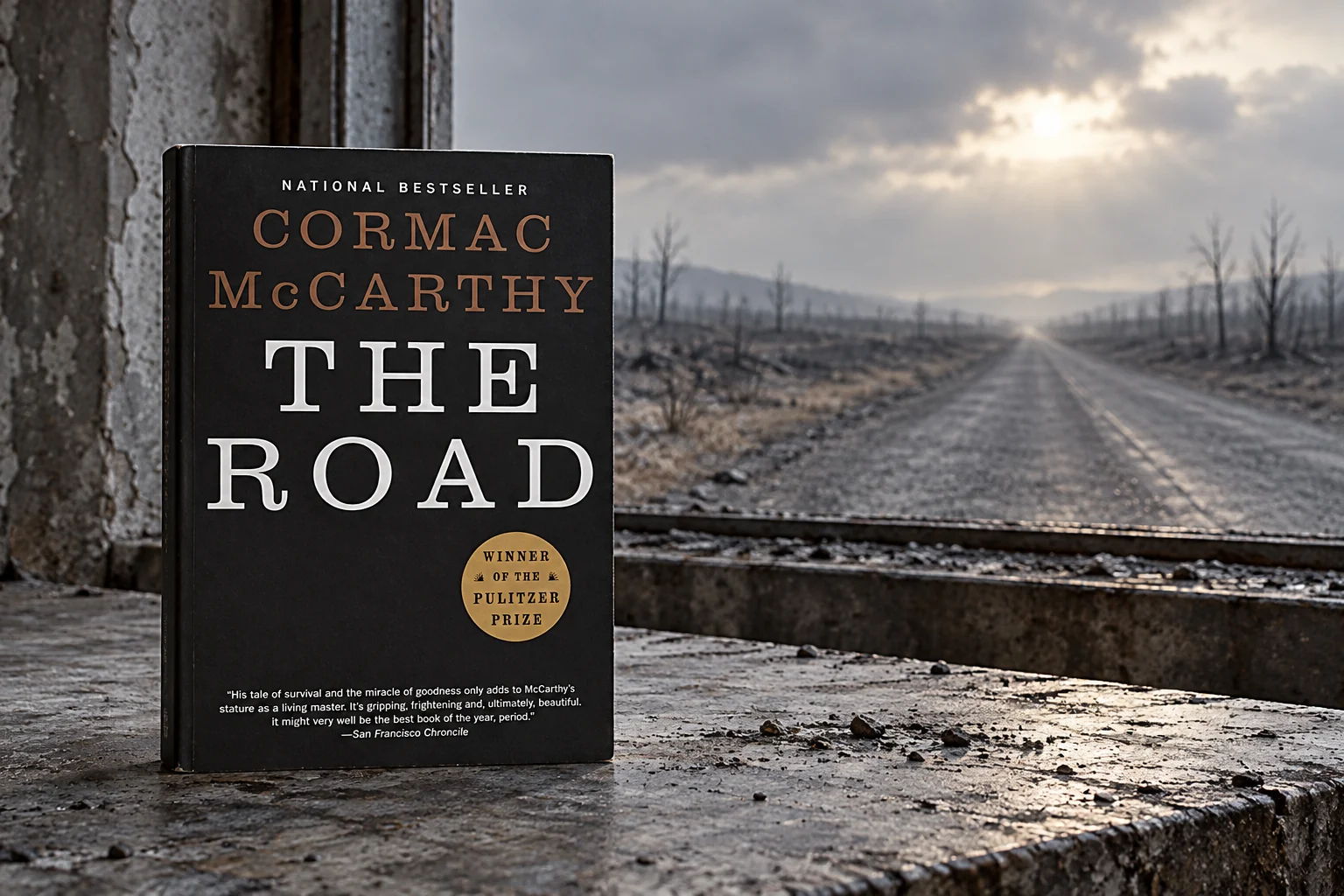
The Road won the 2007 Pulitzer Prize for Fiction, but its reputation should not obscure how demanding it is. It is best approached by readers willing to accept ambiguity, severe imagery, and a deliberately restricted view of the wider catastrophe. Its value is not that it makes disaster beautiful. It is that it keeps the bond between parent and child from becoming sentimental even as that bond remains the story's source of meaning. The novel leaves readers with no comforting blueprint for survival. It offers a harder measure: the attention people give one another when the world gives them very little else.
EDITOR’S VERDICT
Tale24’s assessment
A spare, controlled style and an intense moral focus on parental care under pressure.
Points to considerIts sustained bleakness and limited explanation of the wider catastrophe can make for an exhausting read.
Best for: Readers of demanding literary and postapocalyptic fiction interested in ethics, parenthood, and survival.
Editorial method: This is an independent assessment informed by the work and its official supporting information. AI tools may assist the drafting process; Tale24 reviews and takes responsibility for everything it publishes.