Literature & Thought · TALE24 REVIEW
Lonesome Dove and the Cost of the Frontier Dream
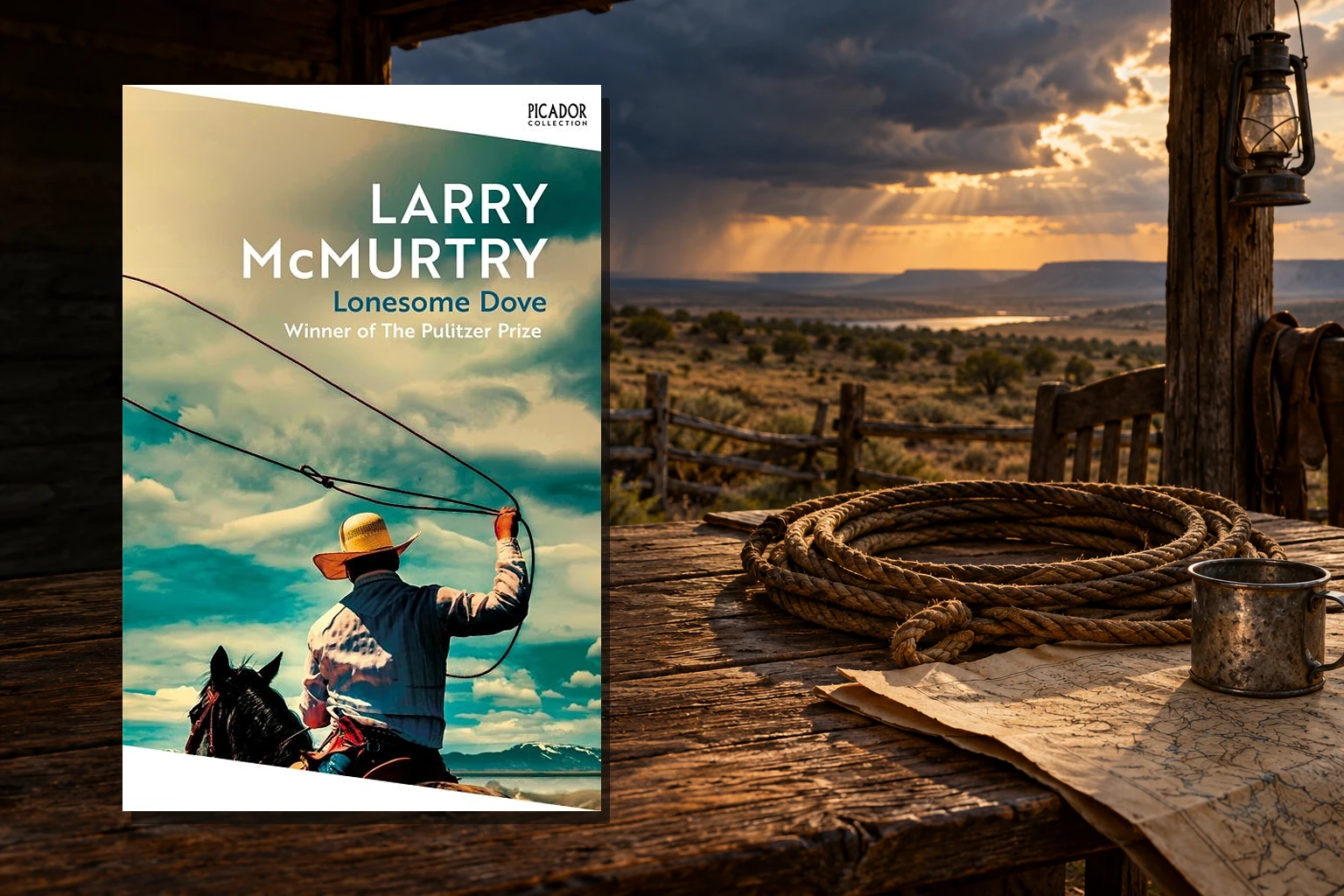
Larry McMurtry turns a cattle drive into an inquiry about loyalty, masculine duty, and the lives left outside the Western legend. The novel's scale is thrilling, but its deepest force lies in the distance between an imagined frontier and the people who must inhabit it.
Expansive characterization, earthy comic detail, and a searching account of loyalty beneath the Western adventure.
The cattle drive in Larry McMurtry’s Lonesome Dove promises the clean forward motion of an old Western: leave Texas, cross dangerous country, reach Montana. Yet the book’s more unsettling movement is inward. Its travelers bring habits, regrets, loyalties, and unspoken debts that no new landscape can erase. The frontier may look like a place to begin again, but McMurtry treats it as a place where inherited ideas of courage and freedom are tested against other people’s needs. That tension gives the novel its scale. The miles matter because each mile makes the gap between a heroic story and a lived life harder to ignore.
At the center stand Augustus McCrae and Woodrow Call, retired Texas Rangers whose long partnership holds together through disagreement. The publisher’s account sets them on a cattle drive from the small town of Lonesome Dove to Montana. Their contrasting temperaments give the journey more than a route. Gus’s talk and appetite for company pull against Call’s discipline and reluctance to reveal himself. Neither man can be reduced to the easy labels of carefree charmer and stern commander; their bond is durable precisely because its differences never disappear. Duty sustains their enterprise, while also giving them a language in which difficult feelings can remain unspoken.
McMurtry’s opening, available in the publisher’s excerpt, gives an early measure of his method. Instead of unveiling the frontier through a grand vista, he begins with pigs, a rattlesnake, heat, and a quarrel over shade. The effect is comic, physical, and faintly disillusioning. Western scenery is never merely a painted backdrop for brave men. Animals want food; people want relief from the sun; a business headquarters is barely more than patched corrals. This attention to inconvenience makes the larger adventure feel earned. It also keeps the reader alert to the distance between the West as an image and the West as an ordinary place where bodies tire and plans go wrong.
That distance is the novel’s central moral resource. A cattle drive is a powerful narrative engine, and McMurtry does not deny the excitement of motion, risk, and unlikely companionship. Yet the drive’s apparent purpose can also conceal individual motives. The wish to see a new country, the desire to prove one’s competence, and the fear of standing still need not mean the same thing to everyone traveling together. A leader can call an undertaking necessary without fully accounting for who carries its danger. The book’s large cast allows the central journey to be viewed from more than one position within the group, weakening the fantasy that a single man’s will can describe an entire expedition.
The novel is especially sharp when fellowship offers both comfort and constraint. Gus and Call share work and history, but friendship does not automatically make them articulate or generous. McMurtry’s interest in loyalty is therefore more demanding than a simple celebration of comradeship. Staying beside someone can be a profound act; it can also become a reason to avoid a conversation that ought to happen. The contrast between speech and silence helps organize their relationship. Gus’s verbal energy keeps testing the world around him, while Call’s reserve can look like strength from a distance and emotional evasion up close. Their partnership gives the book warmth without allowing warmth to excuse every failure of attention.
Women in Lonesome Dove complicate the masculine adventure rather than functioning only as a reward at its end. The publisher’s reading guide singles out Lorena’s changing situation and Clara’s ability to reveal sides of Gus that his friendship with Call cannot. Those prompts point toward an important limit of the trail’s self-description: what counts as freedom depends on the choices actually available to a person. The men may imagine the journey as escape or renewal, but that language does not travel equally. The book asks readers to notice how affection, economic vulnerability, and social expectation alter the meaning of a decision. Its emotional world grows larger whenever the itinerary gives way to those unequal conditions.
Its treatment of violence carries a similar double edge. Danger is part of the Western’s narrative grammar, and McMurtry knows how to make a journey feel exposed to sudden change. But the landscape’s risks do not certify the moral superiority of those who survive them. The novel’s human variety resists a neat division between legends and obstacles. Its people can be capable and cruel, loyal and inattentive, amusing and exhausted. That range is one reason the book’s length serves a purpose: time lets an initial impression gather contradiction. A lesser epic might ask the reader to admire endurance; this one keeps asking what endurance costs, and to whom.
The Pulitzer Prize for Fiction, awarded to Lonesome Dove in 1986, recognizes a novel often approached through the promise of a sweeping American adventure. The award is an important piece of its history, though no prize can explain its continued pull by itself. McMurtry works within a genre rich in familiar images while making those images feel less secure. His dust, distance, horses, and open skies remain vivid, but the book’s dramatic pressure comes from social detail: who speaks, who waits, who is believed, and whose future is treated as negotiable. The frontier myth is present throughout, yet the novel’s vitality comes from letting ordinary human friction interrupt it.
The abundance can also be a hurdle. Readers looking for a lean plot or a quick revisionist argument may find the long journey and broad cast more patient than expected. The book spends time building relationships and atmosphere before every narrative thread declares its importance. Some readers may also want a sustained historical account of the peoples and perspectives the traditional Western places beyond the cowboys’ immediate circle. McMurtry’s challenge to the genre is substantial, but an epic organized around a cattle drive still asks us to examine who has the power to tell the story and who appears mainly as part of its perilous terrain. Those limits are worth carrying into the reading rather than setting aside in the name of admiration.
What remains most compelling is the novel’s refusal to make movement synonymous with change. The drive creates a spectacular line across a map, while the characters’ unresolved attachments travel with them. McMurtry gives readers the pleasures of a large Western—humor, danger, vivid company, and the pull of unknown country—then asks what that pleasure leaves out. Lonesome Dove earns its reach because it can hold adventure and skepticism in the same frame. The frontier is still wide, but it offers no easy escape from duty, loneliness, or the responsibilities people owe one another.
EDITOR’S VERDICT
Tale24’s assessment
Expansive characterization, earthy comic detail, and a searching account of loyalty beneath the Western adventure.
Points to considerIts length and broad cast require patience; the cattle-drive perspective invites scrutiny of whose experience remains peripheral.
Best for: Readers of literary Westerns, American historical fiction, and long character-driven novels about friendship and duty.
Editorial method: This is an independent assessment informed by the work and its official supporting information. AI tools may assist the drafting process; Tale24 reviews and takes responsibility for everything it publishes.