Literature & Thought · TALE24 REVIEW
The Witch and the Stories Pemberton Keeps
Freida McFadden sends a woman looking for shelter into a house that has preserved one version of its past for centuries. The suspense begins when that version starts to come apart.
A precise Gothic setup and two timelines that put competing versions of the past in tension.
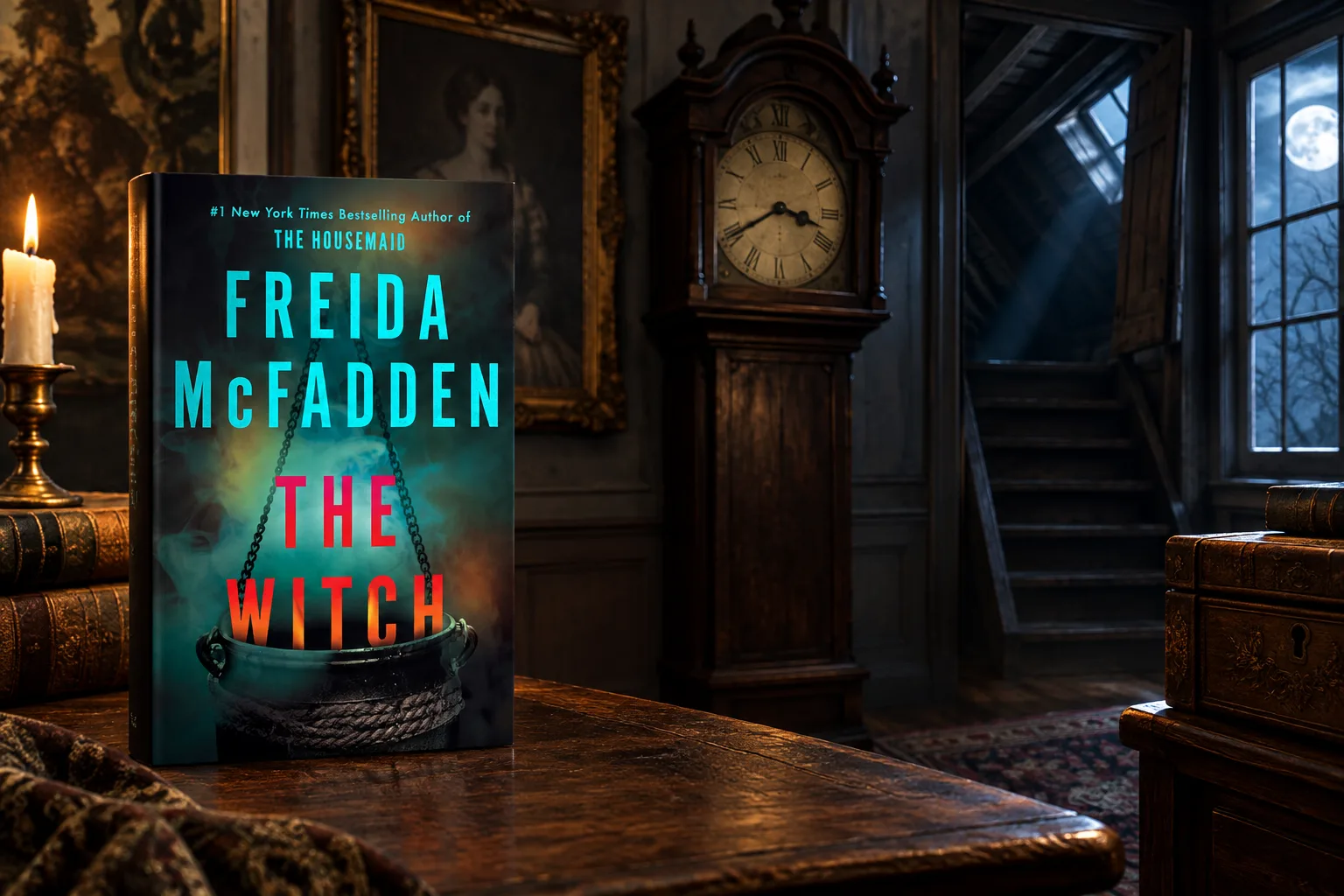
At 3:41 in the morning, the grandfather clock at Pemberton stops. The time is an unusually precise detail to build a haunting around. A dark hallway can be unsettling on any night, but a clock that stops at the same minute invites someone to keep watch, compare experiences, and ask what could possibly account for the pattern. In Freida McFadden's The Witch, that impulse to check the evidence comes up against a harder question. In a house where the family has had centuries to decide which version of its history will survive, what would count as proof that the accepted story is wrong?
Julia Barlow comes to the Massachusetts estate after losing her job and her apartment. Her grandmother gives her a reason to go, and the family house offers somewhere to land while she figures out what happens next. That practical need makes the setup more interesting than a visit undertaken out of curiosity. Julia has something to lose by finding Pemberton uninhabitable. The familiar advice to leave a haunted house sounds simple until the place is also your shelter and an older relative is expecting you. The novel can make an ordinary act of dependence feel dangerous before it has to explain a single strange event.
The disturbances gradually change the kind of attention Julia pays to the place. Flickering lights make the environment unreliable. A voice asking for help outside her bedroom introduces a possible obligation. It matters that the voice asks for something instead of merely making a frightening noise. The sensible reaction to a sound in the dark might be to stay behind the door. A request for help makes staying put feel like a decision about someone else. Suspense grows in the gap between those responses, especially when the identity of the speaker is precisely what Julia cannot establish.
McFadden gives that question a historical counterpart through Caroline Eldridge, whose story takes the novel back to an accusation of witchcraft in 1692. The two periods bring different kinds of uncertainty to the same estate. In Julia's time, the source of a voice is in doubt. In Caroline's, what people choose to believe about a woman can determine her fate. Alternating between those situations gives the familiar haunted-house premise a particular charge. Each return to the present carries the possibility that something Julia takes for settled history once depended on a witness, a reputation, or somebody's interest in being believed.
One of the most suggestive objects in the setup is a portrait that survives at Pemberton. An old painting can look like a piece of neutral evidence simply because it has outlasted everyone who could explain why it was commissioned or kept. Yet a portrait records who was given a place on the wall. Its survival says little about whose account deserved to survive alongside it. This is where the estate earns its place in the story. Its furnishings and rooms give family history a visible form, and the reader has to consider how much confidence to place in that form. The locked attic extends the same idea into space. Access to a room can determine access to a version of the past.
There is a further tension in the interest a local museum takes in the estate. Preserving an old building and explaining its history are distinct jobs. A family might take pride in what it has kept while remaining uncomfortable with an outsider's questions about how it came to own those things or which stories it chose to pass down. The possibility of Pemberton becoming a place the public can visit sharpens the stakes of Julia's inquiry. What she learns could matter to people beyond the household, even as her relationship to the people inside it makes the questions harder to ask.
The conventions are recognizable. An ancestral house, an inaccessible room, a night that seems to run on a schedule of its own, and two timelines that promise to illuminate each other all belong to a familiar branch of Gothic suspense. The appeal lies in the connections McFadden draws among them. Readers who come chiefly for a close account of the institutions and beliefs behind colonial witchcraft prosecutions may want a different balance of interests. Here, the historical accusation matters chiefly for the way it presses on the contemporary mystery. The public descriptions establish that structure, while the pleasure of discovering how closely the two accounts fit is best left to the novel.
What makes the premise especially well suited to a psychological thriller is the difference between being certain something happened and being able to persuade anyone else that it did. Julia can hear a voice without knowing what produced it. The surviving account of Caroline can look authoritative without giving Caroline anything like equal standing in the telling. Those are different problems, separated by centuries and by the stakes of an accusation. Setting them alongside one another allows the book to ask how confidence gets mistaken for credibility, particularly when the people listening already know what they expect to hear.
For readers drawn to family mysteries with a Gothic atmosphere, The Witch offers a strong reason to follow Julia into Pemberton. The house holds both the small, immediate terrors of a night spent listening and the larger unease of finding that the people who cared for a place may also have shaped what could be said about it. The stopped clock gives Julia a minute she can return to and test. The family's account of its own history is harder to test, and that imbalance gives the novel's central mystery its most unsettling edge.
EDITOR’S VERDICT
Tale24’s assessment
A precise Gothic setup and two timelines that put competing versions of the past in tension.
Points to considerReaders looking chiefly for a detailed reconstruction of colonial Massachusetts may find the thriller's priorities elsewhere.
Best for: Readers of Gothic suspense, dual-timeline mysteries, and psychological thrillers about family secrets.
Editorial method: This is an independent assessment informed by the work and its official supporting information. AI tools may assist the drafting process; Tale24 reviews and takes responsibility for everything it publishes.