Psychology & Skills · TALE24 REVIEW
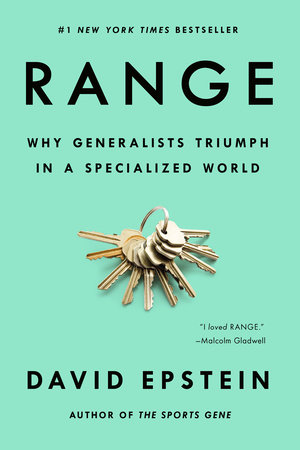
Range: Why Generalists Matter in a World of Specialists
David Epstein argues that varied experiences can help people transfer ideas across fields, especially when familiar patterns offer little guidance.
Many memorable examples, useful learning environment framework and help to review the value of non-linear career paths
In many success stories, talent is discovered early and then honed through thousands of hours of practice. That model is attractive because it gives parents, schools and employees a clear path: choose the right field as early as possible, stay focused and don't get distracted. David Epstein's Range begins by asking whether that path is suitable for all types of jobs. His answer is no, especially in environments with high uncertainty and little repetition.
The book contrasts two familiar examples: Tiger Woods, who practiced golf from a very young age, and Roger Federer, who tried several sports before committing to tennis. Epstein does not deny the value of intensive practice. He distinguishes learning environments where rules are stable and feedback is quick from those where cause and effect are less clear, situations change, and feedback comes late. Golf or chess can reward repeated pattern recognition; science, business, and many real-life decisions are less predictable.
The argument about a sampling phase is the easiest to apply. Before making a long-term commitment, people need opportunities to try different activities and see where their interests and abilities meet. Changing industries or leaving one direction is not necessarily a waste. Past experiences can provide useful comparisons, communication skills, or a different way of framing a problem. Experimentation also needs limits: if we keep starting over without staying long enough to work through difficult stages, we accumulate first impressions without developing competence.
Epstein devotes many pages to analogical thinking. People who know examples from many domains can recognize the common structure under different surfaces. A medical problem, a wildfire, and an organizational incident can all be associated with slow responses or obscured signals. A good analogy is not decorated with metaphor. It helps us escape from the familiar solutions of our industry, but is only effective when we understand deeply enough to know which mechanisms lie in the similarities and which differences cannot be ignored.
The section on learning creates a thought-provoking paradox. A method that makes students progress quickly during a lesson may not create long-term memory. Mixing up different types of problems, testing yourself, and being given a moderate level of difficulty often feels slow, but forces the learner to choose strategy over mechanical repetition. This explains why a smooth course can create the illusion of mastery. We recognize the solution when we see it, but we may not be able to reconstruct it ourselves in a new context.
For careers, Range offers relief to people whose paths have not been linear. Someone who has changed jobs or studied unrelated subjects may feel behind, but early advancement is not the only measure of progress. A better fit may become clear only after a person understands the kind of work, values, and environment they need. That insight should not become an excuse to avoid practicing a craft. Breadth has value when experience is substantial enough to build transferable skills.
The book's stories are memorable, sometimes so memorable that they deserve scrutiny. Almost any popular thesis can be illustrated by a famous person's career. Readers should distinguish examples that generate an idea from evidence strong enough to support a general rule. A scientist who changed fields does not prove that changing fields is always wise; success stories can obscure people whose detours did not pay off. Range is most useful as a counterweight to premature specialization, not as a new rule for every career.
That distinction matters when readers try to turn the book into advice for a specific child, student, or colleague. A chance to explore is valuable only when the person has meaningful choices and enough support to learn from them. A detour that expands one person's options may impose a cost another person cannot afford. The book's defense of breadth is therefore strongest when it challenges a rigid assumption about early specialization. It becomes less persuasive if breadth itself is treated as a universal prescription. A useful reader can take the question Range raises about the nature of a problem without adopting every example as a career plan.
The concept of "giving up" is also recreated in the book. In a culture that glorifies perseverance, stopping a project is often seen as lacking bravery. But continuing just because you've invested a lot of time is a sunk cost trap. A person needs to be both persistent enough to learn through difficulties and alert enough to realize that goals are no longer suitable. There is no general formula for stopping points; The practical way is to set benchmarks first, determine what you want to learn, and see if new data changes your initial assumptions.
For organizations, the lesson is not just about recruiting more "versatile" people. The group needs to create conditions for people with different backgrounds to truly debate and connect knowledge. If every decision still rewards experts who speak the right language of power, diversity on resumes won't help much. Rotating roles, reframing the problem in lay language, and inviting criticism from outside the group are small practices that can make the scope of experience a common asset.
Range does not ask us to choose between specialists and generalists. Important problems often need both: deep understanding so as not to be naive and broad vision so as not to get stuck in a familiar hammer. After reading, the useful question is not “what type am I?”, but rather how stable the problem at hand is, how quickly feedback comes, and whether the group lacks depth or perspective. When you ask the right question, the detour is no longer a flaw that must be hidden. It can be the source of material for a solution where the line is not visible.
EDITOR’S VERDICT
Tale24’s assessment
Many memorable examples, useful learning environment framework and help to review the value of non-linear career paths
Points to considerSome striking illustrations may make the argument broader than the evidence allows
Best for: Students, career changers, managers and learning program designers
Editorial method: This is an independent assessment informed by the work and its official supporting information. AI tools may assist the drafting process; Tale24 reviews and takes responsibility for everything it publishes.
KEEP READING