Literature & Thought · CRITICAL ESSAY
The Catcher in the Rye: Grief Beneath the Teenage Vernacular
More than seventy years after its 1951 debut, J. D. Salinger's sole novel endures not as a manifesto of youthful rebellion, but as a tightly engineered portrait of unresolved bereavement.
Revolutionary vernacular narration that masks acute bereavement and tenderness beneath Holden Caulfield's restless hostility.
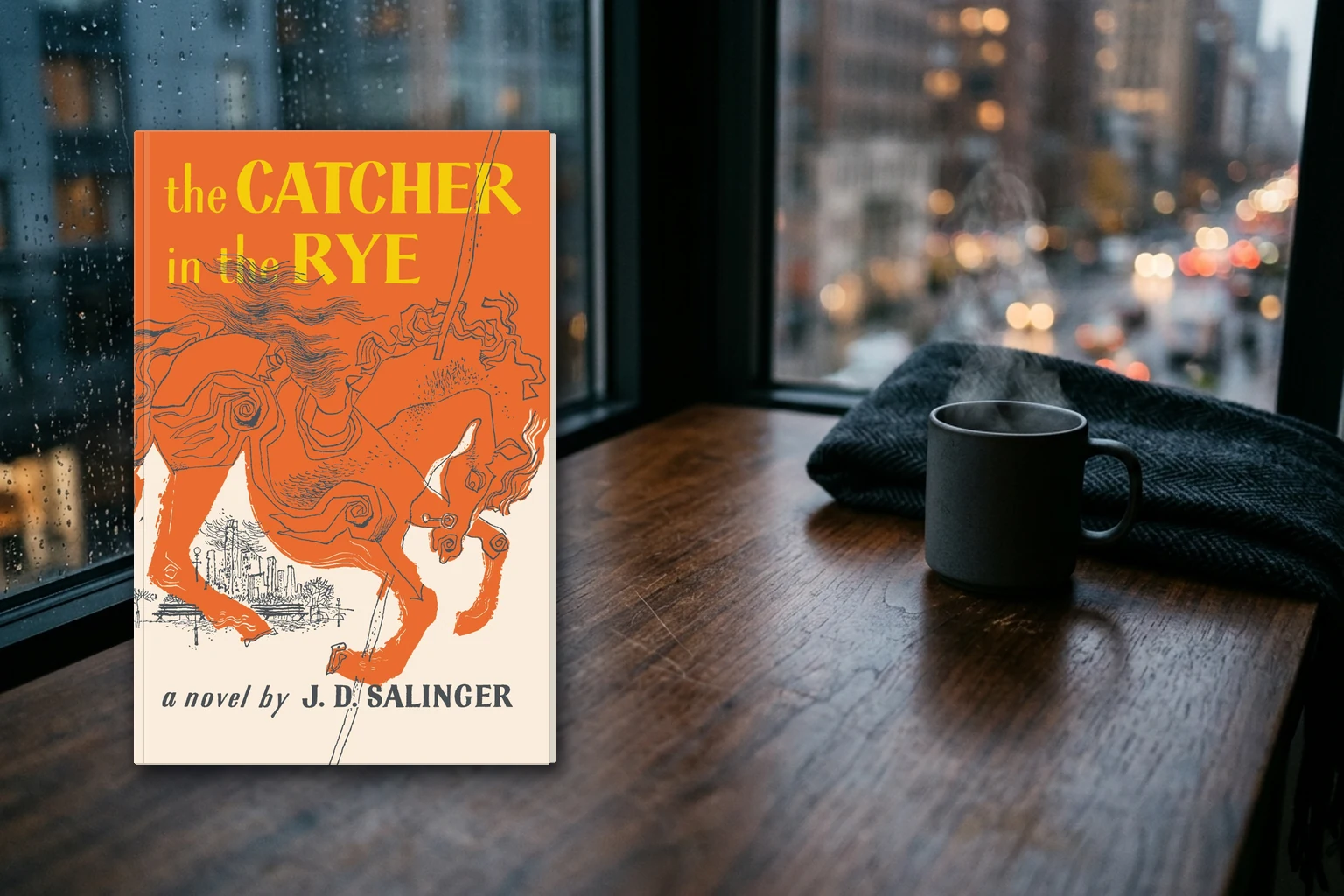
J. D. Salinger's The Catcher in the Rye occupies an unusual paradox in postwar American letters: few novels of the twentieth century are so instantly recognizable by voice alone, yet few have had their central subject misread so persistently by casual admirers and detractors alike. Originally published on July 16, 1951, and maintained in print by Little, Brown and Company under a verified 288-page trade edition, the book has sold more than sixty-five million copies and remains a fixture on TIME's 100 Best English-language Novels and the Modern Library 100 Best Novels lists. Read alongside its earliest notices and subsequent scholarly reception, however, its lasting power does not lie in an endorsement of teenage cynicism. Instead, Salinger constructs an intricate psychological study in which brash, repetitive speech acts as armor around debilitating loss.
Evaluating the novel strictly through its documented textual architecture reveals how carefully Salinger separates what sixteen-year-old Holden Caulfield says from what he actually feels. His famous railing against adult hypocrisy and commercial compromise is less an ideological critique of mid-century America than an avoidance mechanism. When readers look past the surface posture of a disaffected prep-school dropout, they encounter a young narrator terrified of change, paralyzed by his younger brother's death, and quietly desperate for someone to notice his distress without judging or exploiting him.
Narrative Architecture of a Seventy-Two-Hour Drift
Salinger frames the entire novel as a retrospective monologue delivered by Holden from a California medical facility, immediately establishing clinical distance between the wounded speaker and his recent past. Across twenty-six tightly paced chapters, the plot spans roughly seventy-two hours after Holden's expulsion from Pencey Prep, a fictional boarding school in Agerstown, Pennsylvania. Dreadful of confronting his parents ahead of schedule, Holden leaves campus before Christmas break and drifts into Manhattan, moving restlessly from the Edmont Hotel through hotel lounges, theaters, a museum, and Central Park.
Because very little happens in terms of conventional external conflict, the narrative relies on accumulating psychological pressure rather than escalating plot twists. Holden repeatedly reaches out for human connection through late-night phone calls, awkward bar conversations, and impromptu reunions, only to sabotage or flee each encounter the moment intimacy grows uncomfortable. His recurring question about where Central Park's ducks go when the lagoon freezes functions as a comic yet genuinely anxious obsession: an adolescent wondering how fragile creatures survive abrupt seasonal rupture when no clear shelter is visible.
Vernacular Craft and the Architecture of Grief
If the novel's itinerary looks aimless on paper, its linguistic and symbolic design is remarkably disciplined. Salinger anchors Holden's hostility in three quiet emblems that critics consistently identify as the book's emotional core: his deceased younger brother Allie, who died of leukemia; Allie's left-handed fielder's mitt, covered in poetry written in green ink so Allie would have something to read in the outfield; and Holden's own red hunting hat, worn backward as an eccentric badge of separation. Through these recurring objects, Salinger converts what might have remained repetitive teenage complaint into a portrait of stalled mourning.
That hidden grief clarifies the novel's title scene with Holden's younger sister, Phoebe. Holden mishears or reimagines Robert Burns's poem Comin' Thro the Rye, picturing himself standing at the edge of a high cliff in a rye field to catch playing children before they fall into adulthood. Even after Phoebe gently corrects the lyric from catching to meeting, Holden clings to the protective fantasy because adulthood represents irreversibility, corruption, and death. His abrupt midnight flight from former English teacher Mr. Antolini's apartment after waking to Antolini patting his head underscores how severely fear of betrayal distorts his boundaries, until a rain-soaked afternoon watching Phoebe ride the Central Park carousel finally releases some of that tension without resolving his pain.
Contemporary Reception and the Making of an American Voice
Upon its 1951 release, The Catcher in the Rye bypassed major literary awards at a moment when official American taste favored grander, more traditionally structured realism, yet attentive critics recognized immediately that Salinger had altered the possibilities of first-person American prose. Archival accounts documented by Literary Hub show how struck initial reviewers were by Salinger's acoustic precision. Writing in The New York Times, critic Nash K. Burger hailed it as "an unusually brilliant novel" and singled out Salinger's "incredibly fast, exact, and funny ear for the way people talk—especially teenagers," while fellow author James Stern famously composed his New York Times Book Review notice inside Holden's own idiomatic cadence.
That stylistic breakthrough becomes clearer when juxtaposed with institutional skepticism of the period. Even The New Yorker, which published much of Salinger's finest short fiction, rejected early Caulfield material out of concern that the voice leaned toward precocious exhibitionism. Yet it was precisely that unfiltered rhythm—the verbal tics, sudden tonal reversals between bravado and tenderness, and self-interruptions—that made Holden feel startlingly alive to generations of young readers who rarely encountered their interior bewilderment rendered with literary seriousness.
Censorship History, Privilege, and Generational Friction
Any candid assessment of Salinger's classic must confront the sharp polarization that has shadowed it from week one. Even in 1951, Kirkus Reviews captured the split verdict that still divides classrooms, praising the portrayal as "tender and true, and impossible, in its picture of the old hells of young boys," before dismissing the protagonist's outlook as "a sorry little worm's view of the off-beat of adult pressure." Over the following decades, conservative and religious groups targeted the novel's profanity, sexual allusions, and anti-authority mood. According to records from the American Library Association, it ranked as the most frequently censored book in US public schools and libraries between roughly 1961 and 1982, triggering flashpoints as extreme as a 1960 Oklahoma dispute in which a teacher was fired for assigning it.
Twenty-first-century criticism reflected in The Guardian and academic essays shifts the objection from morality to vantage point and relevance. Intersectional and feminist critics point out that Holden's supposed universal adolescence rests heavily on affluent, white, private-school male privilege: he wanders Manhattan spending cash freely while lecturing others on authenticity. Critics also examine his rigid tendency to sort women and girls into untouchable innocents or shallow opportunists, alongside mid-century slang like "crumby" and "phony" that can make his monologue sound self-absorbed or dated to modern students encountering him without historical context.
Verdict for Contemporary Readers
Read today with critical perspective rather than adolescent nostalgia, The Catcher in the Rye remains a landmark technical achievement whose limitations are inseparable from its narrator's blind spots. Salinger never asks readers to endorse Holden Caulfield's snobbery, his evasions, or his hasty judgments of everyone around him; instead, the novel invites readers to hear the panic inside those judgments. That demand requires patience for a meandering three-day plot and tolerance for a voice intentionally locked inside one teenager's defensive habits.
For high school and university literature readers, writers studying voice-driven prose, and educators examining American postwar psychology and intellectual-freedom history, the Little, Brown trade edition remains essential reading. Approached as a study of unresolved grief and the fragile boundary between bravado and vulnerability, Salinger's book earns its canonical stature not by flattering youth, but by exposing how lonely growing up feels when mourning has nowhere to go.
CRITICAL PERSPECTIVE
Tale24’s assessment
Revolutionary vernacular narration that masks acute bereavement and tenderness beneath Holden Caulfield's restless hostility.
Points to considerEpisodic three-day drift, dated mid-century slang, and an affluent prep-school vantage point that contemporary critics increasingly interrogate.
Best for: Students of postwar American fiction, readers of character-driven coming-of-age novels, and educators exploring intellectual freedom.
Editorial method: This is Tale24’s original analysis of the published material and attributed criticism. AI tools may assist the drafting process; Tale24 reviews and takes responsibility for everything it publishes.
READING AND RESEARCH
Sources and edition scope
Bibliographic details and textual claims in this review were checked against the edition and reference records below (The Catcher in the Rye by J. D. Salinger). Commercial retailer links are kept separate from editorial verification.
- hachettebookgroup.com — the catcher in the rye / 9780316769174 Publisher's edition record
- kirkusreviews.com — jd salinger2 / the catcher in the rye Independent review
- theguardian.com — 21 / review salinger catcher rye Editorial reference
- lithub.com — the first reviews of the catcher in the rye Editorial reference
Sources checked November 23, 2026.
KEEP READING