Literature & Thought · TALE24 REVIEW
1929: The Human Machinery of a Market Crash
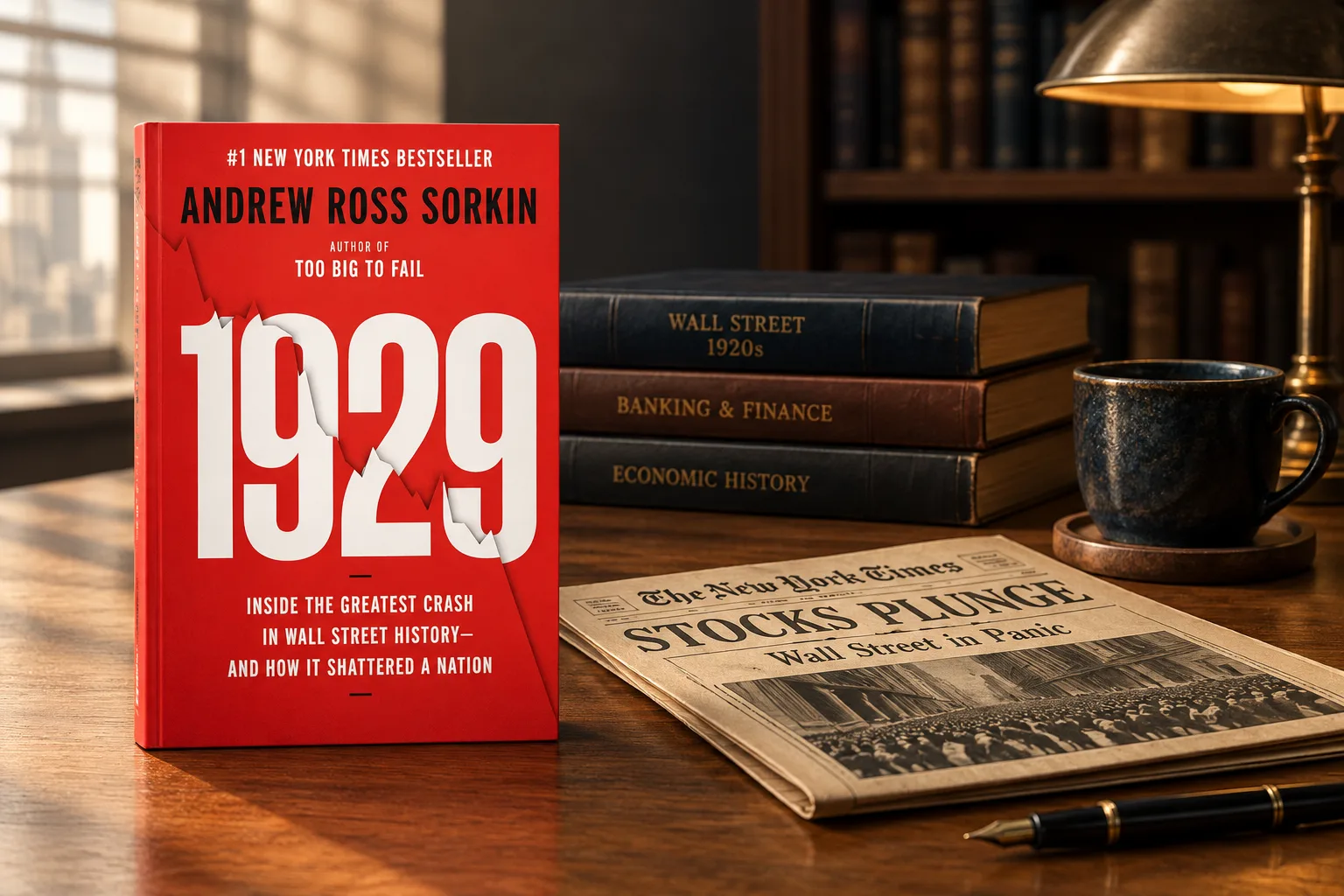
Andrew Ross Sorkin turns the Wall Street crash into a story of decisions, incentives, and misplaced confidence. The history is most useful when read as an inquiry into how crises are made, not as a prediction of the next one.
Vivid archival narrative makes the decisions and confidence behind a financial crisis legible.
An economic crisis can look inevitable once its ending is known. Andrew Ross Sorkin’s 1929 asks readers to return to the more unsettling moment before the ending, when an extraordinary rise in stock prices still had influential defenders and the people closest to the market had reasons to believe it could continue. Sorkin approaches the crash through bankers, investors, public officials, and the confidence that connected them. The result, as the publisher’s account and critical reception suggest, is a history of choices made under uncertainty. Its power lies in making those choices visible; its limitation lies in whose choices receive the most attention.
Sorkin is a practiced narrator of financial emergency. His earlier book, Too Big to Fail, followed the 2008 banking crisis. In 1929, he works backward toward an event that has acquired the simplicity of a date. The title names a year, but the collapse did not appear from nowhere on a single morning. A boom required lenders, buyers, public assurances, and a shared belief that recent gains could justify still greater risk. Historical records, correspondence, diaries, and newspapers give Sorkin a way to show that belief as something people maintained together. The interesting question is not which individual should have known the future. It is how many institutions became invested in a reassuring account of the present.
That emphasis helps distinguish a useful financial history from a collection of famous warnings. After a crash, almost any skeptical remark can be made to sound prophetic. Before it, skeptics must compete with profits, reputations, and apparently reasonable explanations for why the market is rising. Sorkin’s character-led method can make that imbalance understandable without claiming that every participant was foolish. People can recognize a danger in general and still struggle to act against a system that rewards participation now and punishes caution immediately. The book’s enduring subject is this unequal timing between the rewards of confidence and the costs of being wrong.
The cast also puts Wall Street and Washington in the same story. Market behavior is shaped by private ambition, but the scope of a crash depends partly on public authority, financial rules, and the credibility of officials. The publisher describes a struggle involving financiers, politicians, and Federal Reserve figures. That makes the book more than a morality play about greed. A vivid personality may carry a scene, yet no single personality explains why an entire market could become vulnerable. Readers should watch for the gap between what a leader says, what an institution can do, and what other people believe that institution will do. Confidence is social, and so is its collapse.
Sorkin’s archival access is a strength because private papers can unsettle the polished statements that survive in public memory. They may reveal hesitation behind certainty or ambition beneath an assurance of stability. Yet archives also distribute attention unevenly. Prominent financiers leave extensive correspondence; a family living with falling wages may leave far less material. Kirkus Reviews notes that ordinary Americans harmed by the crash and its aftermath are heard less often than the famous men at the center of Sorkin’s account. That observation matters to the argument, not only to representation. A crisis looks different when viewed through the people who could negotiate over money than through those who could only absorb its consequences.
The imbalance does not invalidate a book about elites. Their decisions deserve scrutiny precisely because their reach exceeded their private lives. It does, however, set a boundary around what the narrative can show. A scene in a bank can illuminate a mechanism of power; it cannot by itself describe how unemployment, debt, and insecurity were lived across the country. Readers who want a broader social history will need another account beside this one. Sorkin’s book is most illuminating when its privileged vantage is treated as a subject for examination, rather than mistaken for a complete map of the disaster.
There is a second boundary around the relationship between the market crash and the Great Depression. Popular memory often compresses them into a single chain of cause and effect. Historians have long debated the roles of banking failures, monetary policy, international pressures, and other forces in the depth and duration of the Depression. A narrative centered on the crash can show the behavior and assumptions that made a break in confidence possible. It should not be asked to settle every dispute about the years that followed. The distinction protects the history from becoming too neat: a dramatic market day is easier to tell than a prolonged economic breakdown.
Present-day parallels require the same care. The publisher invites readers to see echoes between the era Sorkin describes and markets today. Speculation, concentrated influence, and the conviction that old warnings no longer apply are recognizable patterns. Recognition is not prediction. The financial system, its institutions, and the wider economy have changed, and an analogy cannot tell a reader when to buy, sell, or expect another collapse. The book’s practical value is more modest and more durable: it trains attention on incentives, weak safeguards, and the stories powerful people tell when things are going well.
Readers drawn to narrative history are likely to find the strongest reason to pick up 1929 in its movement between individual judgment and collective consequence. Readers seeking a technical account of every cause of the Depression, or a history centered on households outside finance, should approach it as one part of a larger shelf. That is a fair exchange. Sorkin makes an old catastrophe less remote by showing how it emerged from decisions that once seemed defensible to the people making them. The final question his account leaves is not whether we can spot the next 1929. It is whether we can recognize the limits of a confident story while it is still paying its authors to believe it.
EDITOR’S VERDICT
Tale24’s assessment
Vivid archival narrative makes the decisions and confidence behind a financial crisis legible.
Points to considerThe focus on prominent financial figures gives ordinary people less space in the account.
Best for: Readers of economic history and narrative nonfiction interested in financial power and public policy.
Editorial method: This is an independent assessment informed by the work and its official supporting information. AI tools may assist the drafting process; Tale24 reviews and takes responsibility for everything it publishes.