Literature & Thought · TALE24 REVIEW
Empire of AI: Who Pays for the Boom?
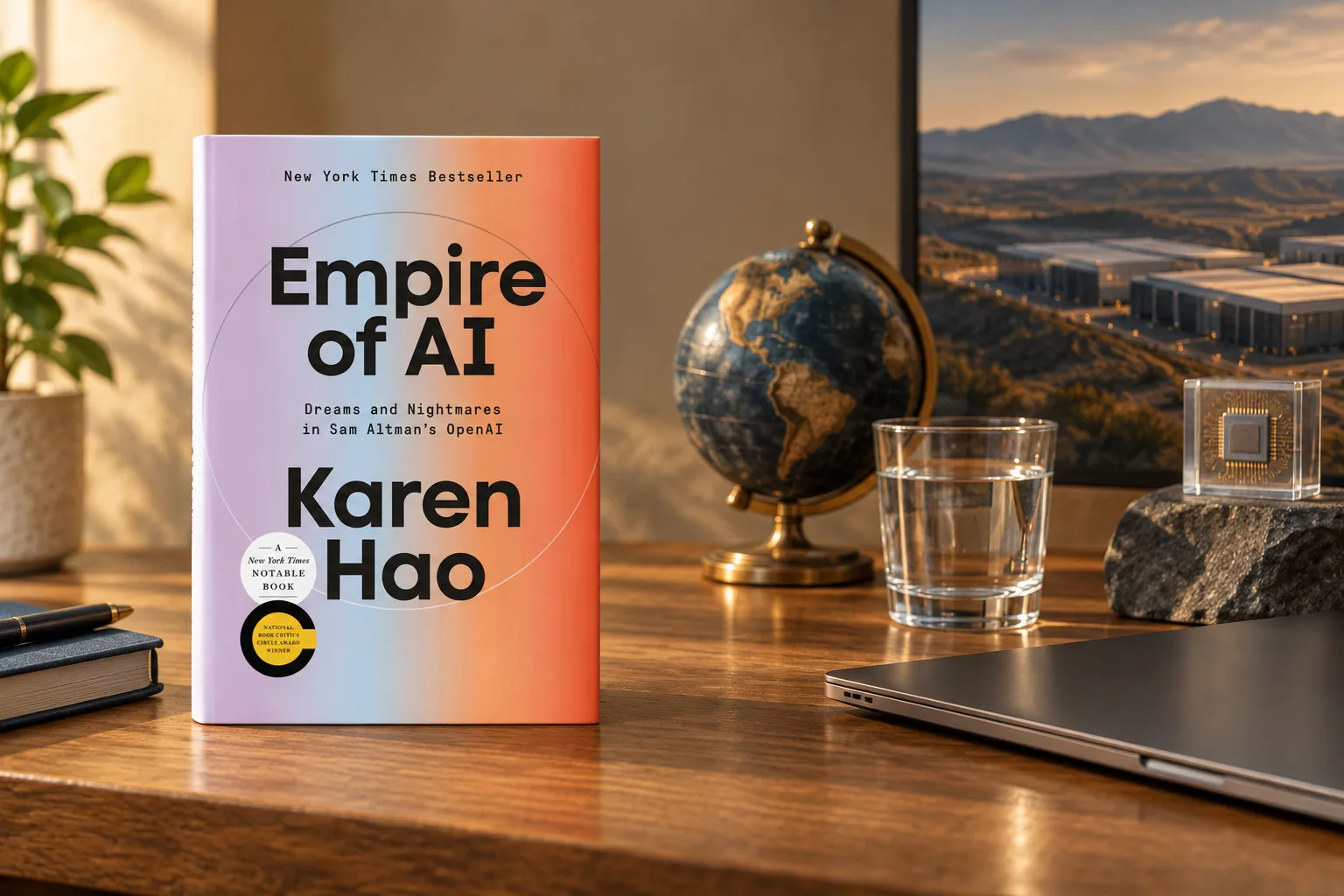
Karen Hao follows the people and resources behind the AI race, from corporate leadership to data labor and water use. Her reporting asks who gets the gains and who bears the costs.
Connects corporate decisions to the workers, infrastructure and resources behind AI services.
The appeal of an AI service is how little of its production a user has to see. A question goes in; an answer appears. Karen Hao’s Empire of AI presses on everything hidden between those two moments: the people who prepare data, the computing systems that process it, the resources those systems consume, and the small circle of executives who decide how fast to expand. Hao’s principal subject is OpenAI, but her economic question reaches beyond one company. What does a product cost when its most consequential inputs are absent from the price and from the story told to its customers?
Hao has reported on OpenAI since 2019, before ChatGPT made it a household name. The publisher describes a book that moves from the organization’s nonprofit origins to its increasingly commercial position and the intense competition around large AI models. That history matters because mission statements and business structures can pull in different directions. A safety commitment may be sincere, yet the need for investment, computing capacity, and market position changes the incentives under which it must operate. Hao’s account invites readers to examine those incentives instead of deciding that a company’s early ideals either explain or excuse everything that came later.
The 2023 firing and return of Sam Altman provides an especially visible governance test. It exposed how decisions at a company with enormous public reach could turn on a small board and a narrow set of private relationships. The episode is dramatic, but its significance is institutional. If a technology is expected to reshape work, information, and public services, who has a meaningful voice when its direction changes? Hao does not need to prove that every governance disagreement produces harm. The dispute itself raises a concrete question about where authority sits and whether the people affected by a system can challenge it.
The book’s strongest reported material, according to its publisher and critical reception, extends beyond leadership. Hao follows data workers in Kenya and people concerned about water use in Chile. Their experiences make the supposedly weightless language of AI harder to sustain. Large models depend on chips, electricity, facilities, data, and human tasks that are often rendered invisible by the interface. The specific conditions differ by place and employer; it would be careless to treat every worker or community as having an identical experience. The point is that a full account of innovation has to include labor and local resources as well as software and capital.
This is where the title’s empire analogy becomes useful, if kept under examination. Hao argues that value and decision-making power can accumulate in one set of places while material demands are pushed onto others. The analogy does not by itself establish a universal law of AI economics. It asks readers to trace a relationship: who receives investment and prestige, who supplies indispensable work, and who bears risks that a balance sheet may not capture. A reviewer should distinguish that interpretive framework from a measured claim about every AI company. Its force lies in directing attention to a distribution that a product demonstration will never reveal.
There is also a reason not to reduce the book to a ledger of harms. AI systems may have genuine uses, and the desire to build them does not make every researcher or user indifferent to consequences. Hao’s argument is more demanding if its target is a set of choices about scale, secrecy, and accountability rather than the existence of the technology itself. The distinction allows a serious reader to ask whether different procurement, labor standards, energy practices, and governance could produce different outcomes. It leaves room for disagreement about solutions while refusing the idea that rapid expansion is simply a natural event beyond public choice.
The OpenAI focus is both an advantage and a constraint. Close reporting can show how a mission is interpreted inside an organization and how leadership struggles affect its priorities. It cannot automatically establish that every rival, open model developer, or smaller provider works the same way. Readers interested in comparative business models will need more than this case study. Even so, examining a prominent company can expose questions the rest of the industry must answer: how much power should sit with the builders, what evidence should support claims of benefit, and what obligations follow when costs fall outside the company’s walls?
Environmental discussion is particularly vulnerable to inflated rhetoric, so Hao’s reported examples deserve careful reading. Data centers consume power and water, but exact footprints depend on location, design, and operating conditions. The existence of a concern in Chile does not justify an invented figure for every facility. The defensible economic point is simpler: a service can impose costs on a grid or a community that the individual user never sees. Accounting for those costs requires public information and local participation, not just a promise that future efficiency will make present demands disappear.
Empire of AI is best approached as investigative reporting with a strong argument, not as a neutral encyclopedia of the sector. Readers who want an uncomplicated celebration of new tools will find its attention to workers and resources challenging. Readers already skeptical of big technology should still resist converting every case in the book into a claim about all AI. Hao offers something more valuable than a slogan: a way to follow money, authority, and physical inputs through a service that is designed to feel effortless. Once those inputs are visible, the question changes from whether AI is impressive to who is allowed to decide what its growth is worth.
EDITOR’S VERDICT
Tale24’s assessment
Connects corporate decisions to the workers, infrastructure and resources behind AI services.
Points to considerIts close focus on OpenAI leaves less room to compare other AI business models.
Best for: Readers interested in technology, political economy, labor and the public costs of innovation.
Editorial method: This is an independent assessment informed by the work and its official supporting information. AI tools may assist the drafting process; Tale24 reviews and takes responsibility for everything it publishes.