Literature & Thought · TALE24 REVIEW
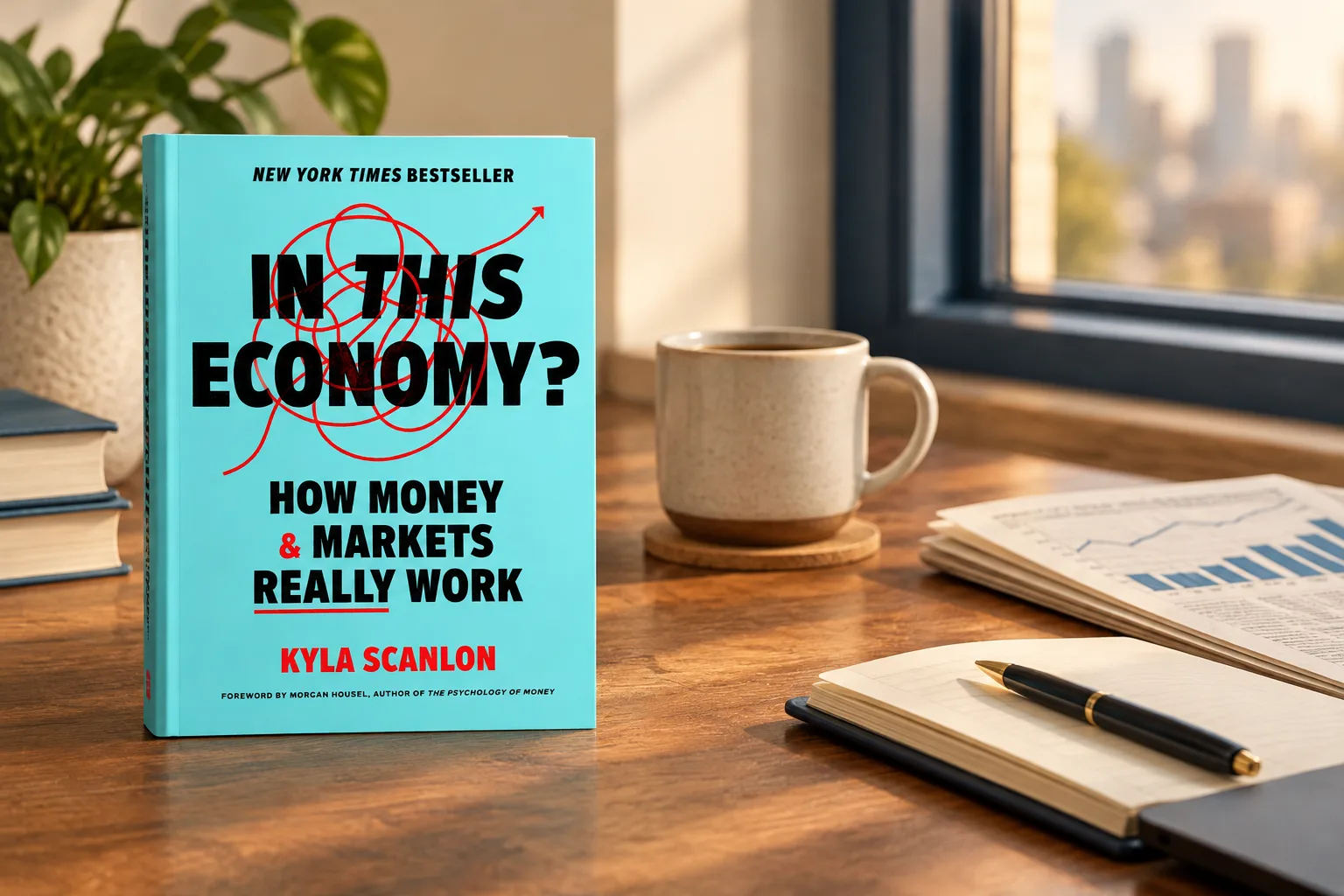
In This Economy?: Making Sense of the Numbers
Kyla Scanlon connects economic indicators to the pressures people feel in daily life. Her accessible explanations are valuable when the headlines and household experience seem to disagree.
Accessible explanations connect macroeconomic ideas with concrete household concerns.
An economy can appear strong in a headline and precarious at a kitchen table. Kyla Scanlon’s In This Economy? begins from the need to understand both views without declaring either one imaginary. A national measure describes millions of people at once; a rent bill arrives for one household on one date. Scanlon’s gift as an explainer is to move between those scales. Her book is an illustrated guide to money and markets, but its more interesting project is teaching readers what an economic number can reveal, what it leaves out, and why public arguments so often confuse the two.
First published in 2024 and issued in paperback in October 2026 with a new afterword on tariffs and AI, the book has had a life beyond a single news cycle. Its continuing appeal makes sense. Inflation, interest rates, debt, employment, and trade appear in daily coverage, often without the definitions needed to judge a claim. Scanlon uses diagrams, analogies, and plain language to give readers a working vocabulary. That approach can make a subject seem less like a closed conversation among experts. The aim is not to turn a newcomer into a professional economist in one volume. It is to make basic questions possible: What exactly is being measured? Over what period? Whose situation can the measure conceal?
Consider the difference between a change in inflation and the price level itself. Inflation can slow while many prices remain higher than they were a few years earlier. A headline celebrating slower inflation may therefore be accurate while a shopper’s sense of continued pressure is also understandable. The same care applies to employment. A national rate can improve even as a particular worker struggles to find a job that pays enough, offers steady hours, or exists near home. These are examples of the kind of scale problem Scanlon addresses, not claims that any single statistic is useless. Better economic literacy depends on knowing what each figure was built to answer.
Scanlon also pays attention to policy makers, whom Kirkus Reviews describes as the book’s “Deciders.” Federal Reserve decisions, for example, can affect borrowing costs and the broader pace of economic activity. The policy goal may be stated in national terms, but households meet it through mortgage offers, credit balances, employment prospects, and business decisions. Explaining that passage from institution to ordinary life is one of the book’s strengths. The bridge matters because economic policy often sounds remote until its mechanisms are traced through a familiar expense or opportunity.
Trade supplies another test of clear explanation. A tariff is easy to present as a simple charge on foreign goods, but its effects depend on supply chains, pricing decisions, alternatives available to buyers, and responses by other countries. Exchange rates create similar difficulty: a currency movement may matter differently to an importer, an exporter, and a household buying a particular product. Scanlon’s accessible treatment helps readers resist the idea that a policy has one uniform effect on “the economy.” The new paperback afterword on tariffs and AI acknowledges how quickly the examples in an introductory book can change even when the underlying questions remain.
The word “vibecession,” which Scanlon coined, captures a tension between economic indicators and public feeling. It is memorable because it names a genuine interpretive problem, but it can be mishandled. Negative sentiment does not automatically prove that official data are false; a strong aggregate number does not prove that a worried person is confused. People assess their lives through housing, wages, debt, expectations, and what they can afford next month. National statistics collect a different kind of evidence. The value of Scanlon’s framework is that it encourages readers to ask why the two accounts diverge before using one to dismiss the other.
There is a political perspective here as well. Kirkus identifies Scanlon’s approach as progressive, and the book’s concern with who benefits from economic arrangements is part of its character. That is no reason to set it aside. It is a reason to notice when an explanation moves from how a mechanism works to what policy should be chosen. Good popular economics can be clear about its values while giving readers enough information to test its conclusions. Some readers may want a more technical or ideologically different companion book, particularly where policy trade-offs are disputed. Scanlon’s openness of style should make that comparison easier, not unnecessary.
Its form sets another limit. A drawing can illuminate a relationship quickly, but real economies contain feedback, delay, and exceptions that a simple diagram cannot hold. An analogy may help a reader remember why a rate changes without giving them enough detail to forecast what a central bank will do next. That trade-off is acceptable for an introductory guide if readers keep the difference between orientation and expertise in view. The book should not be treated as a source of individualized investment advice or a shortcut to certainty about an election, recession, or market move.
In This Economy? is best suited to readers who want to become harder to mislead by economic headlines. Its most useful habit is neither optimism nor pessimism; it is asking what lies behind an apparently simple figure and who may be missing from its average. Scanlon makes that habit approachable without pretending every policy question has an easy answer. The result is a timely guide for anyone trying to connect the language of public economics with the uneven, practical experience of earning, spending, and planning a life.
EDITOR’S VERDICT
Tale24’s assessment
Accessible explanations connect macroeconomic ideas with concrete household concerns.
Points to considerReaders seeking technical models or a politically neutral textbook may want a companion source.
Best for: General readers who want to understand economic headlines and the limits of common indicators.
Editorial method: This is an independent assessment informed by the work and its official supporting information. AI tools may assist the drafting process; Tale24 reviews and takes responsibility for everything it publishes.