Literature & Thought · TALE24 REVIEW
When History Refuses to Stay Buried: Louise Penny’s Miss Wolcott’s Ghost
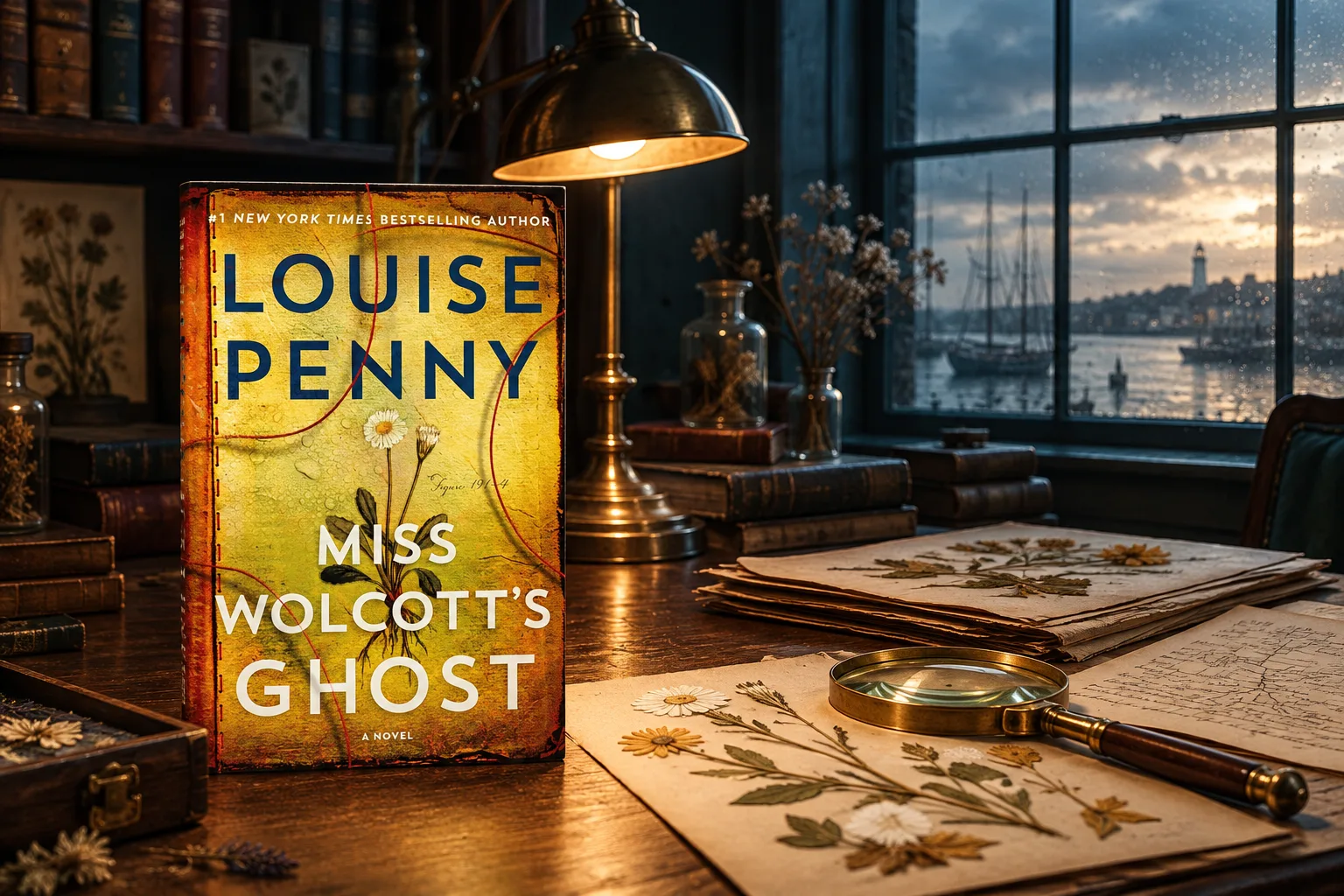
Louise Penny’s Miss Wolcott’s Ghost links a murder mystery to historical tragedy, botanical knowledge, and the ethics of remembering. Its layered design makes the past feel like evidence still waiting to be read, though newcomers may find this 21st Gamache novel a demanding place to begin.
An evidence-rich historical mystery; several distinct routes into the investigation, including botanical and genealogical knowledge; ethical questions add weight to the puzzle.
A historical mystery can use the past as scenery: a period costume here, an old letter there, a present-day detective to tie the pieces together. Louise Penny’s Miss Wolcott’s Ghost appears to ask for more. Its materials place an unidentified body, a gravestone, an interview decades later, botanical knowledge, genealogical research, and the sinking of the Empress of Ireland in the same investigative orbit. The result is a mystery whose central resource is not simply a hidden fact but the difficulty of interpreting what earlier generations left behind. History becomes evidence, and evidence carries obligations.
The novel’s structure crosses two marked periods, 1914 and 1967, while reaching toward a contemporary murder investigation. That arrangement gives the book a useful tension: what a person knows at one moment may be incomplete, and what later generations inherit may arrive stripped of context. A gravestone can preserve a name while concealing a life. An interview can record testimony but cannot make the past fully present. Penny’s architecture, as described by the publisher and reviewers, builds suspense through these gaps between record, memory, and explanation.
That is a promising fit for a series led by Chief Inspector Armand Gamache. The detective’s work can connect personal testimony to public history, yet the historical materials described here widen the frame beyond a conventional puzzle. The Empress of Ireland’s sinking supplies a real event against which fictional investigation must be set. Botanical expertise and a rare plant bring another kind of evidence into play: the natural world has its own specificity, and understanding it depends on patient attention. The book’s strands therefore suggest different ways of knowing—documents, family history, expert observation, and the slow reconstruction of events.
This approach gives the title more than a spectral hook. “Ghost” can imply a supernatural presence, but it also names the persistence of unresolved experience. The historical mystery genre is especially suited to that double meaning. When a past event remains active in the present, it is not because time has literally stopped; it is because choices, losses, and silences continue to shape what can be understood. Penny’s combination of murder, tragedy, and archival inquiry seems designed to make that continuity part of the suspense.
The ethical dimension may be the novel’s most interesting promise. A mystery normally treats information as something to uncover and arrange into a solution. Here, the publisher’s description and reviews point to genealogical research and ethical questions, suggesting that discovery is not automatically neutral. Learning the truth about someone’s past can affect people who did not choose to become part of an investigation. Historical records also preserve the viewpoint of whoever made them. A detective may solve a question while leaving another: what does the present owe to the people it has turned into evidence?
That question can keep a puzzle from becoming a mechanical sequence of clues. It asks readers to consider not only whether an account is accurate but why it survived, whose perspective it carries, and what it leaves out. Such a method suits a book concerned with memory and inheritance. It also demands a writer’s control: multiple timelines, a real catastrophe, family research, scientific detail, and a murder can enrich one another, but they can also compete for attention. Kirkus’s notice of a complex plot is a fair signal that this is likely to be a carefully layered read rather than a spare, single-thread whodunit.
Readers should also know where the book sits in Penny’s series. Miss Wolcott’s Ghost is the 21st Chief Inspector Gamache novel, a substantial commitment for anyone meeting the character for the first time. A long-running series can reward devoted readers with established relationships and accumulated emotional history, but that same continuity can make a late entry feel like joining a conversation already underway. The premise and historical strands offer points of entry, yet new readers who prefer to begin at the beginning may want to start earlier in the series. That is not a flaw unique to this book; it is a practical buying consideration worth making explicit.
The book’s scale seems best suited to readers who enjoy mysteries that ask them to hold several kinds of context at once. Those looking for a quick, clue-forward thriller may be less drawn to a narrative that connects family records, scientific knowledge, and a major historical disaster. The complexity is part of the appeal, but it is also the price of admission. The novel sounds more interested in the texture of how a truth emerges than in rushing toward a tidy reveal.
There is a timely reason the title may be appearing on more readers’ lists: the October 29-30 AP/Publishers Weekly hardcover fiction chart placed it at number one. Bestseller rank signals current attention; it does not guarantee that any individual reader will love the book, nor does it replace a reasoned recommendation. The stronger case is the combination of a recognizable series, a historical mystery with several evidence trails, and an inquiry into what it means to recover a story responsibly.
Miss Wolcott’s Ghost looks most compelling as a mystery about the unfinished work of history. Its layered timeline, botanical and genealogical threads, and connection to real tragedy offer more than atmosphere; they make interpretation itself part of the investigation. The same density may challenge readers who want a fast, uncomplicated puzzle, and the 21st-book position makes it a less obvious starting point for newcomers. For existing Gamache readers and patient historical-mystery fans, however, Penny’s premise promises a thoughtful question beneath the suspense: when the past resurfaces, who gets to decide what its evidence means?
EDITOR’S VERDICT
Tale24’s assessment
An evidence-rich historical mystery; several distinct routes into the investigation, including botanical and genealogical knowledge; ethical questions add weight to the puzzle.
Points to considerThe layered timelines and plot complexity may slow readers seeking a lean thriller; as book 21, it may be an awkward entry point for new Gamache readers.
Best for: Readers already invested in Chief Inspector Gamache and fans of patient historical mysteries that connect investigation with memory, science, and ethical questions.
Editorial method: This is an independent assessment informed by the work and its official supporting information. AI tools may assist the drafting process; Tale24 reviews and takes responsibility for everything it publishes.