Literature & Thought · TALE24 REVIEW
Crying in H Mart: Food, Memory, and the Work of Grief
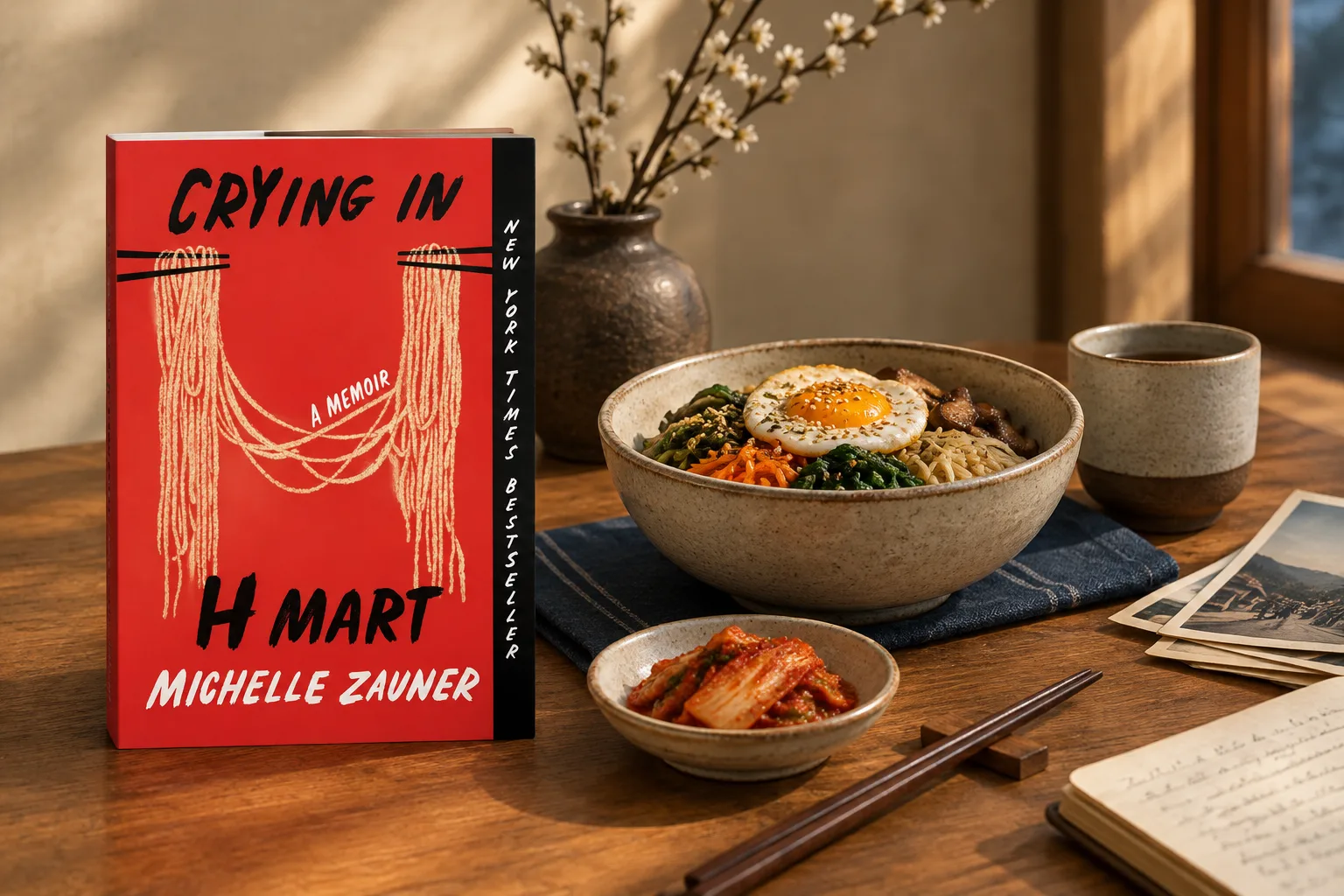
Michelle Zauner’s memoir follows grief through Korean food and family memory, asking how inherited rituals can preserve a complicated bond without simplifying loss.
Precise connections among food, family memory, and Korean American identity give the memoir emotional depth.
A grocery store can be a place to buy dinner and a place where grief becomes suddenly difficult to contain. That double life is the central promise of Michelle Zauner’s Crying in H Mart. The memoir follows her effort to understand what remains of a relationship with her mother after her mother’s death, and it gives food a role more demanding than easy comfort. Ingredients and meals carry learned habits, affection, and expectations. They also recall the distance between two people who loved each other without always understanding each other. The book’s emotional force comes from that combination of ordinary detail and unresolved feeling, rather than from a lesson that loss makes everything clear.
Zauner grew up Korean American in Eugene, Oregon, where the publisher describes her as one of the few Asian American children at school. That context matters because her connection to Korea did not arrive as an abstract label. The publisher identifies time spent with her mother in her grandmother’s small Seoul apartment, especially their late-night meals, as a formative part of the story. A plate of food can bring together place, family, and memory without making them identical. The meals suggest a shared language even when mother and daughter disagree. The reviewable tension is how that language changes when the person who helped teach it is gone.
The relationship resists a purely tender summary. The publisher notes her mother’s high expectations and Zauner’s painful adolescence. These facts complicate the tempting image of a perfect bond destroyed only by illness. A memoir can honor a parent while remembering the friction that made their life together real. To write about disagreement after death is also to refuse an easy form of praise: it preserves a person’s particularity. Readers looking for a simple tribute may find this more uncomfortable, but the discomfort gives the love its weight. Zauner’s grief has to make room for memory that is not uniformly warm.
As a young adult, Zauner moved to the East Coast for college, worked in restaurants, and performed with her developing band. The official description says her sense of Koreanness felt more distant as she built that life. Independence here does not mean a clean break with family history. It creates a period in which inherited practices may be neglected, revised, or understood only in retrospect. Her mother’s terminal cancer diagnosis when Zauner was twenty-five brought that distance into urgent focus. The memoir’s account of identity is therefore tied to timing: the desire to learn more becomes sharp when the person who could answer a question may soon be unavailable.
Food is especially suited to this story because it is learned through repetition. Recipes can be written down, but a family meal also involves preferences, corrections, textures, and decisions made without explanation. The publisher presents taste, language, and history as gifts Zauner comes to recognize through her mother. That formulation need not imply that food can replace a lost person. It suggests the opposite: a remembered flavor can reveal how much of a relationship depended on another person’s presence. Shopping or cooking may offer a way to continue a practice while making the absence more visible.
H Mart gives the memoir a public setting for an intensely private response. A grocery aisle contains products available to many shoppers, but each shopper brings a different history to them. For Zauner, the Korean market in the title becomes a place where heritage is encountered through things to touch, choose, prepare, and eat. That specificity makes the account stronger than a vague celebration of cultural roots. It also protects the memoir from turning Korean food into decoration. Food matters because someone taught the author how to value it, and because continuing that knowledge involves work.
The memoir’s form, as described by its publisher, moves across childhood, adolescence, young adulthood, illness, and mourning. Its range allows grief to change the meaning of earlier episodes without reducing all of them to foreshadowing. The adult musician and writer is not simply a daughter waiting for catastrophe. She has work, relationships, and a developing artistic life. The publisher also notes family photographs, which signal an interest in the tangible record of a life, though their individual contents cannot be assessed from the public description alone. These materials create several ways of asking what can be preserved and what cannot.
There is a risk in discussing a book like this through the promise that it will make readers cry. Such a promise flattens a particular mother-daughter relationship into an expected reaction. The more interesting question is what readers may carry into conversation afterward. Some will recognize how an ordinary store or meal becomes charged after loss. Others may be struck by the tension between independence and inheritance, or by the right to remember a parent’s demands alongside her care. The book gives those responses a concrete place to begin, while leaving room for different family histories to resist the same interpretation.
Its limitation follows from the same commitment to a single life. A reader seeking a practical guide to bereavement or a broad account of Korean American communities will find a memoir shaped by Zauner’s own family and perspective. Specificity is the source of its insight, but it also sets the boundary of what it can claim. The book cannot stand in for every immigrant family, and its food memories cannot be offered as a universal method of healing. That is a fair limit, not a failure of emotional honesty. The best reading keeps the account situated rather than treating a moving personal story as a general rule.
Crying in H Mart earns its impact by making memory physical without pretending that an object or recipe settles grief. The market, the meals in Seoul, and the work of learning a taste are meaningful because the relationship behind them was loving, difficult, and finite. Zauner’s experience invites readers to consider their own rituals of remembrance, but the memoir remains attentive to what belongs uniquely to her mother and to her Korean American life. Its lasting question is not whether food can bring someone back. It is how a person continues to live with the knowledge another person placed in her hands.
EDITOR’S VERDICT
Tale24’s assessment
Precise connections among food, family memory, and Korean American identity give the memoir emotional depth.
Points to considerIts personal scope offers little practical guidance for readers seeking a general account of grief.
Best for: Readers of food memoirs and reflective writing on loss, identity, and mother-daughter relationships.
Editorial method: This is an independent assessment informed by the work and its official supporting information. AI tools may assist the drafting process; Tale24 reviews and takes responsibility for everything it publishes.