Literature & Thought · TALE24 REVIEW
None of This Is True: Who Owns the Story?
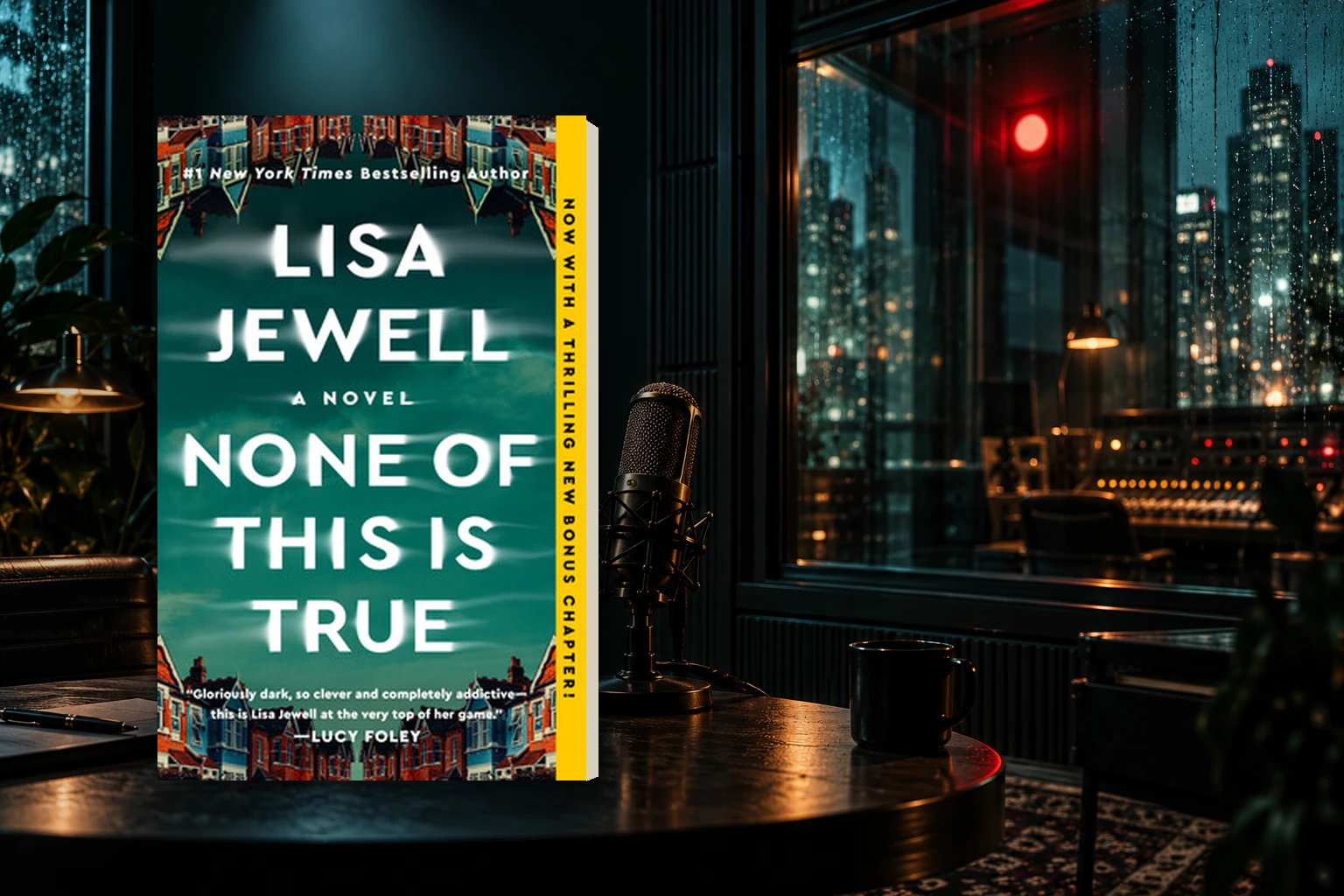
Lisa Jewell places a podcaster and her unsettling subject in a struggle over who gets to shape a public story. The thriller’s sharpest question concerns the point where curiosity becomes vulnerability.
The podcast premise makes narrative control and personal boundaries part of the suspense.
At the center of Lisa Jewell’s None of This Is True is a tempting proposition: what happens when a person who makes stories for an audience meets someone who wants to become one? Podcaster Alix Summer and Josie Fair discover that they share a forty-fifth birthday. Josie later suggests that her life could be a subject for Alix’s show. Alix is uneasy but continues to record. Josie becomes increasingly present in Alix’s private life, and then disappears, leaving Alix and her family in danger. The publisher’s premise is enough to expose the novel’s most interesting question. Who controls a story once the teller and the subject each believe it belongs to them?
A podcast is a useful engine for psychological suspense because it turns conversation into a durable object. An interview can feel private while it is happening, even when everyone knows a recording may eventually reach strangers. A producer chooses what to ask, what to follow up, and what to leave for a later episode. A guest chooses what to disclose and may have reasons the producer does not understand. The recording promises intimacy to an audience without granting that audience a full account of the relationship behind it. Jewell’s setup draws energy from these unequal positions. The microphone makes curiosity look professional, but professionalism does not erase personal risk.
Alix’s unease is therefore an essential part of the premise, not merely a signal that danger is coming. If she senses something troubling about Josie and keeps going, the choice can be understood without treating it as simple foolishness. A compelling subject can make the next question feel necessary. A person who records stories for a living may also believe that more conversation will clarify an uneasy first impression. The novel’s tension begins in the space between that hope and the ordinary right to set a boundary. It asks when the desire to understand another person becomes permission for that person to cross into one’s own life.
Josie’s role is equally difficult to reduce. She proposes herself as a subject, which seems to give her agency in the exchange. Yet a subject is also vulnerable to selection and arrangement by someone else. The unsettling possibility is that Josie understands this arrangement and has her own use for it. The publisher’s description does not require a reader to decide in advance whether her account is truthful or what she ultimately intends. It invites a more careful response: listen to the claims, watch the changing relationship, and notice how quickly a proposed interview can alter the balance of power between two people.
The shared birthday provides a neat point of entry into that relationship. It makes their meeting seem both ordinary and oddly significant: a small coincidence from which a stranger can build a claim of connection. Psychological thrillers often depend on an opening that can be interpreted two ways. What appears like a harmless social detail at first may later acquire another weight because of what follows. Here the coincidence is useful precisely because it is too slight to settle anything. It gives Alix and Josie a reason to talk, not a reason to trust each other. The gap between those two ideas is where the novel’s suspense takes hold.
The movement from recording to Alix’s home changes the scale of the story. A podcast can be paused, edited, and published later; a person in one’s domestic space cannot be managed with the same controls. The publisher notes that Josie becomes entangled in Alix’s life and home before she disappears. That progression turns a professional encounter into a question about access. A person may consent to an interview without consenting to a continuing claim on their family’s attention or safety. Conversely, a guest may discover that being made into content gives the host less distance than either expected. The threat feels personal because the boundary is crossed gradually, through a relationship that originally had a plausible purpose.
Josie’s disappearance reverses the apparent arrangement. Alix began as the person inviting another life into a recorded story; she becomes exposed to a story that involves her own family. This is more than a device for escalating danger. It makes the reader reconsider the authority of the original narrator. Someone who can ask the questions in one setting may have little control over how others describe her once events move beyond that setting. True crime, whether fictional or real, thrives on such shifts in viewpoint. Jewell’s premise asks readers to consider the appetite for a gripping account and the loss of privacy that account can demand from people caught inside it.
The book also sits in a productive tension with the genre it depicts. A thriller must give readers enough information to sustain suspicion while withholding enough to keep them turning pages. A true-crime podcast makes similar choices for its audience, though it claims a different relationship to fact. By putting a podcaster inside a thriller, Jewell opens a question about our own reading habits. We may notice the danger of packaging another person’s distress and still want the next disclosure. That discomfort gives the story an edge beyond the identity of a threat. The reader’s curiosity becomes part of the subject under examination.
There is a limit to this design. Readers looking for the measured verification of a police procedural may find a premise built around personal intrusion and unstable accounts more anxious than satisfying. The escalation from an unusual interview to family danger also asks for a willingness to follow a high-stakes psychological setup. Those preferences matter. The book is better approached as suspense about access, narrative control, and trust than as a promise that every uncertainty will be settled by a tidy chain of forensic evidence. Its appeal lies in the instability of a relationship that initially seems legible.
None of This Is True makes a familiar contemporary activity feel newly vulnerable. Recording a life story can look like an act of attention, an act of ambition, or both; volunteering one can look like openness, a request for help, or a bid for influence. Alix and Josie enter the same project with unequal knowledge of what it may become. Their changing positions give Jewell a focused way to examine the distance between being heard and being known. The most durable suspense is not simply whether a disturbing account can be verified. It is whether anyone can remain safely outside a story after inviting it in.
EDITOR’S VERDICT
Tale24’s assessment
The podcast premise makes narrative control and personal boundaries part of the suspense.
Points to considerReaders who prefer a restrained procedural may find its escalating psychological threat intense.
Best for: Readers of psychological suspense and fiction interested in true-crime storytelling and its ethical costs.
Editorial method: This is an independent assessment informed by the work and its official supporting information. AI tools may assist the drafting process; Tale24 reviews and takes responsibility for everything it publishes.