Literature & Thought · TALE24 REVIEW
The Dry: When a Town Cannot Escape Its Past
Jane Harper makes drought and old suspicion part of the same landscape. Aaron Falk’s return asks whether a community can investigate a new death while still protecting its account of an older one.
The drought setting and intertwined old and new questions give the mystery unusual social pressure.
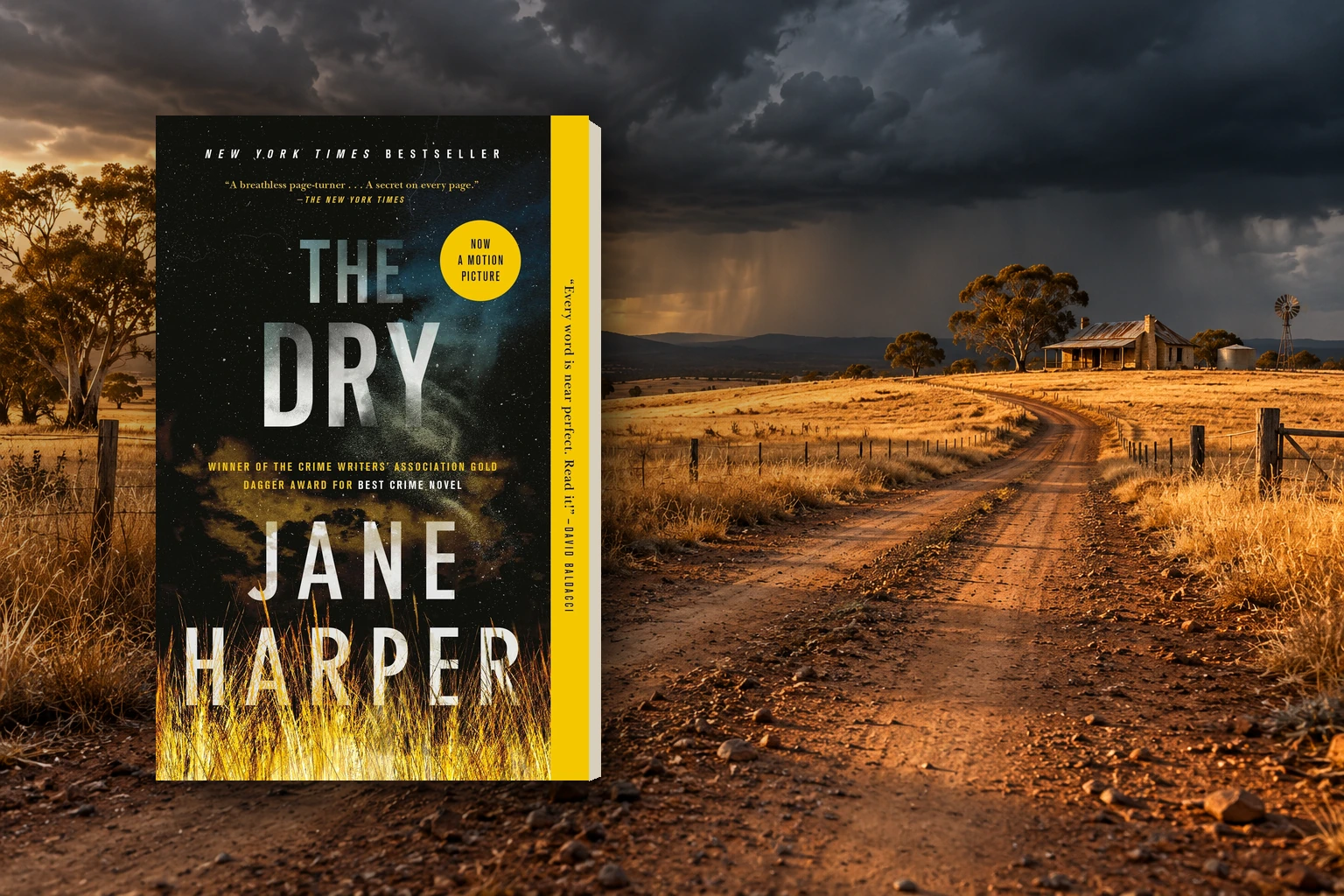
In Jane Harper’s The Dry, an apparent death cannot be separated from a story the town has been telling for twenty years. Federal Agent Aaron Falk returns to the drought-stricken community he left as a young man to attend the funeral of his boyhood friend Luke. Luke once gave Falk an alibi when Falk was accused of murder, and that account helped the Falk family avoid prosecution without clearing its name in the eyes of their neighbors. The publisher’s description tells us the alibi was false. That fact gives the new investigation a sharper question than who did what: how can people judge fresh evidence when an old version of events has become part of their shared identity?
Harper’s premise makes Kiewarra more than an atmospheric location. A prolonged drought places a farming town under material strain; work, income, and confidence in the future depend on conditions no resident can control. The setting therefore gives a practical edge to a familiar crime-fiction idea: neighbors know one another closely, yet closeness does not guarantee understanding. A community may depend on cooperation while carrying private suspicions for years. The dry landscape does not explain anyone’s conduct by itself, and a reader should resist treating weather as an easy metaphor for guilt. It does, however, make the cost of living with uncertainty feel less abstract.
Falk’s return also changes the usual balance between investigator and place. In many mysteries, a detective arrives with the advantage of distance. Falk has professional authority, but he also has a history in the community he must examine. People can weigh his questions against what they think they know about him. His own memories may help him recognize the significance of a detail, yet familiarity can make an assumption harder to see. The tension between expertise and personal implication gives the investigation its particular shape. The problem is not simply whether Falk can find a clue; it is whether any account he gives will be heard apart from the accusation that accompanied his departure.
The false alibi is the novel’s strongest opening instrument because it shows how evidence can do two things at once. At the time, Luke’s statement protected a friend. In the present, its falsity raises new doubts about both men, although it does not by itself establish what happened in the earlier case or in Luke’s death. A good mystery asks readers to keep those distinctions intact. To learn that someone lied is to acquire important information, but it is not to learn every reason for the lie. Harper’s setup asks the reader to measure the distance between contradiction and proof, a distance that public opinion often crosses too quickly.
The pairing of an older accusation with a current death gives The Dry a structure based on pressure from the past. The earlier event is not merely a piece of backstory added to make the present case more dramatic. It determines Falk’s standing in town and complicates the way the new case can be discussed. If Luke was the person who vouched for him, Luke’s death removes a witness to one account and makes that account newly vulnerable. The two inquiries can therefore illuminate each other without needing to be identical. That is a more interesting arrangement than a simple repetition of one crime across two generations: it makes the passage of time part of the evidence problem.
The publisher also notes that Falk works with a local detective. That partnership suggests another productive contrast. A local investigator has access to relationships, habits, and the ordinary context behind a statement; Falk can ask questions with the training and distance of someone who left. Neither position is automatically superior. Local knowledge may preserve facts an outsider would miss, but it can also carry loyalties and settled judgments. An outsider may challenge those judgments while overlooking what makes a town function. The premise gains force from the possibility that finding the truth requires both kinds of attention, especially when the official story has had years to harden.
What distinguishes the book as a mystery is this interest in the life of an explanation after it has been accepted. An alibi can become a legal fact, a family memory, a source of gossip, or a reason to exclude someone; each use gives the same words a different weight. A death described one way at first may invite a different reading when another piece of information emerges. Harper positions the reader to notice how readily people turn a limited observation into a complete narrative. The novel’s suspense rests on the hope that patient inquiry can unsettle such narratives without replacing them with an equally convenient invention.
There is an ethical dimension to that suspense. A small community facing drought is not an interchangeable collection of suspects waiting to be exposed. Its residents have to continue living together after an investigation ends, whether or not every doubt is resolved. Rumor can be useful to a mystery because it spreads possible explanations, but its effects on real relationships within the story deserve attention. Falk’s history makes that cost visible: an accusation can shape a life long after a formal process stops. Readers drawn to crime fiction for the moment of a final answer may find that the more persistent question is what happens to people before any answer is available.
The same design has a limitation. The intertwined histories ask the reader to invest in the town’s social memory as well as the immediate case. Someone seeking a brisk, self-contained procedural may prefer a mystery in which the detective can treat every witness as a new acquaintance and every clue as a discrete fact. The Dry offers a more entangled arrangement. Its appeal depends on accepting that the setting and the long consequences of suspicion matter as much as the mechanics of identifying a culprit. That is a choice of emphasis, not a defect that can be measured independently of the book’s aims.
The Dry is most compelling as a mystery about the authority of familiar stories. Falk comes back to a place where people have had two decades to decide what they believe, and Luke’s death brings that belief into contact with a fresh inquiry. The drought intensifies the sense of exposure, but the central pressure is social: who gets the benefit of doubt, who is required to explain themselves again, and what a community owes to facts that disturb its peace. Harper’s premise gives the reader a case to follow and a reason to question the speed with which any case becomes a story everyone claims to know.
EDITOR’S VERDICT
Tale24’s assessment
The drought setting and intertwined old and new questions give the mystery unusual social pressure.
Points to considerReaders seeking a puzzle detached from local history may find the weight of communal memory demanding.
Best for: Readers who enjoy atmospheric rural mysteries and investigations shaped by place and reputation.
Editorial method: This is an independent assessment informed by the work and its official supporting information. AI tools may assist the drafting process; Tale24 reviews and takes responsibility for everything it publishes.