Literature & Thought · TALE24 REVIEW
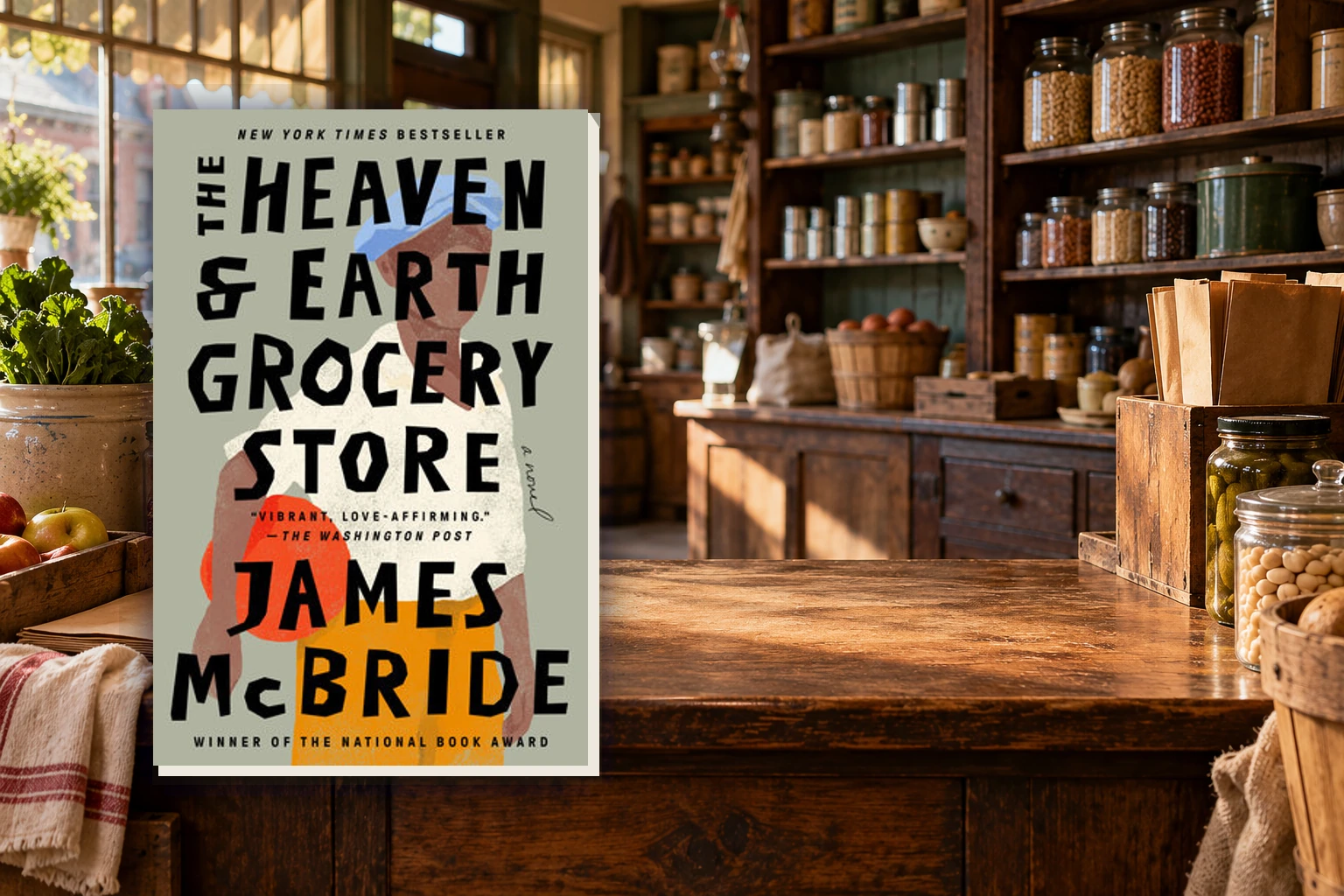
The Heaven & Earth Grocery Store: Community as an Act of Care
James McBride’s historical novel uses the life of Chicken Hill to ask how neighbors protect one another when official institutions fail to see them clearly.
A richly populated neighborhood narrative that connects mystery, historical memory, and practical solidarity.
James McBride’s The Heaven & Earth Grocery Store opens, according to its publisher, with a discovery in 1972: workers find a skeleton in a well in Pottstown, Pennsylvania. The unanswered question gives the novel the shape of a mystery. Its real center, however, is the life of Chicken Hill, a neighborhood where Jewish immigrants and Black residents live beside one another amid unequal power and shared need. McBride uses the secret as a doorway into a larger question: what can a community do for someone when the institutions claiming authority over that person cannot be trusted to care for them?
The Heaven & Earth Grocery Store itself gives that question a physical address. A shop is a place of ordinary exchange, but in a neighborhood story it is also a meeting point, a keeper of news, and a marker of who belongs. Chona Ludlow runs the store; her husband Moshe operates a theater. Their work places them among other people’s routines rather than above them. McBride’s setting suggests that solidarity is made from such routines. It is less a declaration of shared virtue than an accumulation of encounters, favors, obligations, and the willingness to notice who is missing.
The publisher’s account identifies a decisive conflict. State authorities seek to institutionalize a deaf boy, and Chona joins Nate Timblin, a Black worker at Moshe’s theater and a leader within the local Black community, to protect him. That outline is enough to show why the novel’s attention to care is political. Officials can present removal as orderly management while those closest to a child understand the human cost. McBride’s story asks readers to examine the distance between legal power and moral knowledge. The people with fewer resources may be the people paying the closest attention.
Chicken Hill is not a fantasy of perfect agreement. Its residents come from different histories, face different forms of exclusion, and cannot erase those differences by standing on the same street. The significance of the neighborhood is that coexistence requires negotiation. The publisher describes people at the margins of white, Christian America struggling to survive; the phrase points to a common pressure without making everyone’s experience identical. McBride’s broad cast lets the community register as a network of distinct lives rather than a single symbol of goodness.
The novel’s historical setting deepens that network. The skeleton’s discovery in 1972 points backward to lives that a changing town might prefer to bury, literally and figuratively. A new development is being built when the remains appear. The image suggests a familiar civic story: progress is announced at the surface while an unresolved history lies beneath it. McBride’s mystery form turns excavation into an ethical act. To ask what happened is also to ask whose account of the past was allowed to stand, and whose labor or suffering was left outside the official record.
There is an instructive tension between the thriller-like opening and the patient work of a neighborhood novel. A reader may arrive wanting a rapid solution to the question of the skeleton. McBride instead asks for attention to the living relationships that make any answer meaningful. This shift can feel expansive, even leisurely, but it changes the scale of the mystery. The crucial issue is not simply the identity of a body. It is how a town distributes protection, credibility, and vulnerability among the people who inhabit it.
The publisher presents Moshe’s theater as integrated, and the detail is useful without turning it into a complete answer to segregation. A shared cultural space can make new encounters possible, but it does not abolish the structures waiting outside its doors. Similarly, a grocery store can sustain neighbors without replacing fair institutions. McBride’s story becomes most interesting when communal care is understood as necessary and insufficient: people act because harm is immediate, while the broader conditions that made their action necessary remain visible.
The novel’s warmth is therefore more demanding than a comforting message about kindness. Care involves risk, judgment, and a readiness to take someone else’s trouble as partly one’s own. In the case of the boy threatened with institutionalization, the stakes are concrete. The story’s hope depends on action, not on the sentimental idea that diverse neighbors naturally get along. McBride’s cast can be funny and lively while still confronting the difficult question of who receives the benefit of innocence from authorities and who does not.
Its scale is also a potential obstacle. A crowded social world and a mystery delayed by detours may frustrate readers seeking a spare, fast-moving narrative. The novel’s declared faith in community may feel generous to a reader who prefers unresolved ambiguity. Those are reasonable reservations, but the abundance serves the book’s argument. A community cannot be represented by one exemplary person. It has to be heard in the overlap and occasional friction of many voices.
The title holds another useful tension. “Heaven” suggests an ideal beyond daily difficulty; “earth” keeps the work of care among groceries, jobs, and imperfect neighbors. McBride’s premise asks readers to judge goodness by what people actually do in those ordinary circumstances. The novel can imagine a sustaining community without suggesting that affection alone will correct an unjust town. Its vision depends on attention becoming a choice and then an action.
The Heaven & Earth Grocery Store is a contemporary American novel looking into the past to examine an enduring problem. It asks what solidarity costs and what memory requires when public systems fail the vulnerable. Its mystery begins in a well, but its lasting image is the ordinary work of neighbors keeping one another in view. McBride makes that work neither easy nor small.
EDITOR’S VERDICT
Tale24’s assessment
A richly populated neighborhood narrative that connects mystery, historical memory, and practical solidarity.
Points to considerIts broad cast and deliberate detours may test readers expecting a tightly paced mystery.
Best for: Readers of literary historical fiction about community, race, immigrant life, and moral responsibility.
Editorial method: This is an independent assessment informed by the work and its official supporting information. AI tools may assist the drafting process; Tale24 reviews and takes responsibility for everything it publishes.